JEE Main & Advanced

If \[a{{x}^{2}}+2hxy+b{{y}^{2}}+2gx+2fy+c=0\] represents a pair of parallel straight lines, then the distance between them is given by \[2\sqrt{\frac{{{g}^{2}}-ac}{a(a+b)}}\]or \[2\sqrt{\frac{{{f}^{2}}-bc}{b(a+b)}}\].  

Clearly, \[h\ne 0\]. Rotating the axes through an angle \[\theta \], we have, \[x=X\cos \theta -Y\sin \theta \] and  \[y=X\,\sin \theta +Y\cos \theta \]   \[\therefore \]   \[f(x,y)=a{{x}^{2}}+2hxy+b{{y}^{2}}\]   After rotation, new equation is   \[F(X,Y)=(a{{\cos }^{2}}\theta +2h\cos \theta \sin \theta +b{{\sin }^{2}}\text{ }\theta ){{X}^{2}}\]   \[+2\{(b-a)\cos \theta \sin \theta +h({{\cos }^{2}}\theta -{{\sin }^{2}}\theta )XY\]      \[+(a{{\sin }^{2}}\theta -2h\cos \theta \sin \theta +b{{\cos }^{2}}\theta ){{Y}^{2}}\]     Now coefficient of \[XY=0\]. Then we get \[\cot 2\theta =\frac{a-b}{2h}\].     Usually, we use the formula, \[\tan 2\theta =\frac{2h}{a-b}\] for finding the angle of rotation \[\theta \]. However, if \[a=b\], we use \[\cot 2\theta =\frac{a-b}{2h}\] as in this case \[\tan 2\theta \] is not defined.

Let point of intersection of lines represented by \[a{{x}^{2}}+2hxy+b{{y}^{2}}+2gx+2fy+c=0\]       .....(i)  is \[(\alpha ,\beta )\].   Here \[(\alpha ,\beta )=\left( \frac{bg-fh}{{{h}^{2}}-ab},\frac{af-gh}{{{h}^{2}}-ab} \right)\]   For removal of first degree terms, shift the origin to \[(\alpha ,\beta )\] i.e., replacing \[x\] by \[(X+\alpha )\]and \[y\] be \[(Y+\beta )\]in (i).   Alternative Method : Direct equation after removal of first degree terms is \[a{{X}^{2}}+2hXY+b{{Y}^{2}}+(g\alpha +f\beta +c)=0\],   where \[\alpha =\frac{bg-fh}{{{h}^{2}}-ab}\] and \[\beta =\frac{af-gh}{{{h}^{2}}-ab}\].

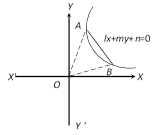
The equation of the lines which joins origin to the point of intersection of the line \[lx+my+n=0\] and curve \[a{{x}^{2}}+2hxy+b{{y}^{2}}+2gx+2fy+c=0\], can be obtained by making the curve homogeneous with the help of line \[lx+my+n=0\], which is         \[a{{x}^{2}}+2hxy+b{{y}^{2}}+2(gx+fy)\left( \frac{lx+my}{-n} \right)+c\,{{\left( \frac{lx+my}{-n} \right)}^{2}}=0\]

(1) The joint equation of the bisectors of the angles between the lines represented by the equation \[a{{x}^{2}}+2hxy+b{{y}^{2}}=0\] is   \[\frac{{{x}^{2}}-{{y}^{2}}}{a-b}=\frac{xy}{h}\Rightarrow h{{x}^{2}}-(a-b)xy-h{{y}^{2}}=0\]   Here, coefficient of \[{{x}^{2}}+\] coefficient of \[{{y}^{2}}=0\]. Hence, the bisectors of the angles between the lines are perpendicular to each other. The bisector lines will pass through origin also.   (i) If \[a=b\], the bisectors are \[{{x}^{2}}-{{y}^{2}}=0\].   i.e., \[x-y=0,x+y=0\]   (ii) If \[h=0\], the bisectors are \[xy=0\] i.e., \[x=0,y=0\].   (2) The equation of the bisectors of the angles between the lines represented by  \[a{{x}^{2}}+2hxy+b{{y}^{2}}+2gx+2fy+c=0\] are given by \[\frac{{{(x-\alpha )}^{2}}-{{(y-\beta )}^{2}}}{a-b}=\frac{(x-\alpha )(y-\beta )}{h}\], where \[\alpha ,\,\,\beta \] is the point of intersection of the lines represented by the given equation.

The angle between the lines represented by        \[a{{x}^{2}}+2hxy+b{{y}^{2}}+2gx+2fy+c=0\] or \[a{{x}^{2}}+2hxy+b{{y}^{2}}=0\]     is given by \[\tan \theta =\left| \frac{2\sqrt{{{h}^{2}}-ab}}{a+b} \right|\,\,\,\,\Rightarrow \theta ={{\tan }^{-1}}\left| \frac{2\sqrt{{{h}^{2}}-ab}}{a+b} \right|\]     From the above formula it is clear, that     (i) The lines represented by \[a{{x}^{2}}+2hxy+b{{y}^{2}}+2gx+2fy+c=0\] are parallel iff \[{{h}^{2}}=ab\] and \[a{{f}^{2}}=b{{g}^{2}}\] or \[\frac{a}{h}=\frac{h}{b}=\frac{g}{f}\].     (ii) The lines represented by \[a{{x}^{2}}+2hxy+b{{y}^{2}}\] \[+2gx+2fy+c=0\] are perpendicular iff \[a+b=0\]     i.e.,  Coefficient of \[{{x}^{2}}+\] Coefficient of \[{{y}^{2}}=0\].     (iii) The lines are coincident, if \[{{g}^{2}}=ac\].

Let \[\varphi \equiv a{{x}^{2}}+2hxy+b{{y}^{2}}+2gx+2fy+c=0\]     \[\frac{\partial \varphi }{\partial x}=2ax+2hy+2g=0\]                          (Keeping \[y\] as constant)       and \[\frac{\partial \varphi }{\partial y}=2hx+2by+2f=0\]    (Keeping \[x\] as constant)     For point of intersection \[\frac{\partial \varphi }{\partial x}=0\] and \[\frac{\partial \varphi }{\partial y}=0\]     We obtain, \[ax+hy+g=0\] and \[hx+by+f=0\]     On solving these equations, we get     \[\frac{x}{fh-bg}=\frac{y}{gh-af}=\frac{1}{ab-{{h}^{2}}}\]i.e.,\[(x,y)=\left( \frac{bg-fh}{{{h}^{2}}-ab},\frac{af-gh}{{{h}^{2}}-ab} \right)\].     (3) Separate equations from joint equation: The general equation of second degree be \[a{{x}^{2}}+2hxy+b{{y}^{2}}+2gx+2fy+c=0\]     To find the lines represented by this equation we proceed as follows :     Step I : Factorize the homogeneous part \[a{{x}^{2}}+2hxy+b{{y}^{2}}\] into two linear factors. Let the linear factors be \[a'x+b'y\] and \[a''x+b''y\].     Step II : Add constants \[c'\]and \[c''\] in the factors obtained in step I to obtain \[a'x+b'y+c'\] and \[a''x+b''y+c''\]. Let the lines be \[a'x+b'y+c'=0\] and \[a''x+b''y+c''=0\].     Step III : Obtain the more...

(1) Equation of a pair of straight lines passing through origin : The equation \[a{{x}^{2}}+2hxy+b{{y}^{2}}=0\] represents a pair of straight line passing through the origin where \[a,\,\,h,\,\,b\] are constants.   Let the lines represented by \[a{{x}^{2}}+2hxy+b{{y}^{2}}=0\] be \[y-{{m}_{1}}x=0,\,\,y-{{m}_{2}}x=0\]. Then, \[{{m}_{1}}+{{m}_{2}}=-\frac{2h}{b}\] and \[{{m}_{1}}{{m}_{2}}=\frac{a}{b}\]   Then, two straight lines represented by \[a{{x}^{2}}+2hxy+b{{y}^{2}}=0\] are \[ax+hy+y\sqrt{{{h}^{2}}-ab}=0\] and \[ax+hy-y\sqrt{{{h}^{2}}-ab}=0\].     Hence, (a) The lines are real and distinct, if \[{{h}^{2}}-ab>0\]     (b) The lines are real and coincident, if \[{{h}^{2}}-ab=0\]     (c) The lines are imaginary, if \[{{h}^{2}}-ab<0\]     (2) General equation of a pair of straight lines : An equation of the form, \[a{{x}^{2}}+2hxy+b{{y}^{2}}+2gx+2fy+c=0\] where \[a,\,\,b,\,\,c,\,\,f,\,\,g,\,\,h\] are constants, is said to be a general equation of second degree in \[x\] and \[y\].     The necessary and sufficient condition for \[a{{x}^{2}}+2hxy+b{{y}^{2}}+2gx+2fy+c=0\] to represents a pair of straight lines is that \[abc+2fgh-a{{f}^{2}}-b{{g}^{2}}-c{{h}^{2}}=0\] or \[\left| \begin{matrix}  a & h & g  \\ more...

(i) AND : It is the boolean function defined by   \[f({{x}_{1}},{{x}_{2}})={{x}_{1}}\wedge {{x}_{2}}\]; \[{{x}_{1}},\,{{x}_{2}}\in \{0,\,1\}\].   It is shown in the figure given below.      
Input Output
\[{{x}_{1}}\] \[{{x}_{2}}\] more...
One of the major practical application of Boolean algebra is to the switching systems (an electrical network consisting of switches) that involves two state devices. The simplest possible example of such a device is an ordinary ON-OFF switch.   By a switch we mean a contact or a device in an electric circuit which lets (or does not let) the current to flow through the circuit. The switch can assume two states ‘closed’ or ‘open’ (ON or OFF). In the first case the current flows and in the second the current does not flow.   Symbols \[a,\,b,\,c,\,p,\,q,\,r,\,x,y,\,z\],..... etc. will denote switches in a circuit.   There are two basic ways in which switches are generally interconnected.   (i) Series   (ii) Parallel     (i) Series : Two switches a, b are said to be connected ‘in series’ if the current can pass only when both are in closed state more...


Archive


You need to login to perform this action.
You will be redirected in 3 sec spinner