JEE Main & Advanced

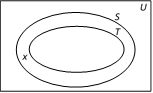
In this section, we shall discuss how Venn diagrams are used to represent truth and falsity of statements or propositions. For this, let us consider the statement: “All teachers are scholars”. Let us assume that this statement is true. To represent the truth of the above statement, we define the following sets     \[U\]= the set of all human beings     S  = the set of all scholars     And T  = the set of all teachers     Clearly, \[S\subset U\] and \[T\subset U\]     According to the above statement , if follows that \[T\subset S\]. Thus, the truth of the above statement can be represented by the Venn diagram shown in        Now, if we consider the statement : ? There are some scholars who are teachers?,  It more...
Propositions : A statement or a proposition is an assertive (or declarative) sentence which is either true or false but not both a true statement is called valid statement. If a statement is false, then it is called invalid statement.     Open statement : A declarative sentence containing variable (s) is an open statement if it becomes a statement when the variable (s) is (are) replaced by some definite value (s).     Truth Set : The set of all those values of the variable (s) in an open statement for which it becomes a true statement is called the truth set of the open statement.     Truth Value : The truth or falsity of a statement is called its truth value.     If a statement is true, then we say that its truth value is ‘True’ or ‘T’. On the other hand the truth value of more...

Logic was extensively developed in Greece. In the middle ages the treatises of Aristotle concerning logic were re-discovered. The axiomatic approach to logic was first proposed by George Boole. On this account logic  relative to mathematics is sometimes called Boolean logic. It is also called mathematical logic or more recently symbolic logic.     The dictionary meaning of the word ‘Logic’ is “the science of reasoning”. It is the study and analysis of the nature of valid arguments. In the process of reasoning we communicate our ideas or thoughts with the help of sentences in a particular language. The following types of sentences are normally used in our every day communication.   (1) Assertive sentence   (2) Imperative sentence   (3) Exclamatory sentence   (4) Interrogative sentence     In this chapter, we shall be discussing about a specific type of sentences which will called as statement or propositions.

(1) Advantages : Linear programming is used to minimize the cost of production for maximum output. In short, with the help of linear programming models, a decision maker can most efficiently and effectively employ his production factor and limited resources to get maximum profit at minimum cost.   (2) Limitations  : (i) The linear programming can be applied only when the objective function and all the constraints can be expressed in terms of linear equations/inequations.   (ii) Linear programming techniques provide solutions only when all the elements related to a problem can be quantified.   (iii) The coefficients in the objective function and in the constraints must be known with certainty and should remain unchanged during the period of study.   (iv) Linear programming technique may give fractional valued answer which is not desirable in some problems.

(1) Bounded region: The region surrounded by the inequations \[ax+by\le m\] and \[cx+dy\le n\] in first quadrant is called bounded region. It is of the form of triangle or quadrilateral. Change these inequations into equations, then by putting \[x=0\] and \[y=0,\] we get the solution. Also by solving the equations we get the vertices of bounded region.     The maximum value of objective function lies at one vertex in limited region.     (2) Unbounded region : The region surrounded by the inequations \[ax+by\ge m\] and \[cx+dy\ge n\] in first quadrant, is called unbounded region.     Change the inequation in equations and solve for \[x=0\]and \[y=0\]. Thus we get the vertices of feasible region.     The minimum value of objective function lies at one vertex in unbounded region but there is no existence of maximum value.

There are two techniques of solving an L.P.P. by graphical method. These are :     (1) Corner point method          (2) Iso-profit or Iso-cost method     (1) Corner point method     Working Rule:     (i) Formulate mathematically the L.P.P.     (ii) Draw graph for every constraint.     (iii) Find the feasible solution region.     (iv) Find the coordinates of the vertices of feasible solution region.     (v) Calculate the value of objective function at these vertices.     (vi) Optimal value (minimum or maximum) is the required solution.     (vii) If there is no possibility to determine the point at which the suitable solution found, then the solution of problem is unbounded.     (viii) If feasible region is empty, then there is no solution for the problem.     (ix) Nearer to the origin, the objective function is minimum and more...

There are mainly four steps in the mathematical formulation of a linear programming problem, as mathematical model. We will discuss formulation of those problems which involve only two variables.     (1) Identify the decision variables and assign symbols x and y to them. These decision variables are those quantities whose values we wish to determine.     (2) Identify the set of constraints and express them as linear equations/inequations in terms of the decision variables. These constraints are the given conditions.     (3) Identify the objective function and express it as a linear function of decision variables. It may take the form of maximizing profit or production or minimizing cost.     (4) Add the non-negativity restrictions on the decision variables, as in the physical problems, negative values of decision variables have no valid interpretation.

The term programming means planning and refers to a process of determining a particular program.     (1) Objective function : The linear function which is to be optimized (maximized or minimized) is called objective function of the L.P.P.     (2) Constraints or Restrictions : The conditions of the problem expressed as simultaneous equations or inequations are called constraints or restrictions.     (3) Non-negative constraints : Variables applied in the objective function of a linear programming problem are always  non-negative. The inequations which represent such constraints are called non-negative constraints.     (4) Basic variables : The \[m\] variables associated with columns of the \[m\times n\] non-singular matrix which may be different from zero, are called basic variables.     (5) Basic solution : A solution in which the vectors associated to m variables are linear and the remaining \[(n-m)\] variables are zero, is called a basic solution. more...

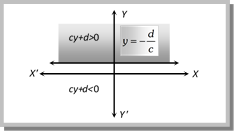
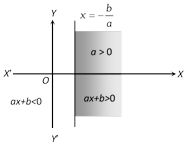
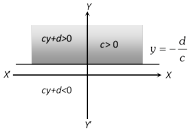
(1) Graph of linear inequations     (i) Linear inequation in one variable: \[ax+b>0,\] \[ax+b<0,\]\[cy+d>0\] etc. are called linear inequations in one variable. Graph of these inequations can be drawn as follows :     The graph of \[ax+b>0\] and \[ax+b<0\] are obtained by dividing xy-plane in two semi-planes by the line \[x=-\frac{b}{a}\](which is parallel to y-axis). Similarly for \[cy+d>0\]and \[cy+d<0\].       (ii) Linear Inequation in two variables : General form of these inequations are \[ax+by>c,ax+by<c\]. If any ordered pair \[\left( {{x}_{1}},{{y}_{1}} \right)\] satisfies an inequation, then it is said to be a solution of the inequation.   The graph of these inequations is given below (for \[c>0\]) more...

(1) \[2{{\sin }^{-1}}x={{\sin }^{-1}}(2x\sqrt{1-{{x}^{2}}})\],                If \[-\frac{1}{\sqrt{2}}\le x\le \frac{1}{\sqrt{2}}\]\[\]     (2) \[2{{\sin }^{-1}}x=\pi -{{\sin }^{-1}}2x\sqrt{1-{{x}^{2}}}\],          If \[\frac{1}{\sqrt{2}}\le x\le 1\]     (3) \[2{{\sin }^{-1}}x=-\pi -{{\sin }^{-1}}(2x\sqrt{1-{{x}^{2}})}\],     If \[-1\le x\le \frac{-1}{\sqrt{2}}\]     (4) \[3{{\sin }^{-1}}x={{\sin }^{-1}}(3x-4{{x}^{3}}),\]                        If \[\frac{-1}{2}\le x\le \frac{1}{2}\]     (5) \[3{{\sin }^{-1}}x=\pi -{{\sin }^{-1}}(3x-4{{x}^{3}})\],                  If \[\frac{1}{2}<x\le 1\]     (6) \[3{{\sin }^{-1}}x=-\pi -{{\sin }^{-1}}(3x-4{{x}^{3}}),\]                If \[-1\le x<-\frac{1}{2}\]     (7) \[2{{\cos }^{-1}}x={{\cos }^{-1}}(2{{x}^{2}}-1)\],                         If \[0\le x\le 1\]     (8) \[2{{\cos }^{-1}}x=2\pi -{{\cos }^{-1}}(2{{x}^{2}}-1)\],                                If \[-1\le x\le 0\]     (9) \[3{{\cos }^{-1}}x={{\cos }^{-1}}(4{{x}^{3}}-3x)\],                       If \[\frac{1}{2}\le x\le 1\]     (10) \[3{{\cos }^{-1}}x=2\pi -{{\cos }^{-1}}(4{{x}^{3}}-3x),\]            If \[-\frac{1}{2}\le x\le \frac{1}{2}\]     (11)  \[3{{\cos }^{-1}}x=2\pi +{{\cos }^{-1}}(4{{x}^{3}}-3x),\]         If \[-1\le x\le -\frac{1}{2}\]     (12)  \[2{{\tan }^{-1}}x={{\tan }^{-1}}\left( \frac{2x}{1-{{x}^{2}}} \right)\],                     If \[-1<x\le 1\]     (13)  \[2{{\tan }^{-1}}x=\pi +{{\tan }^{-1}}\left( \frac{2x}{1-{{x}^{2}}} \right)\] ,                           If \[x>1\]     (14) \[2{{\tan }^{-1}}x=-\pi +{{\tan }^{-1}}\left( \frac{2x}{1-{{x}^{2}}} \right)\],                            If \[x<-1\] more...


Archive


You need to login to perform this action.
You will be redirected in 3 sec spinner