JEE Main & Advanced

(1) \[{{\tan }^{-1}}x+{{\tan }^{-1}}y={{\tan }^{-1}}\left( \frac{x+y}{1-xy} \right)\];      If \[x>0,y>0\] and \[xy<1\]     (2) \[{{\tan }^{-1}}x+{{\tan }^{-1}}y=\pi +{{\tan }^{-1}}\left( \frac{x+y}{1-xy} \right)\];     If \[x>0,\,y>0\] and \[xy>1\]     (3) \[{{\tan }^{-1}}x+{{\tan }^{-1}}y=-\pi +{{\tan }^{-1}}\left( \frac{x+y}{1-xy} \right)\];                 If \[x<0,\,y<0\] and \[xy>1\]     (4) \[{{\tan }^{-1}}x-{{\tan }^{-1}}y={{\tan }^{-1}}\left( \frac{x-y}{1+xy} \right)\];                             If \[xy>-1\]     (5) \[{{\tan }^{-1}}x-{{\tan }^{-1}}y=\pi +{{\tan }^{-1}}\left( \frac{x-y}{1+xy} \right)\] ;                                    If \[x>0,\,y<0\] and \[xy<-1\]     (6) \[{{\tan }^{-1}}x-{{\tan }^{-1}}y=-\pi +{{\tan }^{-1}}\left( \frac{x-y}{1+xy} \right)\];                   If \[x<0,\,y>0\] and \[xy<-1\]     (7) \[{{\tan }^{-1}}x+{{\tan }^{-1}}y+{{\tan }^{-1}}z={{\tan }^{-1}}\left[ \frac{x+y+z-xyz}{1-xy-yz-zx} \right]\]     (8) \[{{\tan }^{-1}}{{x}_{1}}+{{\tan }^{-1}}{{x}_{2}}+..........+{{\tan }^{-1}}{{x}_{n}}\] \[={{\tan }^{-1}}\left[ \frac{{{S}_{1}}-{{S}_{3}}+{{S}_{5}}-...........}{1-{{S}_{2}}+{{S}_{4}}-{{S}_{6}}+........} \right]\]     where \[{{S}_{k}}\] denotes the sum of the products of \[{{x}_{1}},\,{{x}_{2}},........,{{x}_{n}}\] taken k  at a time.     (9) \[{{\cot }^{-1}}x+{{\cot }^{-1}}y={{\cot }^{-1}}\frac{xy-1}{y+x}\]     (10) \[{{\cot }^{-1}}x-{{\cot }^{-1}}y={{\cot }^{-1}}\frac{xy+1}{y-x}\]     (11) \[{{\sin }^{-1}}x+{{\sin }^{-1}}y={{\sin }^{-1}}\{x\sqrt{1-{{y}^{2}}}+y\sqrt{1-{{x}^{2}}}\}\]; more...

(1) \[{{\sin }^{-1}}(\sin \theta )=\theta \],   Provided that \[-\frac{\pi }{2}\le \theta \le \frac{\pi }{2}\],      \[{{\cos }^{-1}}(\cos \theta )=\theta \],   Provided that \[0\le \theta \le \pi \]   \[{{\tan }^{-1}}(\tan \theta )=\theta \],   Provided that \[-\frac{\pi }{2}<\theta <\frac{\pi }{2}\],               \[{{\cot }^{-1}}(\cot \theta )=\theta \],   Provided that \[0<\theta <\pi \]   \[{{\sec }^{-1}}(\sec \theta )=\theta \],  Provided that \[0\le \theta <\frac{\pi }{2}\] or \[\frac{\pi }{2}<\theta \le \pi \]            \[\text{cose}{{\text{c}}^{-1}}(\text{cosec}\theta \text{)}=\theta \text{,}\]Provided that \[-\frac{\pi }{2}\le \theta <0\]or \[0<\theta \le \frac{\pi }{2}\]   (2) \[\sin ({{\sin }^{-1}}x)=x,\] Provided that \[-1\le x\le 1\],          \[\cos ({{\cos }^{-1}}x)=x,\] Provided that \[-1\le x\le 1\]   tan \[({{\tan }^{-1}}x)=x,\] Provided that \[-\infty <x<\infty \]   \[\cot ({{\cot }^{-1}}x)=x,\] Provided that \[-\infty <x<\infty \]   \[\sec ({{\sec }^{-1}}x)=x,\] Provided that \[-\infty <x\le -1\] or \[1\le x<\infty \]   \[\text{cosec }(\text{cose}{{\text{c}}^{\text{--1}}}x)=x,\]Provided that \[-\infty <x\le -1\] or \[1\le x<\infty \]   (3) \[{{\sin }^{-1}}(-x)=-{{\sin }^{-1}}x\],     \[{{\cos more...

     
Function Domain (D) Range (R)
\[{{\sin }^{-1}}x\] \[-1\le x\le 1\] or \[[-1,\,1]\,\] \[-\frac{\pi }{2}\le \theta \le \frac{\pi }{2}\] or \[\left[ -\frac{\pi }{2},\,\frac{\pi }{2} \right]\]
\[{{\cos }^{-1}}x\] \[-1\le x\le 1\] or \[[-1,\,1]\] \[0\le \theta \le \pi more...
   
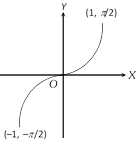
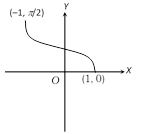
(i) Graph of \[y=\text{si}{{\text{n}}^{1}}x\]   (ii) Graph of \[y={{\cos }^{-1}}x\]  
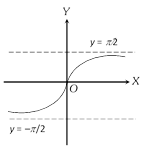
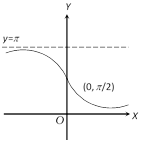
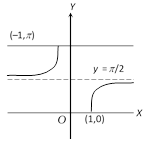
(iii) Graph of \[y={{\tan }^{-1}}x\]     (iv) Graph of \[y={{\cot }^{-1}}x\]  
(v) Graph of \[y={{\sec }^{-1}}x\]   (vi) Graph of \[y=\text{cose}{{\text{c}}^{-1}}x\]   more...
(1) \[\int{\sinh x\,dx}=\cos \,\text{h}x\,+c\]             (2) \[\int{\cos \text{h}x\,dx=\sinh x+c}\]     (3) \[\int{\sec \,{{\text{h}}^{2}}x\,dx=\tan \,\text{h}\,x+c}\]                   (4) \[\int{\text{cosec}{{\text{h}}^{2}}x\,dx=-\cot \text{h}x+c}\]     (5) \[\int{\sec \,\text{h}x\,\tan \,\text{h}x\,dx=-\sec \text{h}x+c}\]                       (6) \[\int{\text{cosec}\,\text{h}x\,\cot \,\text{h}\,dx=-\text{cosec}\,\text{h}x+c}\]

(1) Integral of the form \[\int{si{{n}^{m}}x\,co{{s}^{n}}x\,dx}\]: (i) To evaluate the integrals of the form \[I=\int{{{\sin }^{m}}x\,{{\cos }^{n}}x\,dx,}\] where \[m\] and \[n\] are rational numbers.     (a) Substitute \[\sin x=t,\] if \[n\] is odd;     (b) Substitute cos x = t, if m is odd;     (c) Substitute \[\tan x=t,\] if \[m+n\] is a negative even integer; and     (d) Substitute \[\cot x=t,\] if \[\frac{1}{2}(n-1)\] is an integer.     (e) If \[m\] and \[n\] are rational numbers and \[\left( \frac{m+n-2}{2} \right)\] is a negative integer, then substitution \[\cos x=t\] or \[\tan x=t\] is found suitable.     (ii) Integrals of the form \[\int{R(\sin x,\,\cos x)\,dx,}\] where \[R\] is a rational function of \[\sin x\] and \[\cos x,\] are transformed into integrals of a rational function by the substitution \[\tan \frac{x}{2}=t,\]where \[-\pi <x<\pi .\]  This is the so called universal substitution. Sometimes it is more convenient to more...

If the given function is in the form of fractions of two polynomials, then for its integration, decompose it into partial fractions (if possible). In the beginning chapters, we already discussed the decomposition of partial fractions.  

(1) Integrals of the form\[\int{\frac{a sinx+b cos x}{c sinx+d\,\mathbf{cos} x}}\,dx\]: Such rational functions of \[\sin x\] and \[\cos x\] may be integrated by expressing the numerator of the integrand as follows :     Numerator \[=M\] (Diff. of denominator) \[+N\] (Denominator)     i.e., \[a\sin x+b\cos x=M\frac{d}{dx}(c\sin x+d\cos x)+N(c\sin x+d\cos x)\]     The arbitary constants \[M\] and \[N\] are determined by comparing the coefficients of \[\sin x\] and \[\cos x\] from two sides of the above identity. Then, the given integral is     \[I=\int{\frac{a\sin x+b\cos x}{c\sin x+d\cos x}}\,dx\]     \[=\int{\frac{M(c\cos x-d\sin x)+N(c\sin x+d\cos x)}{c\sin x+d\cos x}}\,dx\]     \[=M\int{\frac{c\cos x-d\sin x}{c\sin x+d\cos x}}\,dx+N\int{1dx}\]     \[=M\log |c\sin x+d\cos x|+Nx+c.\]     (2) Integrals of the form \[\int{\frac{a\,sinx+bcosx+q}{csinx+dcosx+r}}\,dx\] : To evaluate this type of integrals, we express the numerator as follows: Numerator \[=M\text{(Denominator)}+N\text{(Differentiation}\,\text{of}\,\text{denominator)}+P\]     i.e.,\[(c\sin x+b\cos x+q)=M(c\sin x+d\cos x+r)\] \[+N(c\cos x-d\sin x)+P.\]     where M, N, more...

To evaluate the above forms of integrals proceed as follows:     (1) Divide both the numerator and denominator by \[{{\cos }^{2}}x.\]     (2) Replace \[{{\sec }^{2}}x\]in the denominator, if any by \[(1+{{\tan }^{2}}x).\]     (3) Put \[\tan x=t\,\,\,\Rightarrow \,\,{{\sec }^{2}}xdx=dt.\]     (4) Now, evaluate the integral thus obtained, by the method discussed earlier.

(1) Integral of the form \[\int{\frac{dx}{a+b\,cos\,x+csinx}}\]: To evaluate such integrals, we put \[b=r\cos \alpha \] and \[c=r\sin \alpha .\]     So that, \[{{r}^{2}}={{b}^{2}}+{{c}^{2}}\] and \[\alpha ={{\tan }^{-1}}\frac{c}{b}.\]      \[\therefore \,\,\,I=\int{\frac{dx}{a+r(\cos \alpha \,\cos x+\sin \alpha \sin x)}}\]\[=\int{\frac{dx}{a+r\cos (x-\alpha )}}\]     Again, put \[x-\alpha =t\,\]\[\Rightarrow \,\,dx=dt,\] we have \[I=\int{\frac{dt}{a+r\cos t}}\]     Which can be evaluated by the method discussed earlier.     (2) Integral of the form \[\int{\frac{dx}{a\,sin\,x+b\,cos\,x}}\] : To evaluate this type of integrals we substitute \[a=r\cos \theta ,\] \[b=r\sin \theta \] and so \[r=\sqrt{{{a}^{2}}+{{b}^{2}}},\,\,\alpha ={{\tan }^{-1}}\frac{b}{a}\] .     So, \[\int{\frac{dx}{a\sin x+b\cos x}}=\frac{1}{r}\int{\frac{dx}{\sin (x+\alpha )}}=\frac{1}{r}\int{\text{cosec}(x+\alpha )dx}\]     \[=\frac{1}{r}\log \left| \tan \left( \frac{x}{2}+\frac{\alpha }{2} \right)\, \right|\]\[=\frac{1}{\sqrt{{{a}^{2}}+{{b}^{2}}}}\log \left| \tan \left( \frac{x}{2}+\frac{1}{2}{{\tan }^{-1}}\frac{b}{a} \right)\, \right|+c\]     The integral of the above form can be evaluated by using \[\cos x=\frac{1-{{\tan }^{2}}x/2}{1+{{\tan }^{2}}x/2}\] and \[\sin x=\frac{2\tan (x/2)}{1+{{\tan }^{2}}(x/2)}\].


Archive


You need to login to perform this action.
You will be redirected in 3 sec spinner