
| Atoms involved | Type |
| A + B | Electrovalent |
| more...
On the basis of the elecronic configuration principles the electronic configuration of various elements are given in the following table :
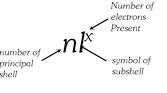
The above method of writing the electronic configurations is quite cumbersome. Hence, usually the electronic configuration of the atom of any element is simply represented by the notation.
 Some Unexpected Electronic Configuration
Some of the exceptions are important though, because they occur with common elements, notably chromium and copper.
\[Cu\] has 29 electrons. Its excepted electronic configuration is \[1{{s}^{2}}2{{s}^{2}}2{{p}^{6}}3{{s}^{2}}3{{p}^{6}}4{{s}^{2}}3{{d}^{9}}\] but in reality the configuration is \[1{{s}^{2}}2{{s}^{2}}2{{p}^{6}}3{{s}^{2}}3{{p}^{6}}4{{s}^{1}}3{{d}^{10}}\] as this configuration is more stable. Similarly \[Cr\] has the configuration of \[1{{s}^{2}}2{{s}^{2}}s{{p}^{6}}3{{s}^{2}}3{{p}^{6}}4{{s}^{1}}3{{d}^{5}}\] instead of \[1{{s}^{2}}2{{s}^{2}}2{{p}^{6}}3{{s}^{2}}3{{p}^{6}}4{{s}^{2}}3{{d}^{4}}\].
Factors responsible for the extra stability of half-filled and completely filled subshells,
(i) Symmetrical distribution : It is well known fact that symmetry leads to stability. Thus the electronic configuration more...
Some Unexpected Electronic Configuration
Some of the exceptions are important though, because they occur with common elements, notably chromium and copper.
\[Cu\] has 29 electrons. Its excepted electronic configuration is \[1{{s}^{2}}2{{s}^{2}}2{{p}^{6}}3{{s}^{2}}3{{p}^{6}}4{{s}^{2}}3{{d}^{9}}\] but in reality the configuration is \[1{{s}^{2}}2{{s}^{2}}2{{p}^{6}}3{{s}^{2}}3{{p}^{6}}4{{s}^{1}}3{{d}^{10}}\] as this configuration is more stable. Similarly \[Cr\] has the configuration of \[1{{s}^{2}}2{{s}^{2}}s{{p}^{6}}3{{s}^{2}}3{{p}^{6}}4{{s}^{1}}3{{d}^{5}}\] instead of \[1{{s}^{2}}2{{s}^{2}}2{{p}^{6}}3{{s}^{2}}3{{p}^{6}}4{{s}^{2}}3{{d}^{4}}\].
Factors responsible for the extra stability of half-filled and completely filled subshells,
(i) Symmetrical distribution : It is well known fact that symmetry leads to stability. Thus the electronic configuration more...
The atom is built up by filling electrons in
various orbitals according to the following rules,
(1) Aufbau?s principle
This principle states that the electrons are added one by one
to the various orbitals in order of their increasing energy starting with the
orbital of lowest energy. The increasing order of energy of various orbitals is
\[1s<2s<2p<3s<3p<4s<3d<4p<5s<4d<5p<6s<4f\]
\[<5d<6p<7s<\,5f<6d<7p.........\]
(2) (n+l) Rule
In neutral isolated atom, the lower the
value of (n + l) for an orbital, lower is its energy. However, if the
two different types of orbitals have the same value of (n + l), the
orbitals with lower value of \[n\] has lower energy.
(3) Pauli?s exclusion principle
According to this principle ?no two
electrons in an atom will have same value of all the four quantum numbers?.
If one electron in an atom has the quantum
numbers \[n=1\], more...
The atom is built up by filling electrons in various orbitals according to the following rules,
(1) Aufbau's principle
This principle states that the electrons are added one by one to the various orbitals in order of their increasing energy starting with the orbital of lowest energy. The increasing order of energy of various orbitals is
\[1s<2s<2p<3s<3p<4s<3d<4p<5s<4d<5p<6s<4f\] \[<5d<6p<7s<\,5f<6d<7p.........\]
(2) (n+l) Rule
In neutral isolated atom, the lower the value of (n + l) for an orbital, lower is its energy. However, if the two different types of orbitals have the same value of (n + l), the orbitals with lower value of \[n\] has lower energy.
(3) Pauli's exclusion principle
According to this principle ?no two electrons in an atom will have same value of all the four quantum numbers?.
If one electron in an atom has the quantum numbers \[n=1\], \[l=0\], more...
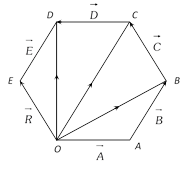
If a number of non zero vectors are represented by the (n - 1) sides of an n-sided polygon then the resultant is given by the closing side or the nth side of the polygon taken in opposite order. So,
\[\overrightarrow{R}=\overrightarrow{A}+\overrightarrow{B}+\overrightarrow{C}+\overrightarrow{D}+\overrightarrow{E}\]
\[\overrightarrow{OA}+\overrightarrow{AB}+\overrightarrow{BC}+\overrightarrow{CD}+\overrightarrow{DE}=\overrightarrow{OE}\]
 Note :
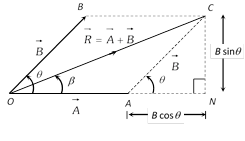
If two non zero vectors are represented by the two adjacent sides of a parallelogram then the resultant is given by the diagonal of the parallelogram passing through the point of intersection of the two vectors.
(1) Magnitude
Since, \[{{R}^{2}}=O{{N}^{2}}+C{{N}^{2}}\]
\[\Rightarrow \]\[{{R}^{2}}={{(OA+AN)}^{2}}+C{{N}^{2}}\]
\[\Rightarrow \]\[{{R}^{2}}={{A}^{2}}+{{B}^{2}}+2AB\cos \theta \] \[\therefore \]
\[R=\,|\overrightarrow{R}|\,=\,|\overrightarrow{A}+\overrightarrow{B}|\,=\sqrt{{{A}^{2}}+{{B}^{2}}+2AB\cos \theta }\]
 Special cases : \[R=A+B\] when q = 0o
\[R=A-B\] when q = 180o
\[R=\sqrt{{{A}^{2}}+{{B}^{2}}}\] when q = 90o
(2) Direction
\[\tan \beta =\frac{CN}{ON}=\frac{B\sin \theta }{A+B\cos \theta }\]
Special cases : \[R=A+B\] when q = 0o
\[R=A-B\] when q = 180o
\[R=\sqrt{{{A}^{2}}+{{B}^{2}}}\] when q = 90o
(2) Direction
\[\tan \beta =\frac{CN}{ON}=\frac{B\sin \theta }{A+B\cos \theta }\]
Each orbital in an atom is specified by a set of three quantum numbers (n, l, m) and each electron is designated by a set of four quantum numbers (n, l, m and s).
(1) Principle quantum number (n)
(i) It was proposed by Bohr and denoted by 'n'.
(ii) It determines the average distance between electron and nucleus, means it denotes the size of atom.
(iii) It determine the energy of the electron in an orbit where electron is present.
(iv) The maximum number of an electron in an orbit represented by this quantum number as \[2{{n}^{2}}.\] No energy shell in atoms of known elements possess more than 32 electrons.
(v) It gives the information of orbit K, L, M, N------------.
(vi) Angular momentum can also be calculated using principle quantum number
(2) Azimuthal quantum number (l)
(i) more...
Articles CategoriesArchive
Trending Articles






You need to login to perform this action. |