
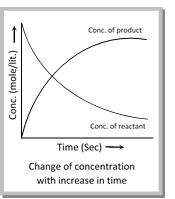
 \[\text{Rate of reaction}=\frac{\text{Total change in concentration of reactants or products}}{\text{Change in time (in sec}\text{.)}}\]
If \[dx\] is the change in concentration in time interval dt then,
The reaction rate for reactants = \[-\frac{dx}{dt}\]; The reaction rate for products = \[+\frac{dx}{dt}\]
\[\text{Rate of reaction}=\frac{\text{Total change in concentration of reactants or products}}{\text{Change in time (in sec}\text{.)}}\]
If \[dx\] is the change in concentration in time interval dt then,
The reaction rate for reactants = \[-\frac{dx}{dt}\]; The reaction rate for products = \[+\frac{dx}{dt}\]
| more...
Soddy, Fajans and Russell (1911-1913) observed that when an a-particle is lost, a new element with atomic number less by 2 and mass number less by 4 is formed. Similarly, when b-particle is lost, new element with atomic number greater by 1 is obtained. The element emitting then a or b-particle is called parent element and the new element formed is called daughter element. The above results have been summarized as,
(1) When an a-particle is emitted, the new element formed is displaced two positions to the left in the periodic table than that of the parent element (because the atomic number decreases by 2).
(2) When a b-particle is emitted, the new element formed is displaced one position to the right in the periodic table than that of the parent element (because atomic number increased by 1).
(3) When a positron is emitted, the daughter element occupies its position more...
(1) Nuclear fission : The splitting of a heavier atom like that of uranium – 235 into a number of fragments of much smaller mass, by suitable bombardment with sub-atomic particles with liberation of huge amount of energy is called Nuclear fission. Hahn and Startsman discovered that when uranium-235 is bombarded with neutrons, it splits up into two relatively lighter elements.
\[_{92}{{U}^{235}}{{+}_{0}}{{n}^{1}}\to {{\,}_{56}}B{{a}^{140}}{{+}_{36}}K{{r}^{93}}+3{{\,}_{0}}{{n}^{1}}\]+ Huge amount of energy
Spallation reactions are similar to nuclear fission. However, they differ by the fact that they are brought by high energy bombarding particles or photons.
Elements capable of undergoing nuclear fission and their fission products. Among elements capable of undergoing nuclear fission, uranium is the most common. The natural uranium consists of three isotopes, namely \[{{U}^{234}}(0.006%)\], \[{{U}^{235}}(0.7%)\] and \[{{U}^{238}}(99.3%)\]. Of the three isomers of uranium, nuclear fission of \[{{U}^{235}}\] and \[{{U}^{238}}\] are more important. Uranium-238 undergoes fission by fast moving neutrons while \[{{U}^{235}}\] undergoes more...
Nuclides can be grouped on the basis of nuclear stability, i.e. stable and unstable nucleus. The most acceptable theory about the atomic nuclear stability is based upon the fact that the observed atomic mass of all known isotopes (except hydrogen) is always less from the sum of the weights of protons and neutrons present in it. Electron (b- particle) from a radioactive nucleus may be regarded as derived from a neutron in the following way,
\[Neutron\to Proton+Electron\]
Similarly, photons are produced from internal stresses within the nucleus.
The stability of nucleus may be discussed in terms of any one of the following,
(1) Nuclear Binding Energy and Mass defect : It is observed that atomic mass of all nuclei (except hydrogen) is different from the sum of masses of protons and neutrons. The difference is termed mass defect.
Mass defect = Total mass of nucleons – obs. atomic mass
The more...
“According to the law of radioactive decay, the quantity of a radio-element which disappears in unit time (rate of disintegration) is directly proportional to the amount present.”
The law of radioactive decay may also be expressed mathematically.
Suppose N0 be the number of atoms of the radioactive element present at the commencement of observation, \[t=0\] and after time t, the number of atoms remaining unchanged is \[{{N}_{t}}\]. The rate of disintegration \[\left( -\frac{d{{N}_{t}}}{dt} \right)\]at any time t is directly proportional to N. Then,\[-\frac{d{{N}_{t}}}{dt}\]= lN
where l is a radioactive constant or decay constant.
Various forms of equation for radioactive decay are,
\[{{N}_{t}}={{N}_{0}}{{e}^{-\lambda t}}\]; \[\log {{N}_{0}}-\log {{N}_{t}}=0.4343\,\lambda t\]
\[\log \frac{{{N}_{0}}}{{{N}_{t}}}=\frac{\lambda t}{2.303}\]; \[\lambda =\frac{2.303}{t}\log \frac{{{N}_{0}}}{{{N}_{t}}}\]
This equation is similar to that of first order reaction, hence we can say that radioactive disintegration are examples of first order reactions. However, unlike first order rate constant (K), the decay constant (l) is independent of more...
The conversion of one element into another by artificial means, i.e., by means of bombarding with some fundamental particles, is known as artificial transmutation. The phenomenon was first applied on nitrogen whose nucleus was bombarded with a-particles to produce oxygen.
\[\underset{\text{Nitrogen isotope}}{\mathop{_{7}{{N}^{14}}}}\,+\,\underset{\text{Alpha particle}}{\mathop{_{2}H{{e}^{4}}}}\,\to \,\underset{\text{Oxygen isotope}}{\mathop{_{8}{{O}^{17}}}}\,+\,\underset{\text{Proton}}{\mathop{_{1}{{H}^{1}}}}\,\]
The element, which is produced, shows radioactivity, the phenomenon is known as Induced radioactivity. The fundamental particles which have been used in the bombardment of different elements are,
a-particle : \[_{2}H{{e}^{4}}\] ; Proton : \[_{1}{{H}^{1}}\]
Deutron : \[_{1}{{H}^{2}}\] or \[_{1}{{D}^{2}}\] ; Neutron : \[_{0}{{n}^{1}}\]
Since a-particles, protons and deutrons carry positive charge, they are repelled by the positively charged nucleus and hence these are not good projectiles. On the other hand, neutrons, which carry no charge at all, are the best projectiles. Cyclotron is the most commonly used instrument for accelerating these particles. The particles leave the instrument with a velocity of about 25,000 miles more...
(1) Nuclear fission : The splitting of a heavier atom like that of uranium – 235 into a number of fragments of much smaller mass, by suitable bombardment with sub-atomic particles with liberation of huge amount of energy is called Nuclear fission. Hahn and Startsman discovered that when uranium-235 is bombarded with neutrons, it splits up into two relatively lighter elements.
\[_{92}{{U}^{235}}{{+}_{0}}{{n}^{1}}\to {{\,}_{56}}B{{a}^{140}}{{+}_{36}}K{{r}^{93}}+3{{\,}_{0}}{{n}^{1}}\]+ Huge amount of energy
Spallation reactions are similar to nuclear fission. However, they differ by the fact that they are brought by high energy bombarding particles or photons.
Elements capable of undergoing nuclear fission and their fission products. Among elements capable of undergoing nuclear fission, uranium is the most common. The natural uranium consists of three isotopes, namely \[{{U}^{234}}(0.006%)\], \[{{U}^{235}}(0.7%)\] and \[{{U}^{238}}(99.3%)\]. Of the three isomers of uranium, nuclear fission of \[{{U}^{235}}\] and \[{{U}^{238}}\] are more important. Uranium-238 undergoes fission by fast moving neutrons while \[{{U}^{235}}\] undergoes more...
Articles CategoriesArchive
Trending Articles






You need to login to perform this action. |