
 Join \[{{G}_{1}}{{G}_{2}}\]; then G must lie on \[{{G}_{1}}\]\[{{G}_{2}}\]. Let O be any fixed point on \[{{G}_{1}}{{G}_{2}}\]. Let \[O{{G}_{1}}={{x}_{1}},O{{G}_{2}}={{x}_{2}}\] and \[OG=\bar{x}\]. Taking moments about O, we have \[({{w}_{1}}+{{w}_{2}})\bar{x}={{w}_{1}}{{x}_{1}}+{{w}_{2}}{{x}_{2}}\]
or \[\bar{x}=\frac{{{w}_{1}}{{x}_{1}}+{{w}_{2}}{{x}_{2}}}{{{w}_{1}}+{{w}_{2}}}\].
(2) Centre of gravity of the remainder : Let w be the weight of the whole body. Let a part B of the body of weight \[{{w}_{1}}\]be removed so that a part A of weight \[w-{{w}_{1}}\] is left behind.
Join \[{{G}_{1}}{{G}_{2}}\]; then G must lie on \[{{G}_{1}}\]\[{{G}_{2}}\]. Let O be any fixed point on \[{{G}_{1}}{{G}_{2}}\]. Let \[O{{G}_{1}}={{x}_{1}},O{{G}_{2}}={{x}_{2}}\] and \[OG=\bar{x}\]. Taking moments about O, we have \[({{w}_{1}}+{{w}_{2}})\bar{x}={{w}_{1}}{{x}_{1}}+{{w}_{2}}{{x}_{2}}\]
or \[\bar{x}=\frac{{{w}_{1}}{{x}_{1}}+{{w}_{2}}{{x}_{2}}}{{{w}_{1}}+{{w}_{2}}}\].
(2) Centre of gravity of the remainder : Let w be the weight of the whole body. Let a part B of the body of weight \[{{w}_{1}}\]be removed so that a part A of weight \[w-{{w}_{1}}\] is left behind.
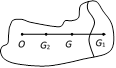 Let G be the centre of gravity of whole body and \[{{G}_{1}}\], the C.G. of portion B which is removed. Let \[{{G}_{2}}\] be the C.G. of the remaining portion A. Let O be a point on \[{{G}_{1}}{{G}_{2}}\] and let it be regarded as origin. Let \[O{{G}_{1}}={{x}_{1}},OG=x\], \[O{{G}_{2}}={{x}_{2}}\] Taking moments about O,
\[(w-{{w}_{1}}){{x}_{2}}+{{w}_{1}}{{x}_{1}}=wx\]
or \[{{x}_{2}}=\frac{wx-{{w}_{1}}{{x}_{1}}}{w-{{w}_{1}}}\].
Let G be the centre of gravity of whole body and \[{{G}_{1}}\], the C.G. of portion B which is removed. Let \[{{G}_{2}}\] be the C.G. of the remaining portion A. Let O be a point on \[{{G}_{1}}{{G}_{2}}\] and let it be regarded as origin. Let \[O{{G}_{1}}={{x}_{1}},OG=x\], \[O{{G}_{2}}={{x}_{2}}\] Taking moments about O,
\[(w-{{w}_{1}}){{x}_{2}}+{{w}_{1}}{{x}_{1}}=wx\]
or \[{{x}_{2}}=\frac{wx-{{w}_{1}}{{x}_{1}}}{w-{{w}_{1}}}\].
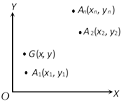 \[{{w}_{1}},{{w}_{2}},...........,\,{{w}_{n}}\] are the weights of the particles placed at the points \[{{A}_{1}}({{x}_{1}},{{y}_{1}}),{{A}_{2}}({{x}_{2}},{{y}_{2}}),..........,{{A}_{n}}({{x}_{n}},{{y}_{n)}}\] respectively, then the centre of gravity \[G(\bar{x},\bar{y})\] is given by \[\bar{x}=\frac{\sum{{{w}_{1}}{{x}_{1}}}}{\sum{{{w}_{1}}}},\bar{y}=\frac{\sum{{{w}_{1}}{{y}_{1}}}}{\sum{{{w}_{1}}}}\].
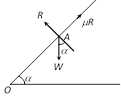 Thus, if a body be on the point of sliding down an inclined plane under its own weight, the inclination of the plane is equal to the angle of the friction.
(1) Least force required to pull a body up an inclined rough plane : Let a body of weight W be at point \[A,\,\,\alpha \] be the inclination of rough inclined plane to the horizontal and \[\lambda \] be the angle of friction. Let P be the force acting at an angle \[\theta \] with the plane required just to move body up the plane.
\[P=W\frac{\sin (\alpha +\lambda )}{\cos (\theta -\lambda )}\], \[\left\{ \because \mu =\tan \lambda \right\}\]
Thus, if a body be on the point of sliding down an inclined plane under its own weight, the inclination of the plane is equal to the angle of the friction.
(1) Least force required to pull a body up an inclined rough plane : Let a body of weight W be at point \[A,\,\,\alpha \] be the inclination of rough inclined plane to the horizontal and \[\lambda \] be the angle of friction. Let P be the force acting at an angle \[\theta \] with the plane required just to move body up the plane.
\[P=W\frac{\sin (\alpha +\lambda )}{\cos (\theta -\lambda )}\], \[\left\{ \because \mu =\tan \lambda \right\}\]
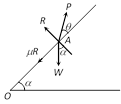 Clearly, the force P is least when \[\cos (\theta -\lambda )\]is maximum, i.e. when \[\cos (\theta -\lambda )=1\], i.e. \[\theta -\lambda =0\]or \[\theta =\lambda \]. The least value of P is \[W\sin (\alpha +\lambda )\]
(2) Least force required to pull a body down an inclined plane : Let a body of weight W be at the point A, a be the inclination of rough inclined plane to the horizontal and l be the angle of friction. Let P be the force acting an angle q with the plane, required just to move the body up the plane.
\[P=\frac{W\sin (\lambda -\alpha )}{\cos (\theta -\lambda )}\], \[[\because \mu =\tan \lambda ]\]
Clearly, the force P is least when \[\cos (\theta -\lambda )\]is maximum, i.e. when \[\cos (\theta -\lambda )=1\], i.e. \[\theta -\lambda =0\]or \[\theta =\lambda \]. The least value of P is \[W\sin (\alpha +\lambda )\]
(2) Least force required to pull a body down an inclined plane : Let a body of weight W be at the point A, a be the inclination of rough inclined plane to the horizontal and l be the angle of friction. Let P be the force acting an angle q with the plane, required just to move the body up the plane.
\[P=\frac{W\sin (\lambda -\alpha )}{\cos (\theta -\lambda )}\], \[[\because \mu =\tan \lambda ]\]
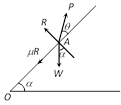 Clearly, P is least when \[\cos (\theta -\lambda )\] is maximum, i.e. when \[\theta -\lambda =0\] or \[\theta =\lambda \]. The least value of P is W\[\sin (\lambda -\alpha )\].
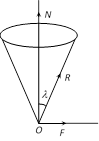
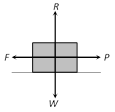 (1) Friction is a self adjusting force : Let a horizontal force P pull a heavy body of weight W resting on a smooth horizontal table. It will be noticed that up to a certain value of P, the body does not move. The reaction R of the table and the weight W of the body do not have any effect on the horizontal pull as they are vertical. It is the force of friction F, acting in the horizontal direction, which balances P and prevents the body from moving.
As P is increased, F also increases so as to balance P. Thus F increases with P. A stage comes when P just begins to move the body. At this stage F reaches its maximum value and is equal to the value of P at that instant. After that, if P is increased further, F does not increase any more and body begins to move.
This shows that friction is self adjusting, i.e. amount of friction exerted is not constant, but increases gradually from zero to a certain maximum limit.
(2) Statical friction : When one body tends to slide over the surface of another body and is not on the verge of motion then the friction called into play is called statical friction.
(3) Limiting friction : When one body is on the verge of sliding over the surface of another body then the friction called into play is called limiting friction.
(4) Dynamical friction : When one body is actually sliding over the surface of another body the friction called into play is called dynamical friction. Dynamical friction is of two types i.e., sliding friction and Rolling friction.
(5) Laws of friction
(i) Friction acts in the direction opposite to that in which the body is about to move.
(ii) The magnitude of the Friction between two bodies bears a constant ratio depends only on the nature of the materials of which these bodies are made.
(iii) Friction is independent of the shape and the area of the surfaces in contact, so long as the normal reaction between them is same, if the normal reaction is constant.
(iv) Limiting friction fs is directly proportional to the normal reaction R, i.e. \[{{f}_{s}}\,\,\propto \,\,R\]
\[{{f}_{s}}={{\mu }_{s}}.R;\]\[{{\mu }_{s}}=\frac{{{f}_{s}}}{R}\], where \[{{\mu }_{s}}\] is a constant which is called coefficient of statical friction.
In case of dynamic friction, \[{{\mu }_{k}}=\frac{{{f}_{k}}}{R}\], more...
(1) Friction is a self adjusting force : Let a horizontal force P pull a heavy body of weight W resting on a smooth horizontal table. It will be noticed that up to a certain value of P, the body does not move. The reaction R of the table and the weight W of the body do not have any effect on the horizontal pull as they are vertical. It is the force of friction F, acting in the horizontal direction, which balances P and prevents the body from moving.
As P is increased, F also increases so as to balance P. Thus F increases with P. A stage comes when P just begins to move the body. At this stage F reaches its maximum value and is equal to the value of P at that instant. After that, if P is increased further, F does not increase any more and body begins to move.
This shows that friction is self adjusting, i.e. amount of friction exerted is not constant, but increases gradually from zero to a certain maximum limit.
(2) Statical friction : When one body tends to slide over the surface of another body and is not on the verge of motion then the friction called into play is called statical friction.
(3) Limiting friction : When one body is on the verge of sliding over the surface of another body then the friction called into play is called limiting friction.
(4) Dynamical friction : When one body is actually sliding over the surface of another body the friction called into play is called dynamical friction. Dynamical friction is of two types i.e., sliding friction and Rolling friction.
(5) Laws of friction
(i) Friction acts in the direction opposite to that in which the body is about to move.
(ii) The magnitude of the Friction between two bodies bears a constant ratio depends only on the nature of the materials of which these bodies are made.
(iii) Friction is independent of the shape and the area of the surfaces in contact, so long as the normal reaction between them is same, if the normal reaction is constant.
(iv) Limiting friction fs is directly proportional to the normal reaction R, i.e. \[{{f}_{s}}\,\,\propto \,\,R\]
\[{{f}_{s}}={{\mu }_{s}}.R;\]\[{{\mu }_{s}}=\frac{{{f}_{s}}}{R}\], where \[{{\mu }_{s}}\] is a constant which is called coefficient of statical friction.
In case of dynamic friction, \[{{\mu }_{k}}=\frac{{{f}_{k}}}{R}\], more... 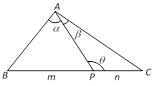 (6) Trigonometrical theorem : If P is any point on the base BC of \[\Delta ABC\] such that \[BP\,:\,CP=m:n\].
Then, (i) \[(m+n)\cot \theta =m\cot \alpha -n\cot \beta \],
where \[\angle BAP=\alpha ,\angle CAP=\beta \].
(ii) \[(n+m)\cot \theta =n\cot B-m\cot C\].
(6) Trigonometrical theorem : If P is any point on the base BC of \[\Delta ABC\] such that \[BP\,:\,CP=m:n\].
Then, (i) \[(m+n)\cot \theta =m\cot \alpha -n\cot \beta \],
where \[\angle BAP=\alpha ,\angle CAP=\beta \].
(ii) \[(n+m)\cot \theta =n\cot B-m\cot C\].




You need to login to perform this action.
You will be redirected in
3 sec