 (1) \[a=b\ne c\]
(2) Number of atoms per unit cell = 6
(3) The volume of the hexagonal cell = \[3\sqrt{2}\,{{a}^{3}}\]
(4) The packing fraction \[=\frac{\pi \sqrt{2}}{6}\]
(5) Coordination number = 12
(6) Magnesium is a special example of HCP lattice structure.
(1) \[a=b\ne c\]
(2) Number of atoms per unit cell = 6
(3) The volume of the hexagonal cell = \[3\sqrt{2}\,{{a}^{3}}\]
(4) The packing fraction \[=\frac{\pi \sqrt{2}}{6}\]
(5) Coordination number = 12
(6) Magnesium is a special example of HCP lattice structure. 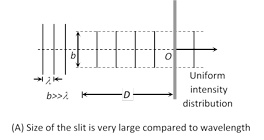
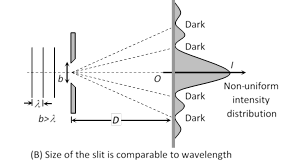 (2) The phenomenon resulting from the superposition of secondary wavelets originating from different parts of the same wave front is define as diffraction of light.
(3) Diffraction is the characteristic of all types of waves.
(4) Greater the wave length of wave higher will be it?s degree of diffraction.
(2) The phenomenon resulting from the superposition of secondary wavelets originating from different parts of the same wave front is define as diffraction of light.
(3) Diffraction is the characteristic of all types of waves.
(4) Greater the wave length of wave higher will be it?s degree of diffraction.  (2) Plane of symmetry : It is an imaginary plane which passes through the centre of a crystal and divides it into two equal portions such that one part is exactly the mirror image of the other.
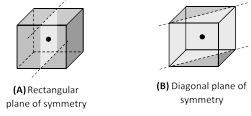 A cubical crystal possesses six diagonal plane of symmetry and three rectangular plane of symmetry.
(3) Axis of symmetry : It is an imaginary straight line about which, if the crystal is rotated, it will present the same appearance more than once during the complete revolution. In general, if the same appearance of a crystal is repeated on rotating through an angle \[\frac{{{360}^{o}}}{n}\], around an imaginary axis, the axis is called an n-fold axis.
A cubical crystal possesses in all 13 axis of symmetry
A cubical crystal possesses six diagonal plane of symmetry and three rectangular plane of symmetry.
(3) Axis of symmetry : It is an imaginary straight line about which, if the crystal is rotated, it will present the same appearance more than once during the complete revolution. In general, if the same appearance of a crystal is repeated on rotating through an angle \[\frac{{{360}^{o}}}{n}\], around an imaginary axis, the axis is called an n-fold axis.
A cubical crystal possesses in all 13 axis of symmetry
| Axis of four-fold symmetry = 3 (Because of six faces) | Axis of three-fold symmetry = 4 (Because of eight corners) | Axis of two-fold symmetry = 6 (Because of twelve edges) |
 |
 |
 |
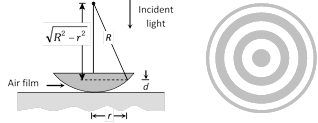 (3) The central fringe is a dark spot then there are alternate bright and dark fringes (Ring shape).
(4) Radius of nth dark ring \[{{r}_{m}}\tilde{}\,\sqrt{\lambda R}\]
n = 0, 1, 2, ....., R = Radius of convex surface
(5) Radius of nth bright ring \[{{r}_{n}}=\sqrt{\left( n+\frac{1}{2} \right)\lambda R}\]
(6) If a liquid of ref index m is introduced between the lens and glass plate, the radii of dark ring would be \[{{r}_{n}}=\sqrt{\frac{n\lambda R}{\mu }}\]
(7) Newton's ring arrangement is used of determining the wavelength of monochromatic light. For this the diameter of nth dark ring \[({{D}_{n}})\] and \[{{(n+p)}^{th}}\] dark ring \[({{D}_{n+p}})\] are measured then
\[D_{(n+p)}^{2}=4(n+p)\lambda R\] and \[D_{n}^{2}=4n\lambda R\]\[\Rightarrow \]\[\lambda =\frac{D_{n+p}^{2}-D_{n}^{2}}{4pR}\]
(3) The central fringe is a dark spot then there are alternate bright and dark fringes (Ring shape).
(4) Radius of nth dark ring \[{{r}_{m}}\tilde{}\,\sqrt{\lambda R}\]
n = 0, 1, 2, ....., R = Radius of convex surface
(5) Radius of nth bright ring \[{{r}_{n}}=\sqrt{\left( n+\frac{1}{2} \right)\lambda R}\]
(6) If a liquid of ref index m is introduced between the lens and glass plate, the radii of dark ring would be \[{{r}_{n}}=\sqrt{\frac{n\lambda R}{\mu }}\]
(7) Newton's ring arrangement is used of determining the wavelength of monochromatic light. For this the diameter of nth dark ring \[({{D}_{n}})\] and \[{{(n+p)}^{th}}\] dark ring \[({{D}_{n+p}})\] are measured then
\[D_{(n+p)}^{2}=4(n+p)\lambda R\] and \[D_{n}^{2}=4n\lambda R\]\[\Rightarrow \]\[\lambda =\frac{D_{n+p}^{2}-D_{n}^{2}}{4pR}\] 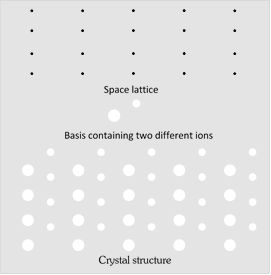 (3) Unit cell : Is defined as that volume of the solid from which the entire crystal structure can be constructed by the translational repetition in three dimensions. The length of three sides of a unit cell (3D) are called primitives or lattice constant they are denoted by a, b, c
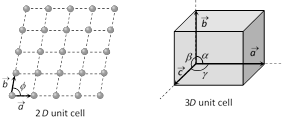 (4) Primitive cell : A primitive cell is a minimum volume unit cell or the simple unit cell with particles only at the corners is a primitive unit cell and other types of unit cells are called non-primitive unit cells. There is only one lattice point per primitive cell.
(5) Crystallographic axis : The lines drawn parallel to the lines of intersection of the faces of the unit cell are called crystallographic axis. All the crystals on the basis of the shape of their unit cells, have been divided into seven crystal systems as shown in the following table.
Different crystal systems
(4) Primitive cell : A primitive cell is a minimum volume unit cell or the simple unit cell with particles only at the corners is a primitive unit cell and other types of unit cells are called non-primitive unit cells. There is only one lattice point per primitive cell.
(5) Crystallographic axis : The lines drawn parallel to the lines of intersection of the faces of the unit cell are called crystallographic axis. All the crystals on the basis of the shape of their unit cells, have been divided into seven crystal systems as shown in the following table.
Different crystal systems
| System | Lattice constants | Angle between lattice constants | Examples |
Cubic  Number of lattices = 3 Number of lattices = 3 |
\[a=b=c\] | \[\alpha =\beta =\gamma ={{90}^{o}}\] | Diamond, NaCl, Li, Ag, Cu, \[N{{H}_{4}}Cl\], Pb etc. |
Tetragonal 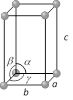 Number of lattices = 2 Number of lattices = 2 |
more...
It is a state of matter which has a definite shape and a definite volume. The characteristic properties of the solid depends upon the nature of forces acting between their constituent particles (i.e. ions, atoms or molecules). Solids are divided into two categories.
Crystalline solids
(1) These solids have definite external geometrical form.
(2) Ions, atoms or molecules of these solid are arranged in a definite fashion in all it's three dimensions.
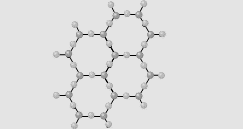 (3) Examples : Quartz, calacite, mica, diamond etc.
(4) They have well defined facets or faces.
(5) They are ordered at short range as well as at long range.
(6) They are anisotropic, i.e. the physical properties like elastic modulii, thermal conductivity, electrical conductivity, refractive index have different values in different direction.
(7) They have sharp melting point.
(8) Bond strengths are identical throughout the solid.
(9) These are considered as true solids.
(10) An important property of crystals is their symmetry.
Amorphous or glassy solids
(1) These solids have no definite external geometrical form.
(3) Examples : Quartz, calacite, mica, diamond etc.
(4) They have well defined facets or faces.
(5) They are ordered at short range as well as at long range.
(6) They are anisotropic, i.e. the physical properties like elastic modulii, thermal conductivity, electrical conductivity, refractive index have different values in different direction.
(7) They have sharp melting point.
(8) Bond strengths are identical throughout the solid.
(9) These are considered as true solids.
(10) An important property of crystals is their symmetry.
Amorphous or glassy solids
(1) These solids have no definite external geometrical form.
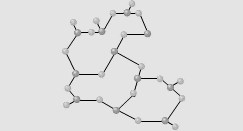 (2) Ions, atoms or molecules of these solids are not arranged in a definite fashion.
(3) Example : Rubber, plastic, paraffin wax, cement etc.
(4) They do not possess definite facets or faces.
(5) These have short range order, and there is no long range order.
(6) They are isotropic.
(7) They do not have a sharp melting point.
(8) Bond strengths vary.
(9) These are considered as pseudo-solids or super cooled liquids.
(10) Amorphous solids do not have any symmetry.
(2) Ions, atoms or molecules of these solids are not arranged in a definite fashion.
(3) Example : Rubber, plastic, paraffin wax, cement etc.
(4) They do not possess definite facets or faces.
(5) These have short range order, and there is no long range order.
(6) They are isotropic.
(7) They do not have a sharp melting point.
(8) Bond strengths vary.
(9) These are considered as pseudo-solids or super cooled liquids.
(10) Amorphous solids do not have any symmetry.
(1) It is an optical device of producing interference of light Fresnel's biprism is made by joining base to base two thin prism of very small angle
(2) Acute angle of prism is about \[1/{{2}^{o}}\] and obtuse angle of prism is about \[{{179}^{o}}\].
(3) When a monochromatic light source is kept in front of biprism two coherent virtual source \[{{S}_{1}}\] and \[{{S}_{2}}\]are produced.
(4) Interference fringes are found on the screen placed behind the biprism interference fringes are formed in the limited region which can be observed with the help eye piece.
(5) Fringe width is measured by a micrometer attached to the eye piece. Fringes are of equal width and its value is \[\beta =\frac{\lambda \,D}{d}\]
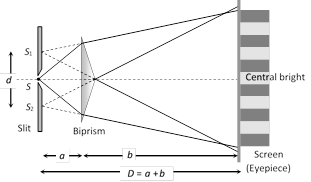 (6) Let the separation between \[{{S}_{1}}\] and \[{{S}_{2}}\] be d and the distance of slits and the screen from the biprism be a and b respectively i.e. \[D=(a+b)\]. If angle of prism is \[\alpha \] and refractive index is \[\mu \] then \[d=2a(\mu -1)\alpha \] \[\therefore \] \[\lambda =\frac{\beta \,[2a\,(\mu -1)\alpha ]}{(a+b)}\]\[\Rightarrow \]\[\beta =\frac{(a+b)\lambda }{2a(\mu -1)\alpha }\]
(7) If a convex lens is mounted between the biprism and eye piece. There will be two positions of lens when the sharp images of coherent sources will be observed in the eyepiece. The separation of the images in the two positions are measured. Let these be d1 and d2 then \[d=\sqrt{{{d}_{1}}{{d}_{2}}}\] \[\therefore \]\[\lambda =\frac{\beta d}{D}=\frac{\beta \sqrt{{{d}_{1}}{{d}_{2}}}}{(a+b)}\].
(6) Let the separation between \[{{S}_{1}}\] and \[{{S}_{2}}\] be d and the distance of slits and the screen from the biprism be a and b respectively i.e. \[D=(a+b)\]. If angle of prism is \[\alpha \] and refractive index is \[\mu \] then \[d=2a(\mu -1)\alpha \] \[\therefore \] \[\lambda =\frac{\beta \,[2a\,(\mu -1)\alpha ]}{(a+b)}\]\[\Rightarrow \]\[\beta =\frac{(a+b)\lambda }{2a(\mu -1)\alpha }\]
(7) If a convex lens is mounted between the biprism and eye piece. There will be two positions of lens when the sharp images of coherent sources will be observed in the eyepiece. The separation of the images in the two positions are measured. Let these be d1 and d2 then \[d=\sqrt{{{d}_{1}}{{d}_{2}}}\] \[\therefore \]\[\lambda =\frac{\beta d}{D}=\frac{\beta \sqrt{{{d}_{1}}{{d}_{2}}}}{(a+b)}\].
A plane glass plate (acting as a mirror) is illuminated at almost grazing incidence by a light from a slit \[{{S}_{1}}\]. A virtual image \[{{S}_{2}}\] of \[{{S}_{1}}\] is formed closed to \[{{S}_{1}}\] by reflection and these two act as coherent sources. The expression giving the fringe width is the same as for the double slit, but the fringe system differs in one important respect.
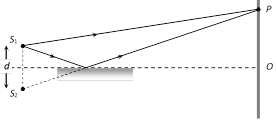 The path difference \[{{S}_{2}}P-{{S}_{1}}P\] is a whole number of wavelengths, the fringe at P is dark not bright. This is due to \[{{180}^{o}}\] phase change which occurs when light is reflected from a denser medium. At grazing incidence a fringe is formed at O, where the geometrical path difference between the direct and reflected waves is zero and it follows that it will be dark rather than bright.
Thus, whenever there exists a phase difference of a \[\pi \] between the two interfering beams of light, conditions of maximas and minimas are interchanged, i.e., \[\Delta x=n\lambda \](for minimum intensity)
and \[\Delta x=(2n-1)\lambda /2\] (for maximum intensity)
The path difference \[{{S}_{2}}P-{{S}_{1}}P\] is a whole number of wavelengths, the fringe at P is dark not bright. This is due to \[{{180}^{o}}\] phase change which occurs when light is reflected from a denser medium. At grazing incidence a fringe is formed at O, where the geometrical path difference between the direct and reflected waves is zero and it follows that it will be dark rather than bright.
Thus, whenever there exists a phase difference of a \[\pi \] between the two interfering beams of light, conditions of maximas and minimas are interchanged, i.e., \[\Delta x=n\lambda \](for minimum intensity)
and \[\Delta x=(2n-1)\lambda /2\] (for maximum intensity) Current Affairs CategoriesArchive
Trending Current Affairs






You need to login to perform this action. |