
| Induced current (i) | Induced charge (q) | Induced power (P) |
| \[i=\frac{e}{R}=-\frac{N}{R}.\frac{d\varphi }{dt}\] | \[dq=i\,dt=-\frac{N}{R}\cdot d\varphi \] Induced charge is time independent. | \[P=\frac{{{e}^{2}}}{R}\]\[=\frac{{{N}^{2}}}{R}{{\left( \frac{d\varphi }{dt} \right)}^{2}}\] It depends on time and resistance |
 (2) Net flux through the surface \[\phi =\oint{\vec{B}\cdot d\vec{A}}=BA\cos \theta \]
(\[\theta \] is the angle between area vector and magnetic field vector)
If \[\theta ={{0}^{o}}\] then \[\phi =BA,\] If \[\theta ={{90}^{o}}\] then \[\phi =0\]
(3) Unit and Dimension : Magnetic flux is a scalar quantity. It?s S.I. unit is weber (wb), CGS unit is Maxwell or Gauss \[\times \,\,c{{m}^{2}}\]; (\[1\,wb={{10}^{8}}\,Maxwell\]).
(4) Other units : Tesla \[\times \,\,{{m}^{2}}\]\[=\frac{N\times m}{Amp}=\frac{Joule}{Amp}\]\[=\frac{Volt\times \text{Coulomb}}{Amp}\]
\[=Volt\times sec\] = Ohm \[\times \] Coulomb = Henry \[\times \] Amp. It?s dimensional formula \[[\phi ]=[M{{L}^{2}}{{T}^{2}}{{A}^{-1}}]\]
(2) Net flux through the surface \[\phi =\oint{\vec{B}\cdot d\vec{A}}=BA\cos \theta \]
(\[\theta \] is the angle between area vector and magnetic field vector)
If \[\theta ={{0}^{o}}\] then \[\phi =BA,\] If \[\theta ={{90}^{o}}\] then \[\phi =0\]
(3) Unit and Dimension : Magnetic flux is a scalar quantity. It?s S.I. unit is weber (wb), CGS unit is Maxwell or Gauss \[\times \,\,c{{m}^{2}}\]; (\[1\,wb={{10}^{8}}\,Maxwell\]).
(4) Other units : Tesla \[\times \,\,{{m}^{2}}\]\[=\frac{N\times m}{Amp}=\frac{Joule}{Amp}\]\[=\frac{Volt\times \text{Coulomb}}{Amp}\]
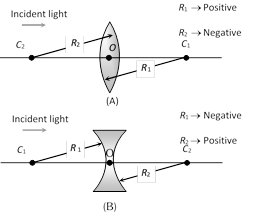
\[=Volt\times sec\] = Ohm \[\times \] Coulomb = Henry \[\times \] Amp. It?s dimensional formula \[[\phi ]=[M{{L}^{2}}{{T}^{2}}{{A}^{-1}}]\] 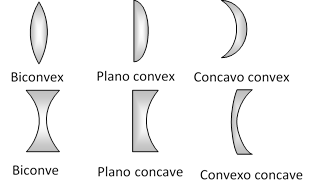 (3) As there are two spherical surfaces, there are two centres of curvature \[{{C}_{1}}\] and \[{{C}_{2}}\] and correspondingly two radii of curvature \[{{R}_{1}}\] and \[{{R}_{2}}\]
(4) The line joining \[{{C}_{1}}\] and \[{{C}_{2}}\] is called the principal axis of the lens. The centre of the thin lens which is on the principal axis, is called the optical centre.
(5) A ray passing through optical centre proceeds undeviated through the lens.
(3) As there are two spherical surfaces, there are two centres of curvature \[{{C}_{1}}\] and \[{{C}_{2}}\] and correspondingly two radii of curvature \[{{R}_{1}}\] and \[{{R}_{2}}\]
(4) The line joining \[{{C}_{1}}\] and \[{{C}_{2}}\] is called the principal axis of the lens. The centre of the thin lens which is on the principal axis, is called the optical centre.
(5) A ray passing through optical centre proceeds undeviated through the lens.
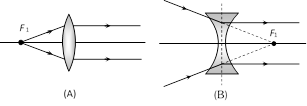
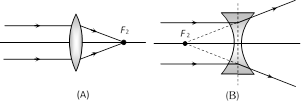
 (6) Principal focus : We define two principal focus for the lens. We are mainly concerned with the second principal focus (F). Thus wherever we write the focus, it means the second principal focus.
First principal focus : An object point for which image is formed at infinity.
(6) Principal focus : We define two principal focus for the lens. We are mainly concerned with the second principal focus (F). Thus wherever we write the focus, it means the second principal focus.
First principal focus : An object point for which image is formed at infinity.
 Second principal focus : An image point for an object at infinity.
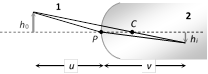
 (1) Refraction formula : \[\frac{{{\mu }_{2}}-{{\mu }_{1}}}{R}=\frac{{{\mu }_{2}}}{v}-\frac{{{\mu }_{1}}}{u}\]
Where \[{{\mu }_{1}}=\]Refractive index of the medium from which light rays are coming (from object).
\[{{\mu }_{2}}=\]Refractive index of the medium in which light rays are entering.
u = Distance of object, v = Distance of image, R = Radius of curvature
(2) Lateral magnification : The lateral magnification m is the ratio of the image height to the object height
or \[m=\,\left( \frac{{{h}_{i}}}{{{h}_{0}}} \right)=\left( \frac{{{\mu }_{1}}}{{{\mu }_{2}}} \right)\,\left( \frac{v}{u} \right)\]
(1) Refraction formula : \[\frac{{{\mu }_{2}}-{{\mu }_{1}}}{R}=\frac{{{\mu }_{2}}}{v}-\frac{{{\mu }_{1}}}{u}\]
Where \[{{\mu }_{1}}=\]Refractive index of the medium from which light rays are coming (from object).
\[{{\mu }_{2}}=\]Refractive index of the medium in which light rays are entering.
u = Distance of object, v = Distance of image, R = Radius of curvature
(2) Lateral magnification : The lateral magnification m is the ratio of the image height to the object height
or \[m=\,\left( \frac{{{h}_{i}}}{{{h}_{0}}} \right)=\left( \frac{{{\mu }_{1}}}{{{\mu }_{2}}} \right)\,\left( \frac{v}{u} \right)\]
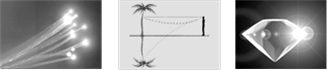
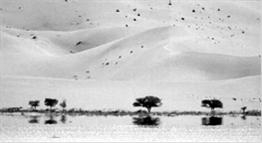 (3) Brilliance of diamond : Due to repeated internal reflections diamond sparkles.
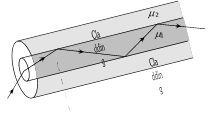
(4) Optical fibre : Optical fibres consist of many long high quality composite glass/quartz fibres. Each fibre consists of a core and cladding.
(i) The refractive index of the material of the core \[({{\mu }_{1}})\]is higher than that of the cladding \[({{\mu }_{2}})\].
(ii) When the light is incident on one end of the fibre at a small angle, the light passes inside, undergoes repeated total internal reflections along the fibre and finally comes out. The angle of incidence is always larger than the critical angle of the core material with respect to its cladding.
(iii) Even if the fibre is bent, the light can easily travel through along the fibre
(iv) A bundle of optical fibres can be used as a 'light pipe' in medical and optical examination. It can also be used for optical signal transmission. Optical fibres have also been used for transmitting and receiving electrical signals which are converted to light by suitable transducers.
(3) Brilliance of diamond : Due to repeated internal reflections diamond sparkles.
(4) Optical fibre : Optical fibres consist of many long high quality composite glass/quartz fibres. Each fibre consists of a core and cladding.
(i) The refractive index of the material of the core \[({{\mu }_{1}})\]is higher than that of the cladding \[({{\mu }_{2}})\].
(ii) When the light is incident on one end of the fibre at a small angle, the light passes inside, undergoes repeated total internal reflections along the fibre and finally comes out. The angle of incidence is always larger than the critical angle of the core material with respect to its cladding.
(iii) Even if the fibre is bent, the light can easily travel through along the fibre
(iv) A bundle of optical fibres can be used as a 'light pipe' in medical and optical examination. It can also be used for optical signal transmission. Optical fibres have also been used for transmitting and receiving electrical signals which are converted to light by suitable transducers.
 (5) Field of vision of fish (or swimmer) : A fish (diver) inside the water can see the whole world through a cone with.
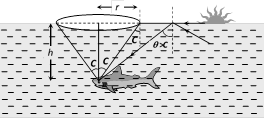 (a) Apex angle\[=2C={{98}^{o}}\]
(b) Radius of base \[r=h\tan C=\frac{h}{\sqrt{{{\mu }^{2}}-1}}\]; for water\[\ r=\frac{3h}{\sqrt{7}}\]
(c) Area of base A\[=\frac{\pi {{h}^{2}}}{({{\mu }^{2}}-1)}\]; for water \[a=\frac{9\pi }{7}{{h}^{2}}\]
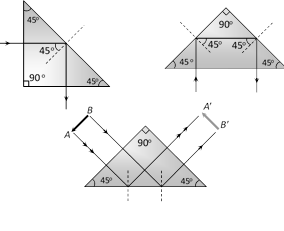
(6) Porro prism : A right angled isosceles prism, which is used in periscopes or binoculars. It is used to deviate light rays through \[{{90}^{o}}\]and \[{{180}^{o}}\]and also to erect the image.
(a) Apex angle\[=2C={{98}^{o}}\]
(b) Radius of base \[r=h\tan C=\frac{h}{\sqrt{{{\mu }^{2}}-1}}\]; for water\[\ r=\frac{3h}{\sqrt{7}}\]
(c) Area of base A\[=\frac{\pi {{h}^{2}}}{({{\mu }^{2}}-1)}\]; for water \[a=\frac{9\pi }{7}{{h}^{2}}\]
(6) Porro prism : A right angled isosceles prism, which is used in periscopes or binoculars. It is used to deviate light rays through \[{{90}^{o}}\]and \[{{180}^{o}}\]and also to erect the image.
 When a ray of light goes from denser to rarer medium it bends away from the normal and as the angle of incidence in denser medium increases, the angle of refraction in rarer medium also increases and at a certain angle, angle of refraction becomes \[{{90}^{o}}\], this angle of incidence is called critical angle (C).
When Angle of incidence exceeds the critical angle than light ray comes back in to the same medium after reflection from interface. This phenomenon is called Total internal reflection (TIR).
When a ray of light goes from denser to rarer medium it bends away from the normal and as the angle of incidence in denser medium increases, the angle of refraction in rarer medium also increases and at a certain angle, angle of refraction becomes \[{{90}^{o}}\], this angle of incidence is called critical angle (C).
When Angle of incidence exceeds the critical angle than light ray comes back in to the same medium after reflection from interface. This phenomenon is called Total internal reflection (TIR).
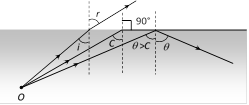 (1) \[\mu =\frac{1}{sin\,C}=cosec\,C\] where \[\mu \to \,{{\,}_{\text{Rarer}}}{{\mu }_{\text{Denser}}}\]
(2) Conditions for TIR
(i) The ray must travel from denser medium to rarer medium.
(ii) The angle of incidence i must be greater than critical angle C
(3) Dependence of critical angle
(i) Colour of light (or wavelength of light) : Critical angle depends upon wavelength as \[\lambda \propto \frac{1}{\mu }\propto \text{sin}\,C\]
(a) \[{{\lambda }_{R}}>{{\lambda }_{V}}\Rightarrow {{C}_{R}}>{{C}_{V}}\]
(b) Sin C \[=\frac{1}{_{R}{{\mu }_{D}}}=\frac{{{\mu }_{R}}}{{{\mu }_{D}}}=\frac{{{\lambda }_{D}}}{{{\lambda }_{R}}}=\frac{{{v}_{D}}}{{{v}_{R}}}\] (for two media)
(ii) Nature of the pair of media : Greater the refractive index lesser will be the critical angle.
(a) For (glass- air) pair \[\to \,\,{{C}_{\text{glass}}}={{42}^{o}}\]
(b) For (water-air) pair \[\to \,\,{{C}_{\text{water}}}={{49}^{o}}\]
(c) For (diamond-air) pair \[\to \,\,{{C}_{\text{di amond}}}={{24}^{o}}\]
(iii) Temperature : With temperature rise refractive index of the material decreases therefore critical angle increases.
(1) \[\mu =\frac{1}{sin\,C}=cosec\,C\] where \[\mu \to \,{{\,}_{\text{Rarer}}}{{\mu }_{\text{Denser}}}\]
(2) Conditions for TIR
(i) The ray must travel from denser medium to rarer medium.
(ii) The angle of incidence i must be greater than critical angle C
(3) Dependence of critical angle
(i) Colour of light (or wavelength of light) : Critical angle depends upon wavelength as \[\lambda \propto \frac{1}{\mu }\propto \text{sin}\,C\]
(a) \[{{\lambda }_{R}}>{{\lambda }_{V}}\Rightarrow {{C}_{R}}>{{C}_{V}}\]
(b) Sin C \[=\frac{1}{_{R}{{\mu }_{D}}}=\frac{{{\mu }_{R}}}{{{\mu }_{D}}}=\frac{{{\lambda }_{D}}}{{{\lambda }_{R}}}=\frac{{{v}_{D}}}{{{v}_{R}}}\] (for two media)
(ii) Nature of the pair of media : Greater the refractive index lesser will be the critical angle.
(a) For (glass- air) pair \[\to \,\,{{C}_{\text{glass}}}={{42}^{o}}\]
(b) For (water-air) pair \[\to \,\,{{C}_{\text{water}}}={{49}^{o}}\]
(c) For (diamond-air) pair \[\to \,\,{{C}_{\text{di amond}}}={{24}^{o}}\]
(iii) Temperature : With temperature rise refractive index of the material decreases therefore critical angle increases. 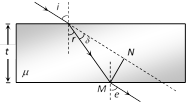 The Lateral shift of the ray is the perpendicular distance between the incident and the emergent ray, and it is given by
\[\mathbf{MN = t sec r sin (i - r)}\]
(2) Normal shift : If a glass slab is placed in the path of a converging or diverging beam of light then point of convergence or point of divergence appears to be shifted as shown
Normal shift
\[OO'=x=\left( 1-\frac{1}{\mu } \right)\,t\]
The Lateral shift of the ray is the perpendicular distance between the incident and the emergent ray, and it is given by
\[\mathbf{MN = t sec r sin (i - r)}\]
(2) Normal shift : If a glass slab is placed in the path of a converging or diverging beam of light then point of convergence or point of divergence appears to be shifted as shown
Normal shift
\[OO'=x=\left( 1-\frac{1}{\mu } \right)\,t\]
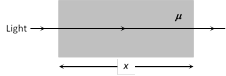
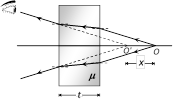 (3) Optical path : It is defined as distance travelled by light in vacuum in the same time in which it travels a given path length in a medium.
Time taken by light ray to pass through the medium \[=\frac{\mu \,x}{c}\]; where \[x=\] geometrical path and \[\mu x=\] optical path
(3) Optical path : It is defined as distance travelled by light in vacuum in the same time in which it travels a given path length in a medium.
Time taken by light ray to pass through the medium \[=\frac{\mu \,x}{c}\]; where \[x=\] geometrical path and \[\mu x=\] optical path
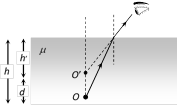 (i) \[\mu =\frac{\text{Real depth}}{\text{Apparent depth}}=\frac{h}{{{h}'}}\]
(ii) Real depth > Apparent depth
(iii) Shift \[d=h-{{h}^{'}}=\left( 1-\frac{1}{\mu } \right)\,h\].
For water \[\mu =\frac{4}{3}\Rightarrow d=\frac{h}{4}\]; For glass \[\mu =\frac{3}{2}\Rightarrow d=\frac{h}{3}\]
(iv) Lateral magnification : consider an object of height \[x\] placed vertically in a medium \[{{\mu }_{1}}\] such that the lower end \[(B)\] is a distance h from the interface and the upper end (A) at a distance \[(h-x)\] from the interface.
(i) \[\mu =\frac{\text{Real depth}}{\text{Apparent depth}}=\frac{h}{{{h}'}}\]
(ii) Real depth > Apparent depth
(iii) Shift \[d=h-{{h}^{'}}=\left( 1-\frac{1}{\mu } \right)\,h\].
For water \[\mu =\frac{4}{3}\Rightarrow d=\frac{h}{4}\]; For glass \[\mu =\frac{3}{2}\Rightarrow d=\frac{h}{3}\]
(iv) Lateral magnification : consider an object of height \[x\] placed vertically in a medium \[{{\mu }_{1}}\] such that the lower end \[(B)\] is a distance h from the interface and the upper end (A) at a distance \[(h-x)\] from the interface.
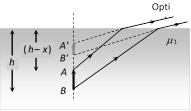 Distance of image of B (i.e. B') from the interface = \[\frac{{{\mu }_{2}}}{{{\mu }_{1}}}h\]
Distance of image of A (i.e. A') from the interface \[=\frac{{{\mu }_{2}}}{{{\mu }_{1}}}(h-x)\]
Therefore, length of the image \[\frac{{{\mu }_{2}}}{{{\mu }_{1}}}x\]
or, the lateral magnification of the object \[m=\frac{{{\mu }_{2}}}{{{\mu }_{1}}}\]\[=\frac{1}{\mu }\]
(v) If a beaker contains various immiscible liquids as shown then
Apparent depth of bottom\[=\frac{{{d}_{1}}}{{{\mu }_{1}}}+\frac{{{d}_{2}}}{{{\mu }_{2}}}+\frac{{{d}_{3}}}{{{\mu }_{3}}}+....\]
Distance of image of B (i.e. B') from the interface = \[\frac{{{\mu }_{2}}}{{{\mu }_{1}}}h\]
Distance of image of A (i.e. A') from the interface \[=\frac{{{\mu }_{2}}}{{{\mu }_{1}}}(h-x)\]
Therefore, length of the image \[\frac{{{\mu }_{2}}}{{{\mu }_{1}}}x\]
or, the lateral magnification of the object \[m=\frac{{{\mu }_{2}}}{{{\mu }_{1}}}\]\[=\frac{1}{\mu }\]
(v) If a beaker contains various immiscible liquids as shown then
Apparent depth of bottom\[=\frac{{{d}_{1}}}{{{\mu }_{1}}}+\frac{{{d}_{2}}}{{{\mu }_{2}}}+\frac{{{d}_{3}}}{{{\mu }_{3}}}+....\]
 \[\mu \]combination = \[\frac{{{d}_{AC}}}{{{d}_{App.}}}=\frac{{{d}_{1}}+{{d}_{2}}+.....}{\frac{{{d}_{1}}}{{{\mu }_{1}}}+\frac{{{d}_{2}}}{{{\mu }_{2}}}+....}\]
(In case of two liquids if \[{{d}_{1}}={{d}_{2}}\] than \[\mu =\frac{2{{\mu }_{1}}{{\mu }_{2}}}{{{\mu }_{1}}+{{\mu }_{2}}}\])
(2) Object is in rarer medium and observer is in denser medium
\[\mu \]combination = \[\frac{{{d}_{AC}}}{{{d}_{App.}}}=\frac{{{d}_{1}}+{{d}_{2}}+.....}{\frac{{{d}_{1}}}{{{\mu }_{1}}}+\frac{{{d}_{2}}}{{{\mu }_{2}}}+....}\]
(In case of two liquids if \[{{d}_{1}}={{d}_{2}}\] than \[\mu =\frac{2{{\mu }_{1}}{{\mu }_{2}}}{{{\mu }_{1}}+{{\mu }_{2}}}\])
(2) Object is in rarer medium and observer is in denser medium
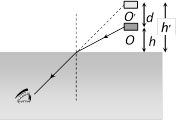 (i) \[\mu =\frac{{{h}^{'}}}{h}\]
(ii) Real depth < Apparent depth.
(iii) \[d=(\mu -1)h\]
(iv) Shift for water \[{{d}_{w}}=\frac{h}{3}\]; Shift for glass \[{{d}_{g}}=\frac{h}{2}\]
(i) \[\mu =\frac{{{h}^{'}}}{h}\]
(ii) Real depth < Apparent depth.
(iii) \[d=(\mu -1)h\]
(iv) Shift for water \[{{d}_{w}}=\frac{h}{3}\]; Shift for glass \[{{d}_{g}}=\frac{h}{2}\] | Substance | Refractive index | Substance | Refractive index |
| Solids at \[{{20}^{o}}C\] | Liquids at \[{{20}^{o}}C\] | ||
| Diamond (C) | 2.419 | Benzene | 1.501 |
| more...
The bending of the ray of light passing from one medium to the other medium is called refraction.
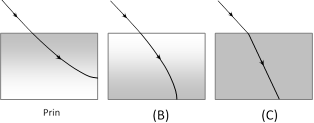 (1) The refraction of light takes place on going from one medium to another because the speed of light is different in the two media.
(2) Greater the difference in the speeds of light in the two media, greater will be the amount of refraction.
(3) A medium in which the speed of light is more is known as optically rarer medium and a medium is which the speed of light is less, is known as optically denser medium.
(4) When a ray of light goes from a rarer medium to a denser medium, it bends towards the normal.
(1) The refraction of light takes place on going from one medium to another because the speed of light is different in the two media.
(2) Greater the difference in the speeds of light in the two media, greater will be the amount of refraction.
(3) A medium in which the speed of light is more is known as optically rarer medium and a medium is which the speed of light is less, is known as optically denser medium.
(4) When a ray of light goes from a rarer medium to a denser medium, it bends towards the normal.
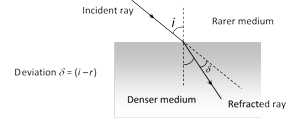 (5) When a ray of light goes from a denser medium to a rarer medium, it bends away from the normal.
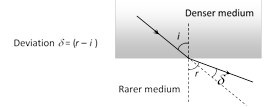 (6) Snell's law : The ratio of sine of the angle of incidence to the angle of refraction (r) is a constant called refractive index
i.e. \[\frac{\text{sin }i}{\text{sin }r}=\mu \] (a constant). For two media, Snell's law can be written as \[_{1}{{\mu }_{2}}=\frac{{{\mu }_{2}}}{{{\mu }_{1}}}=\frac{\sin i}{\sin r}\]
\[\Rightarrow \]\[{{\mu }_{1}}\times \sin i={{\mu }_{2}}\times \sin r\] i.e. \[\mu \sin \theta =\] constant
Also in vector form : \[\hat{i}\times \hat{n}=\mu \,\mathbf{(}\hat{r}\times \hat{n}\mathbf{)}\]
(6) Snell's law : The ratio of sine of the angle of incidence to the angle of refraction (r) is a constant called refractive index
i.e. \[\frac{\text{sin }i}{\text{sin }r}=\mu \] (a constant). For two media, Snell's law can be written as \[_{1}{{\mu }_{2}}=\frac{{{\mu }_{2}}}{{{\mu }_{1}}}=\frac{\sin i}{\sin r}\]
\[\Rightarrow \]\[{{\mu }_{1}}\times \sin i={{\mu }_{2}}\times \sin r\] i.e. \[\mu \sin \theta =\] constant
Also in vector form : \[\hat{i}\times \hat{n}=\mu \,\mathbf{(}\hat{r}\times \hat{n}\mathbf{)}\] Current Affairs CategoriesArchive
Trending Current Affairs


You need to login to perform this action. |