
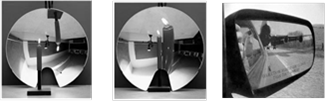
 Concave mirror : Image formed by concave mirror may be real or virtual, may be inverted or erect, may be smaller, larger or equal in size of object.
(1) When object is placed at infinite (i.e. \[u=\infty \])
Image
Concave mirror : Image formed by concave mirror may be real or virtual, may be inverted or erect, may be smaller, larger or equal in size of object.
(1) When object is placed at infinite (i.e. \[u=\infty \])
Image
 \[\to \] At F
\[\to \] Real
\[\to \] Inverted
\[\to \] Very small in size
\[\to \] Magnification \[m<<-1\]
(2) When object is placed between infinite and centre of curvature (i.e. \[u>2f\])
Image
\[\to \] At F
\[\to \] Real
\[\to \] Inverted
\[\to \] Very small in size
\[\to \] Magnification \[m<<-1\]
(2) When object is placed between infinite and centre of curvature (i.e. \[u>2f\])
Image
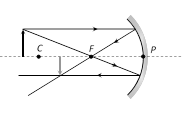 \[\to \] Between F and C
\[\to \] Real
\[\to \] Inverted
\[\to \] Small in size \[m<-1\]
(3) When object is placed at centre of curvature (i.e. \[u=2f\])
Image
\[\to \] Between F and C
\[\to \] Real
\[\to \] Inverted
\[\to \] Small in size \[m<-1\]
(3) When object is placed at centre of curvature (i.e. \[u=2f\])
Image
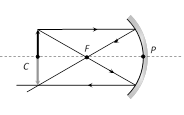 \[\to \] At C
\[\to \] Real
\[\to \] Inverted
\[\to \] Equal in size \[m=-1\]
(4) When object is placed between centre of curvature and focus (i.e. \[f<u<2f\])
Image
\[\to \] At C
\[\to \] Real
\[\to \] Inverted
\[\to \] Equal in size \[m=-1\]
(4) When object is placed between centre of curvature and focus (i.e. \[f<u<2f\])
Image
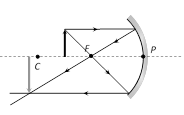 \[\to \] Between 2f and \[\infty \]
\[\to \] Real
\[\to \] Inverted
\[\to \] Large in size
\[m>-1\]
(5) When object is placed at focus (i.e. \[u=f\])
Image
\[\to \] Between 2f and \[\infty \]
\[\to \] Real
\[\to \] Inverted
\[\to \] Large in size
\[m>-1\]
(5) When object is placed at focus (i.e. \[u=f\])
Image
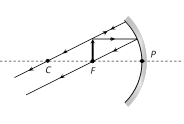 \[\to \] At \[\infty \]
\[\to \] Real
\[\to \] Inverted
\[\to \] Very large in size
\[m>>-1\]
(6) When object is placed between focus and pole (i.e. u < f)
Image
\[\to \] At \[\infty \]
\[\to \] Real
\[\to \] Inverted
\[\to \] Very large in size
\[m>>-1\]
(6) When object is placed between focus and pole (i.e. u < f)
Image
 \[\to \] Behind the mirror
\[\to \] Virtual
\[\to \] Erect
\[\to \] Large in size \[m>+1\]
Convex mirror : Image formed by convex mirror is always virtual, erect and smaller in size.
(1) When object is placed at infinite (i.e. \[u=\infty \])
Image
\[\to \] Behind the mirror
\[\to \] Virtual
\[\to \] Erect
\[\to \] Large in size \[m>+1\]
Convex mirror : Image formed by convex mirror is always virtual, erect and smaller in size.
(1) When object is placed at infinite (i.e. \[u=\infty \])
Image
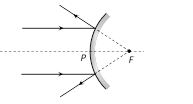 \[\to \] At F
\[\to \] Virtual
\[\to \] Erect
\[\to \] Very small in size
\[\to \]Magnification \[m<<+1\]
(2) When object is placed any where on the principal axis
Image
\[\to \] At F
\[\to \] Virtual
\[\to \] Erect
\[\to \] Very small in size
\[\to \]Magnification \[m<<+1\]
(2) When object is placed any where on the principal axis
Image
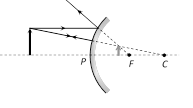 \[\to \] Between P and F
\[\to \] Virtual
\[\to \] Erect
\[\to \] Small in size
\[\to \] Magnification \[m<+1\]
\[\to \] Between P and F
\[\to \] Virtual
\[\to \] Erect
\[\to \] Small in size
\[\to \] Magnification \[m<+1\]  Concave mirror converges the light rays and used as a shaving mirror, In search light, in cinema projector, in telescope, by E.N.T. specialists etc.
Convex mirror diverges the light rays and used in road lamps, side mirror in vehicles etc.
(1) Terminology
(i) Pole (P) : Mid point of the mirror
(ii) Centre of curvature (C) : Centre of the sphere of which the mirror is a part.
(iii) Radius of curvature (R): Distance between pole and centre of curvature. \[({{R}_{\,\text{concave}}}=ve,~{{R}_{\,\text{convex}}}=+ve,~{{R}_{\,\text{plane}}}=\,\infty )\]
(iv) Principle axis : A line passing through P and C.
(v) Focus (F) : An image point on principle axis for an object at \[\infty \].
(vi) Focal length (f) : Distance between P and F.
(vii) Relation between f and R: \[f=\frac{R}{2}\] \[({{f}_{\text{concave}}}=ve,{{f}_{\text{convex}}}=+ve,{{f}_{\text{plane}}}=\,\,\infty )\]
(viii) Power : The converging or diverging ability of mirror
(ix) Aperture : Effective diameter of light reflecting area. Intensity of image \[\propto \] Area \[\propto \] (Aperture)\[^{2}\]
(x) Focal plane : A plane passing from focus and perpendicular to principle axis.
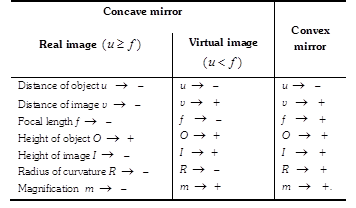
(2) Sign conventions :
Concave mirror converges the light rays and used as a shaving mirror, In search light, in cinema projector, in telescope, by E.N.T. specialists etc.
Convex mirror diverges the light rays and used in road lamps, side mirror in vehicles etc.
(1) Terminology
(i) Pole (P) : Mid point of the mirror
(ii) Centre of curvature (C) : Centre of the sphere of which the mirror is a part.
(iii) Radius of curvature (R): Distance between pole and centre of curvature. \[({{R}_{\,\text{concave}}}=ve,~{{R}_{\,\text{convex}}}=+ve,~{{R}_{\,\text{plane}}}=\,\infty )\]
(iv) Principle axis : A line passing through P and C.
(v) Focus (F) : An image point on principle axis for an object at \[\infty \].
(vi) Focal length (f) : Distance between P and F.
(vii) Relation between f and R: \[f=\frac{R}{2}\] \[({{f}_{\text{concave}}}=ve,{{f}_{\text{convex}}}=+ve,{{f}_{\text{plane}}}=\,\,\infty )\]
(viii) Power : The converging or diverging ability of mirror
(ix) Aperture : Effective diameter of light reflecting area. Intensity of image \[\propto \] Area \[\propto \] (Aperture)\[^{2}\]
(x) Focal plane : A plane passing from focus and perpendicular to principle axis.
(2) Sign conventions :
 (i) All distances are measured from the pole.
(ii) Distances measured in the direction of incident rays are taken as positive while in the direction opposite of incident rays are taken negative.
(iii) Distances above the principle axis are taken positive and below the principle axis are taken negative.
Useful sign
(i) All distances are measured from the pole.
(ii) Distances measured in the direction of incident rays are taken as positive while in the direction opposite of incident rays are taken negative.
(iii) Distances above the principle axis are taken positive and below the principle axis are taken negative.
Useful sign
 .
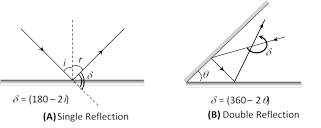
. 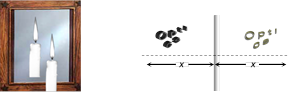 (1) Deviation \[(\delta )\]: Deviation produced by a plane mirror and by two inclined plane mirrors.
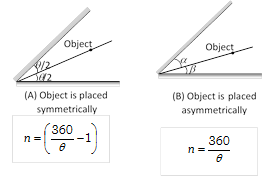
 (2) Images by two inclined plane mirrors : When two plane mirrors are inclined to each other at an angle \[\theta ,\] then number of images (n) formed of an object which is kept between them.
(i) \[n=\left( \frac{{{360}^{o}}}{\theta }-1 \right)\]; If \[\frac{{{360}^{o}}}{\theta }=\]even integer
(ii) If \[\frac{{{360}^{o}}}{\theta }=\] odd integer then there are two possibilities
(2) Images by two inclined plane mirrors : When two plane mirrors are inclined to each other at an angle \[\theta ,\] then number of images (n) formed of an object which is kept between them.
(i) \[n=\left( \frac{{{360}^{o}}}{\theta }-1 \right)\]; If \[\frac{{{360}^{o}}}{\theta }=\]even integer
(ii) If \[\frac{{{360}^{o}}}{\theta }=\] odd integer then there are two possibilities
 (3) Other important informations
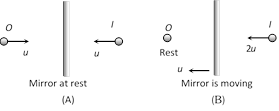
(i) When the object moves with speed u towards (or away) from the plane mirror then image also moves towards (or away) with speed u. But relative speed of image w.r.t. object is 2u.
(ii) When mirror moves towards the stationary object with speed u, the image will move with speed 2u in same direction as that of mirror.
(3) Other important informations
(i) When the object moves with speed u towards (or away) from the plane mirror then image also moves towards (or away) with speed u. But relative speed of image w.r.t. object is 2u.
(ii) When mirror moves towards the stationary object with speed u, the image will move with speed 2u in same direction as that of mirror.
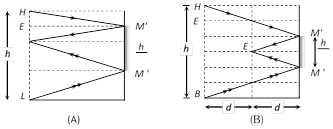
 (iii) A man of height h requires a mirror of length at least equal to h/2, to see his own complete image.
(iv) To see complete wall behind himself a person requires a plane mirror of at least one third the height of wall. It should be noted that person is standing in the middle of the room.
(iii) A man of height h requires a mirror of length at least equal to h/2, to see his own complete image.
(iv) To see complete wall behind himself a person requires a plane mirror of at least one third the height of wall. It should be noted that person is standing in the middle of the room.
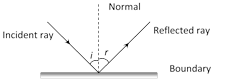 (1) \[\angle i=\angle r\]
(2) After reflection, velocity, wave length and frequency of light remains same but intensity decreases.
(3) There is a phase change of \[\pi \] if reflection takes place from denser medium.
(1) \[\angle i=\angle r\]
(2) After reflection, velocity, wave length and frequency of light remains same but intensity decreases.
(3) There is a phase change of \[\pi \] if reflection takes place from denser medium. 
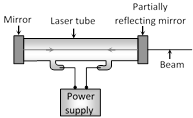 Because of the energy-level structure for helium, collisions often excite helium atoms to the level labeled \[{{E}_{3}}\] in the figure. In a process called collision transfer, energy is transferred from excited helium atoms to neon atoms during collisions, thus producing a population of neon atoms in the \[{{E}_{2}}\] level. The transition from level \[{{E}_{2}}\] to \[{{E}_{1}}\] in neon is forbidden, but the transition out of the \[{{E}_{1}}\] level is allowed. This means that the population of atoms in the \[{{E}_{2}}\] level builds up, and that of the \[{{E}_{1}}\] level is rapidly depleted.
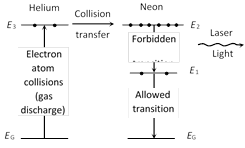 Stimulated emission from \[{{E}_{2}}\] to \[{{E}_{1}}\] predominates and laser light is generated.
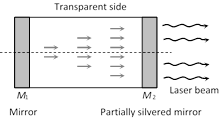
The mirrors at each end of the tube encourage emissions along the tube axis by reflecting the light back and forth inside the tube. One of the mirrors is slightly leaky, transmitting about 1 percent of the incident light. This transmitted light forms the laser beam which we find so useful.
Stimulated emission from \[{{E}_{2}}\] to \[{{E}_{1}}\] predominates and laser light is generated.
The mirrors at each end of the tube encourage emissions along the tube axis by reflecting the light back and forth inside the tube. One of the mirrors is slightly leaky, transmitting about 1 percent of the incident light. This transmitted light forms the laser beam which we find so useful. 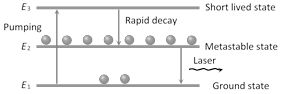 Atoms from the ground state \[{{E}_{1}}\] are 'pumped' up to an excited state \[{{E}_{3}}\]. From \[{{E}_{3}}\] the atom decay rapidly to state of energy \[{{E}_{2}}\]. For lasing (lasing means laser action) to occur, this state must be metastable. If conditions are right, state \[{{E}_{2}}\] can then become more heavily populated than state \[{{E}_{1}}\], thus providing the needed population inversion.
When photon of energy \[h\nu ={{E}_{2}}-{{E}_{1}}\] is incident on one of the atoms present in the metastable state, the atom will drop to lower energy state \[{{E}_{1}}\], emitting a photon of same energy as that of the incident photon, which is in phase with it and is emitted in the same direction. The two photons, then interact with two more atoms present in metastable state and so on. This process is called amplification of light.
For smooth process two conditions are necessary
(1) The metastable state should all the time have larger number of atoms than the number of atoms in lower energy state.
(It is achieved by pumping)
(2) The photons emitted due to stimulated emission should stimulate other atoms to multiply the photons inside the system.
(It is achieved by two mirrors are fixed at the ends of the system containing lasing material. The mirrors reflect the photons back and forth to keep them inside the region for a long time.)
Atoms from the ground state \[{{E}_{1}}\] are 'pumped' up to an excited state \[{{E}_{3}}\]. From \[{{E}_{3}}\] the atom decay rapidly to state of energy \[{{E}_{2}}\]. For lasing (lasing means laser action) to occur, this state must be metastable. If conditions are right, state \[{{E}_{2}}\] can then become more heavily populated than state \[{{E}_{1}}\], thus providing the needed population inversion.
When photon of energy \[h\nu ={{E}_{2}}-{{E}_{1}}\] is incident on one of the atoms present in the metastable state, the atom will drop to lower energy state \[{{E}_{1}}\], emitting a photon of same energy as that of the incident photon, which is in phase with it and is emitted in the same direction. The two photons, then interact with two more atoms present in metastable state and so on. This process is called amplification of light.
For smooth process two conditions are necessary
(1) The metastable state should all the time have larger number of atoms than the number of atoms in lower energy state.
(It is achieved by pumping)
(2) The photons emitted due to stimulated emission should stimulate other atoms to multiply the photons inside the system.
(It is achieved by two mirrors are fixed at the ends of the system containing lasing material. The mirrors reflect the photons back and forth to keep them inside the region for a long time.)
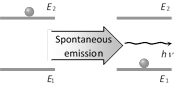
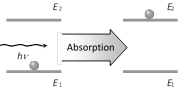 (2) Spontaneous emission : If an atom is present in the higher energy state, it tends to return to the lower energy state within a time of \[{{10}^{-8}}\] sec by emitting a photon of energy \[hv={{E}_{2}}-{{E}_{1}}\]. We call this process spontaneous emission. Spontaneous because the event was not triggered by any outside influence.
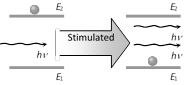
 (3) Stimulated emission : Suppose a photon of energy \[hv={{E}_{2}}-{{E}_{1}}\] interacts with an atom that is already in the excited state \[{{E}_{2}}\].
The incident photon may stimulate the atom to emit a photon, the energy, phase, and direction of travel of this second photon are exactly the same as those of the incident photon. That is the quantum state of the stimulated photon is identical to that of the incident photon. This process is called stimulated emission.
If these two photons then interact with two more excited state atoms, two more photons are produced, and soon. Therefore, the stimulation process leads to photon amplification.
(3) Stimulated emission : Suppose a photon of energy \[hv={{E}_{2}}-{{E}_{1}}\] interacts with an atom that is already in the excited state \[{{E}_{2}}\].
The incident photon may stimulate the atom to emit a photon, the energy, phase, and direction of travel of this second photon are exactly the same as those of the incident photon. That is the quantum state of the stimulated photon is identical to that of the incident photon. This process is called stimulated emission.
If these two photons then interact with two more excited state atoms, two more photons are produced, and soon. Therefore, the stimulation process leads to photon amplification.
 (4) Population inversion : Usually the number of atoms in the lower energy state is more than the number of atoms in the excited state. To emit photons which are coherent (i.e. in phase), the number of atoms in the higher state must be greater than the number of atoms in the lower energy state. In other words, population of atoms in the higher energy state must be larger than the population of atoms in the lower energy state. The process of making the population of atoms in the higher energy state more than that of lower energy state is known as population inversion.
The method used to invert the population of atoms is known as pumping.
(5) Metastable states : A metastable state is one, which has a mean life time of the order of \[{{10}^{-3}}\,s\] or more i.e. much larger than \[{{10}^{-8}}\,s\], the life time of a higher energy state. Some atomic systems, such as chromium, neon, etc possess metastable states. The atom of such an atomic system, when in higher energy state, does not come down to lower energy state directly. It first returns to metastable state and then after a finite lapse of time of the order of \[{{10}^{-3}}\,s\], returns to the lower energy state. Since such atom stays in metastable state for a sufficiently long time, the population inversion can sustain in such atomic system.
A system in which population inversion is achieved more...
(4) Population inversion : Usually the number of atoms in the lower energy state is more than the number of atoms in the excited state. To emit photons which are coherent (i.e. in phase), the number of atoms in the higher state must be greater than the number of atoms in the lower energy state. In other words, population of atoms in the higher energy state must be larger than the population of atoms in the lower energy state. The process of making the population of atoms in the higher energy state more than that of lower energy state is known as population inversion.
The method used to invert the population of atoms is known as pumping.
(5) Metastable states : A metastable state is one, which has a mean life time of the order of \[{{10}^{-3}}\,s\] or more i.e. much larger than \[{{10}^{-8}}\,s\], the life time of a higher energy state. Some atomic systems, such as chromium, neon, etc possess metastable states. The atom of such an atomic system, when in higher energy state, does not come down to lower energy state directly. It first returns to metastable state and then after a finite lapse of time of the order of \[{{10}^{-3}}\,s\], returns to the lower energy state. Since such atom stays in metastable state for a sufficiently long time, the population inversion can sustain in such atomic system.
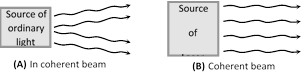
A system in which population inversion is achieved more... 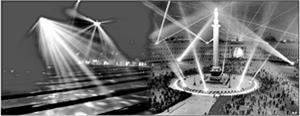 Laser is a process by which we get a beam which is coherent, highly monochromatic and almost perfectly parallel. Such a beam is also called laser.
| Coherent : | Because all the photons in the light beam, emitted by different atoms, at different instant are in phase. |
| Monochromatic : | Because, the spread \[\Delta \lambda \] in wavelength is very small, of the order of \[{{10}^{-6}}nm\]. |
| Perfectly parallel : | Because, a laser beam can be sent to a far off place and returns back without any practical loss of intensity. |

You need to login to perform this action.
You will be redirected in
3 sec