
 Transparent Sheet
(a)
Transparent Sheet
(a)  (b)
(b)  (c)
(c)  (d)
(d)  Explanation (c):
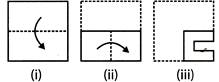
It is clear that the lower half of the sheet is folded over the upper half.
The resultant design would be the combination of the design in upper half and the water image of the design in the lower half.
2. The three figures (i), (ii) and (iii) shows a sequence of folding a sheet of paper. Figure (iii) shows the manner in which the folded paper has been cut out. If then the sheet is unfolded, which of the option figures (a), (b), (c), (d) would show the unfolded form?
Explanation (c):
It is clear that the lower half of the sheet is folded over the upper half.
The resultant design would be the combination of the design in upper half and the water image of the design in the lower half.
2. The three figures (i), (ii) and (iii) shows a sequence of folding a sheet of paper. Figure (iii) shows the manner in which the folded paper has been cut out. If then the sheet is unfolded, which of the option figures (a), (b), (c), (d) would show the unfolded form?
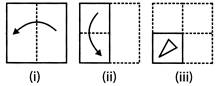 (a)
(a)  (b)
(b)  (c)
(c)  (d)
(d)  Explanation (d):
In figure (i) the right half of the sheet is put over the left half. In figure (ii), the upper half of the sheet is put over the lower half of the sheet to form a quarter.
In the third figure, a triangle is punched out.
Consequently the triangle will be created in each quarter of the sheet. In the upper half of the unfolded sheet, the two punched triangles have a horizontal line of symmetry (as a mirror).
The same is for left and right halves of the sheet.
3. A set of three figures (i), (ii), (Hi) is showing a sequence of folding of a piece of paper. Fig. (iii) shows the manner in which the folded paper has been cut. The three figures are followed by four answer figures from which you have to choose a figure which would most closely resemble the unfolded form of fig. (iii).
Explanation (d):
In figure (i) the right half of the sheet is put over the left half. In figure (ii), the upper half of the sheet is put over the lower half of the sheet to form a quarter.
In the third figure, a triangle is punched out.
Consequently the triangle will be created in each quarter of the sheet. In the upper half of the unfolded sheet, the two punched triangles have a horizontal line of symmetry (as a mirror).
The same is for left and right halves of the sheet.
3. A set of three figures (i), (ii), (Hi) is showing a sequence of folding of a piece of paper. Fig. (iii) shows the manner in which the folded paper has been cut. The three figures are followed by four answer figures from which you have to choose a figure which would most closely resemble the unfolded form of fig. (iii).
 more...
  (a) 1, 8, 9; 4, 6, 7; 1, 3, 5
(b) 2, 5, 9; 1, 3, 8; 4, 6, 7
(c) 1, 5, 8; 4, 6, 7; 2, 3, 9
(d) 1, 3, 9; 2, 5, 8; 4, 6, 7
Explanation (c):
1, 5, 8 : Each open figure is bisected by a line segment.
4, 6, 7 : A line segment is additionally added to each closed figure.
2, 3, 9 : Each closed figure is intersected by a line segment.
(a) 1, 8, 9; 4, 6, 7; 1, 3, 5
(b) 2, 5, 9; 1, 3, 8; 4, 6, 7
(c) 1, 5, 8; 4, 6, 7; 2, 3, 9
(d) 1, 3, 9; 2, 5, 8; 4, 6, 7
Explanation (c):
1, 5, 8 : Each open figure is bisected by a line segment.
4, 6, 7 : A line segment is additionally added to each closed figure.
2, 3, 9 : Each closed figure is intersected by a line segment. 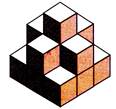 (a) 8 (b) 9 (c) 12 (d) 15
Explanation (d):
There are 4, 4 and 1 columns each containing 1, 2 and 3 cubes respectively.
So number all possible cubes \[=\left( 4\times 1 \right)+\left( 4\times 2 \right)+\left( 1\times 3 \right)=15.\]
Type-II (Construction of boxes)
In such type of problems a net of a cube or cuboid is given and a student is asked to identify the cube or cuboid formed from this net.
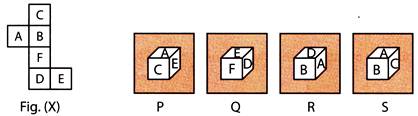
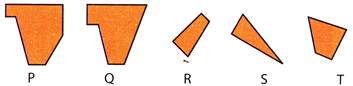
2. A sheet of paper is given in Fig. (X) which has to be folded to form a box.
Choose a box from amongst the alternatives, that is similar to the boxes formed.
(a) 8 (b) 9 (c) 12 (d) 15
Explanation (d):
There are 4, 4 and 1 columns each containing 1, 2 and 3 cubes respectively.
So number all possible cubes \[=\left( 4\times 1 \right)+\left( 4\times 2 \right)+\left( 1\times 3 \right)=15.\]
Type-II (Construction of boxes)
In such type of problems a net of a cube or cuboid is given and a student is asked to identify the cube or cuboid formed from this net.
2. A sheet of paper is given in Fig. (X) which has to be folded to form a box.
Choose a box from amongst the alternatives, that is similar to the boxes formed.
 (a) S only (b) Q and S only (c) P and R only (d) R only
Explanation (b):
The opposite faces of the box so formed are: A and E, B and D, C and F.
The option (b) fulfills this condition.
Type-III (Problems on Dice faces)
In such type of problems the same dice is shown in various positions.
A student is required to observe these positions and then answer the given question.
3. The four different positions of a dice are given below.
How many dots are there on the face opposite the face with three dots?
(a) S only (b) Q and S only (c) P and R only (d) R only
Explanation (b):
The opposite faces of the box so formed are: A and E, B and D, C and F.
The option (b) fulfills this condition.
Type-III (Problems on Dice faces)
In such type of problems the same dice is shown in various positions.
A student is required to observe these positions and then answer the given question.
3. The four different positions of a dice are given below.
How many dots are there on the face opposite the face with three dots?
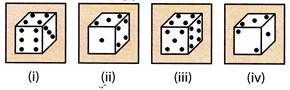 (a) 2 (b) 4 (c) 5 (d) 6
Explanation (c):
From figures (i), (ii) and (iv), we conclude that 6, 4, 1 and 2 dots appear adjacent to 3 dots.
Clearly, there will be 5 dots on the face opposite the face with 3 dots.
(a) 2 (b) 4 (c) 5 (d) 6
Explanation (c):
From figures (i), (ii) and (iv), we conclude that 6, 4, 1 and 2 dots appear adjacent to 3 dots.
Clearly, there will be 5 dots on the face opposite the face with 3 dots. 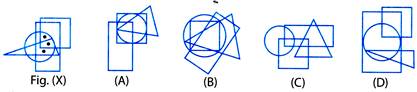 Explanation (b):
We required three regions one common to all the four figures, another common to all the figures except square and the third common to all the figures except triangle. Let us confirm all these three regions in alternative (b) with placement of dots as given below:
Explanation (b):
We required three regions one common to all the four figures, another common to all the figures except square and the third common to all the figures except triangle. Let us confirm all these three regions in alternative (b) with placement of dots as given below:

 (a) QRT (b) PST (c) QRS (d) PRS
Explanation (c):
(a) QRT (b) PST (c) QRS (d) PRS
Explanation (c):

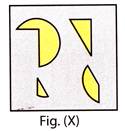 (A)
(A)  (B)
(B)  (c)
(c)  (D)
(D)  Explanation (c):
Joining the four pieces in Fig. (X), we get the following figure:
Explanation (c):
Joining the four pieces in Fig. (X), we get the following figure:

| Marks | Tally Marks | Frequency |
| 28 | \[|\] | 1 |
| 31 | \[||\] | 2 |
| 32 | \[|\] | 1 |
more...
 Introduction
There are different types of figures. Figures are classified by its shapes and sizes.area of a geometrical figure is its total surface area while the volume is the spaceoccupied by the object. Area and volume of everything can be obtained. In this chapter, we will learn about the area and volume of some common shapeswhich are also known as the geometrical figures. Introduction
There are different types of figures. Figures are classified by its shapes and sizes.area of a geometrical figure is its total surface area while the volume is the spaceoccupied by the object. Area and volume of everything can be obtained. In this chapter, we will learn about the area and volume of some common shapeswhich are also known as the geometrical figures.  Perimeter and Area of Plane Figures
Perimeter of every figure is sum of its sides. The perimetre of a rectangular room is the sum of measurement of all sides where the area of a rectangle is the product of their sides. Therefore, the sum of the length of all the sides of a geometrical shape is called perimetre. Sl unit for measurement of perimetre is meter and Sl unit of area is square metre. Perimeter and Area of Plane Figures
Perimeter of every figure is sum of its sides. The perimetre of a rectangular room is the sum of measurement of all sides where the area of a rectangle is the product of their sides. Therefore, the sum of the length of all the sides of a geometrical shape is called perimetre. Sl unit for measurement of perimetre is meter and Sl unit of area is square metre.
 Perimeter and Area of Triangles
A triangle is one of the basic shapes of geometry. It has three vertices and three sides. Perimetre of triangle = Sum of the length of sides. Area of right angle triangle \[~=\frac{1}{2}\times Base\times Height\]
1. In the picture given below, ABC is a triangle whose sides are, AB, BC and AC. A perpendicular line AD is the height or altitude of the triangle. A square box at point D denotes the angle of \[{{90}^{o}}.\] Perimeter and Area of Triangles
A triangle is one of the basic shapes of geometry. It has three vertices and three sides. Perimetre of triangle = Sum of the length of sides. Area of right angle triangle \[~=\frac{1}{2}\times Base\times Height\]
1. In the picture given below, ABC is a triangle whose sides are, AB, BC and AC. A perpendicular line AD is the height or altitude of the triangle. A square box at point D denotes the angle of \[{{90}^{o}}.\]
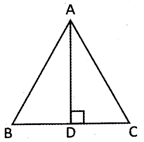 Perimeter of \[=AB+BC+CA.\]of its sides \[=AB+BC+CA.\] Area of \[\Delta ABC\,=\,\frac{1}{2}\times BC\times AD\] whereas BC is the base of the triangle and AD altitude.
 Find the area and perimetre of the figure given below?
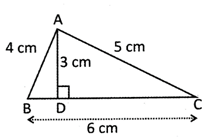 (a) \[8\text{ }c{{m}^{2}},15\text{ }cm\]
(b) \[~9\text{ }c{{m}^{2}},15\text{ }cm\]
(c) \[10\text{ }c{{m}^{2}},\text{ }8\text{ }cm\]
(d) All of these
(e) None of these
Answer: (b)
Explanation
Perimeter of \[\Delta ABC\]= Sum of its sides = AB + BC + CA= 4 cm + 6 cm + 5 cm = 15 cm Therefore, perimeter of \[\Delta ABC\text{ }=\text{ }15\text{ }cm\] Area of \[\Delta ABC=\frac{1}{2}BC\times AD\]whereas BC is the base of the triangle and AD is altitude. \[~\Delta ABC\text{ }=\text{ }9\text{ }c{{m}^{2}}\] The area of\[~\Delta ABC\text{ }=\text{ }9\text{ }c{{m}^{2}}\]
2. In the picture given below, a triangle has three equal sides, AB = BC = CA = a unit. Therefore, the triangle ABC is called equilateral triangle.
(a) \[8\text{ }c{{m}^{2}},15\text{ }cm\]
(b) \[~9\text{ }c{{m}^{2}},15\text{ }cm\]
(c) \[10\text{ }c{{m}^{2}},\text{ }8\text{ }cm\]
(d) All of these
(e) None of these
Answer: (b)
Explanation
Perimeter of \[\Delta ABC\]= Sum of its sides = AB + BC + CA= 4 cm + 6 cm + 5 cm = 15 cm Therefore, perimeter of \[\Delta ABC\text{ }=\text{ }15\text{ }cm\] Area of \[\Delta ABC=\frac{1}{2}BC\times AD\]whereas BC is the base of the triangle and AD is altitude. \[~\Delta ABC\text{ }=\text{ }9\text{ }c{{m}^{2}}\] The area of\[~\Delta ABC\text{ }=\text{ }9\text{ }c{{m}^{2}}\]
2. In the picture given below, a triangle has three equal sides, AB = BC = CA = a unit. Therefore, the triangle ABC is called equilateral triangle.
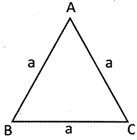 Perimeter of an equilateral triangle = AB + BC + CA \[=\text{ }Side\text{ }+\text{ }Side\text{ }+\text{ }Side\text{ }=\text{ }3\text{ }\times \text{ }Side\]
Therefore the perimetre of an equilateral triangle \[=3\times Side=\text{3}\times a\] Area of an equilateral triangle \[=\frac{\sqrt{3}}{4}\times {{(side)}^{2}}=\frac{\sqrt{3}}{4}\times {{a}^{2}}\]
Find the area of an equilateral triangle whose each side is 6 cm long?
(a) \[6\sqrt{3}\,\,c{{m}^{2}}\]
(b) \[8\sqrt{3}\,\,c{{m}^{2}}\]
(c) \[9\sqrt{3}\,\,c{{m}^{2}}\]
(d) All of these
(e) None of these
Answer: (c)
Explanation
The length of each side of the triangle is 6 cm therefore, it will be the equilateral triangle. Hence the area of the equilateral triangle =
\[\frac{\sqrt{3}}{4}\times {{(side)}^{2}}=\frac{\sqrt{3}}{4}\times 6\times 69\sqrt{3}\,\,c{{m}^{2}}.\]
Perimeter and Area of Parallelogram
Parallelogram is a quadrilateral more...
Perimeter of an equilateral triangle = AB + BC + CA \[=\text{ }Side\text{ }+\text{ }Side\text{ }+\text{ }Side\text{ }=\text{ }3\text{ }\times \text{ }Side\]
Therefore the perimetre of an equilateral triangle \[=3\times Side=\text{3}\times a\] Area of an equilateral triangle \[=\frac{\sqrt{3}}{4}\times {{(side)}^{2}}=\frac{\sqrt{3}}{4}\times {{a}^{2}}\]
Find the area of an equilateral triangle whose each side is 6 cm long?
(a) \[6\sqrt{3}\,\,c{{m}^{2}}\]
(b) \[8\sqrt{3}\,\,c{{m}^{2}}\]
(c) \[9\sqrt{3}\,\,c{{m}^{2}}\]
(d) All of these
(e) None of these
Answer: (c)
Explanation
The length of each side of the triangle is 6 cm therefore, it will be the equilateral triangle. Hence the area of the equilateral triangle =
\[\frac{\sqrt{3}}{4}\times {{(side)}^{2}}=\frac{\sqrt{3}}{4}\times 6\times 69\sqrt{3}\,\,c{{m}^{2}}.\]
Perimeter and Area of Parallelogram
Parallelogram is a quadrilateral more...  Volume of Geometrical Figures
A solid has capacity to acquire space.
The space occupied by a solid is called its volume. Sl unit of volume\[~={{m}^{3}}\]
If the volume of a cube is \[1{{m}^{3}},1{{m}^{3}}\] is the space occupied by a cube of sides 1m.
If the volume of the solid is 6 cm3 it means it occupies the space six times of the volume,\[~1c{{m}^{3}}\]
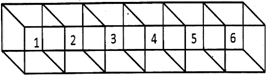
In the picture given below six shapes are combined to each other and length, width and height of every figure is 1 cm, therefore, the total length of the entire picture is 6 cm and width and height is 1cm, hence the volume of the entire picture is six times of the volume of every one. Volume of Geometrical Figures
A solid has capacity to acquire space.
The space occupied by a solid is called its volume. Sl unit of volume\[~={{m}^{3}}\]
If the volume of a cube is \[1{{m}^{3}},1{{m}^{3}}\] is the space occupied by a cube of sides 1m.
If the volume of the solid is 6 cm3 it means it occupies the space six times of the volume,\[~1c{{m}^{3}}\]
In the picture given below six shapes are combined to each other and length, width and height of every figure is 1 cm, therefore, the total length of the entire picture is 6 cm and width and height is 1cm, hence the volume of the entire picture is six times of the volume of every one.
 Cube
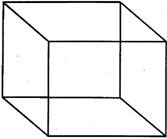
The solid figure whose all sides or edges are equal is called cube. In the picture given below the edges of the cube are equal. Cube
The solid figure whose all sides or edges are equal is called cube. In the picture given below the edges of the cube are equal.
 Features of the Cube
(i) A cube has 6 surfaces and shape of every surface is equal.
(ii) A cube has 12 equal edges called sides.
(iii) It has 8 vertices.
Therefore, formula the total surface area of Cube \[=6\times sid{{e}^{2}}\]
Lateral surface area of Cube \[=\text{ }4\times sid{{e}^{2}}\]
Volume of cube = side x side x side = \[{{\left( side \right)}^{3}}\]
Features of the Cube
(i) A cube has 6 surfaces and shape of every surface is equal.
(ii) A cube has 12 equal edges called sides.
(iii) It has 8 vertices.
Therefore, formula the total surface area of Cube \[=6\times sid{{e}^{2}}\]
Lateral surface area of Cube \[=\text{ }4\times sid{{e}^{2}}\]
Volume of cube = side x side x side = \[{{\left( side \right)}^{3}}\]
 Find the surface area of a cube whose side is 14 cm.
(a) \[1170c{{m}^{2~}}\]
(b) \[1175c{{m}^{2}}\]
(c) \[1176c{{m}^{2}}\]
(d) All of these
(e) None of these
Answer: (c)
Explanation
Side = 14 cm Surface area of a cube \[=6\times {{\text{(}side\text{)}}^{2}}\]
\[=6\times {{(14)}^{2}}c{{m}^{2}}\] \[=6\times 196\text{ }c{{m}^{2}}\]
\[=1176\text{ }c{{m}^{2}}\]
Cuboid
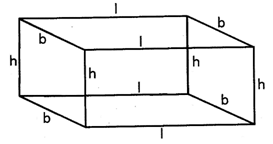
A solid made up of 6 rectangular surfaces is called cuboid. Match box is the example of a cuboid. In the picture given below I is length, b is breadth and h is the height of the cuboid.
Find the surface area of a cube whose side is 14 cm.
(a) \[1170c{{m}^{2~}}\]
(b) \[1175c{{m}^{2}}\]
(c) \[1176c{{m}^{2}}\]
(d) All of these
(e) None of these
Answer: (c)
Explanation
Side = 14 cm Surface area of a cube \[=6\times {{\text{(}side\text{)}}^{2}}\]
\[=6\times {{(14)}^{2}}c{{m}^{2}}\] \[=6\times 196\text{ }c{{m}^{2}}\]
\[=1176\text{ }c{{m}^{2}}\]
Cuboid
A solid made up of 6 rectangular surfaces is called cuboid. Match box is the example of a cuboid. In the picture given below I is length, b is breadth and h is the height of the cuboid.
 Features of cuboid
(i) A cuboid has 6 rectangular surfaces.
(ii) It has 12 edges.
(iii) A cuboid has 8 vertices.
Therefore the total surface area of a cuboid = Sum of the surface area of its 6rectangular faces
\[=\text{l}\times b\text{ }+\text{l}\times b\text{ }+\text{ }b\times h+b\times h+\text{l}\times \text{ }h\text{ }+\text{ l}\times h\]\[=21b+2bh+21h\]
Therefore the total surface area of cuboid \[=2\left( lb+bh+lh \right)\]
Area of four walls of a cuboid = 2 (breadth \[\times \] height + length \[\times \] height)
Area of four walls of a cuboid \[=2(bh+Ih)\]
Area of four walls of a cuboid \[=2h(l+b)\]
The lateral surface area of a cuboid = The total surface area of four walls.
Volume of cuboid = length \[\times \] breath \[\times \] height \[=l\times b\times h=lbh.\]
more...
Features of cuboid
(i) A cuboid has 6 rectangular surfaces.
(ii) It has 12 edges.
(iii) A cuboid has 8 vertices.
Therefore the total surface area of a cuboid = Sum of the surface area of its 6rectangular faces
\[=\text{l}\times b\text{ }+\text{l}\times b\text{ }+\text{ }b\times h+b\times h+\text{l}\times \text{ }h\text{ }+\text{ l}\times h\]\[=21b+2bh+21h\]
Therefore the total surface area of cuboid \[=2\left( lb+bh+lh \right)\]
Area of four walls of a cuboid = 2 (breadth \[\times \] height + length \[\times \] height)
Area of four walls of a cuboid \[=2(bh+Ih)\]
Area of four walls of a cuboid \[=2h(l+b)\]
The lateral surface area of a cuboid = The total surface area of four walls.
Volume of cuboid = length \[\times \] breath \[\times \] height \[=l\times b\times h=lbh.\]
more... Current Affairs CategoriesArchive
Trending Current Affairs
You need to login to perform this action. |