Current Affairs NEET

  Alcoholism   Regular consumption of alcohol either in low concentration (beer, wine, etc.) or in high concentration (brandy, whisky, rum, gin, Vodka, etc.) causes dependency on alcohol which is called alcoholism. The person who has become a habitual drinker is called an alcoholic.   Ethyl alcohol is consumed as fermented beverages with low content of alcohol (beer, wine, toddy) and as distilled beverages with a relatively high alcohol percentage (brandy, rum, whisky, gin, vodka). This alcohol is rapidly absorbed from the wall of stomach and enters the blood stream within minutes of ingestion. In the liver alcohol is converted into a more toxic substance - acetaldehyde.   The organ which is most affected by alcohol, is Liver. Intoxication begins from the first sip of drink containing alcohol but early signs are not visible. With the increase in its dose the body loses its control. And, gradually, the individual loses his consciousness and in extreme cases death may occur. People who get into the habit of drinking begin with a small dose, but soon many of them become addicted and they start consuming alcohol frequently and in large quantities. When they come to realize that they have become the victims of the hazards of alcohol, then it is too late for them to give up the habit.   Research studies have revealed that the people who resort to drinking offer one or more of the following reasons: (1) Social pressure, (2) Feeling of independence, (3) Liking of the taste, (4) Desire of excitement, (5) Desire to escape from such realities of life as disappointments and failures, and (6) hardships and monotony of everyday life.   When a person drinks alcohol, it passes to the stomach. Some amount of alcohol is also carried to the small intestine. Alcohol is quickly absorbed in the stomach and upper part of small intestine and is transferred to the blood. This blood carries alcohol to the liver. Liver synthesizes fat from alcohol. The excess fat reduces the formation of glycogen, enzymes and structural proteins. The liver is an important centre of carbohydrate, fat and protein metabolism. But due to excess of fat in the liver makes the liver only a store house of fat. From the liver alcohol follows the following route through blood. Liver ® heart ® lungs ® heart ® various body parts (tissues). Its oxidation starts so that a some amount of energy is produced which gives false impression of warmth in the skin.   Many people think that alcohol is a stimulant. But alcohol is not a stimulant. Actually alcohol acts as sedative (lessens functional activity), analgesic (relieves pain) and anesthetic (causes loss of sensation).   (i) Effects of Alcohol: It has been proved that the intake of alcohol affects individual health, family life and ultimately creates several community and social problems. (a) Effects on Individual Health (1) Effect on Nervous System: Many people drink alcohol for more...

  Drug Addiction   (i) Symptoms and Control (a) Drugs: Drugs are normally used for the treatment of diseases. The prolonged use of drugs may lead to the dependence of the body on them. This is drug addiction. Some people without any medical advice, start taking drugs and soon become drug addicts. Certain drugs form habit, but some make the body completely dependent upon them.   (b) Addiction: Some persons are unable to bear tensions or think themselves unable to solve the problems of life or due to certain other curious factors start drinking, smoking and taking certain narcotic drugs and feel relief and peace. Gradually this becomes their habit and they are addicted to these things. Thus addiction can be defined as a physical and mental dependence on any of the above mentioned factors and get temporary relief and feel pleasure. The common factors are:   (c) Drug Addiction: The compounds used for the cure of the diseases are known as drugs. Certain drugs of specific category are nerve stimulants and depressants. Some of the drugs function as sedative and others act as hallucinogens. The regular use of such drugs causes the drug addiction in human and they become habitual of these drugs. Drugs such as aspirin and antihistamines when taken with alcohol may have dangerous effects. Including death.   (ii) Types of Drugs: These are a large number of drugs on which people become dependent. On the basis of their mode of action on the brain, these drugs are of four types: Sedatives and Tranquillisers, Opiate Narcotics, stimulants and hallucinogens. (a) Sedatives and Tranquillizers: These drugs depress the activities of the central nervous system. They give a feeling of calmness, relaxation or drowsiness in the body. Their higher doses induce sleep. Tranquillisers lower tension and anxiety without inducing sleep. Examples: barbiturates and benzodiazephines (e.g., Valium). Barbiturates are synthetic drugs derived from barbituric acid and are called sleeping pills.   (b) Opiate Narcotics: These drugs suppress brain activity and relieve pain. They are called pain killers. Examples opium and its derivatives and some synthetic drugs (e.g., pethidine and methadone). Opium and its Derivatives: Opium is the extract from the unripe capsules of the poppy plant (Papaver somniferum). It has bitter taste. The opium addict loses weight fertility and interest in work. Its derivatives are morphine, codeine and heroin. Opium derivatives immediately reduce respiratory and cardiovascular activity, constricts the pupils of the eye, reduce the visual activity and cause nausea and vomiting. An overdose leads to respiratory arrest and death. If the supply of the drug is not available, the addicts exhibit terrible “with-drawal symptoms” in the form of muscle cramps, running nose, vomiting and epilepsy.   (1) Morphine and Codeine: These are derived from opium. Morphine is a most valuable analgesic but it causes addiction. Codeine is a mild analgesic but causes no addiction so codeine is commonly used in many medicines and cough syrups.   more...

  Mental Health     There is a general feeling that if you are and not ill you are healthy. A truly healthy person is the one who has a sound body, lives in harmony with others, has the ability to face stresses and strains and holds certain moral and spiritual values. Body and mind are intimately related. Any disturbance in one has its effect on the other. Like the body, mind too can become ill. It is estimated that 1 percent of the world population suffers from serious mental illness and 10 percent from mild mental disorders. In India, there are 67million people with incapacitating mental disorders. Characters of Mentally Healthy Person If potential conflicting instinctive drives. A mentally healthy person has (1) Self-respect. (2) Knowledge of one's capabilities and limits. (3) Independent personality but comfortably placed in hierarchy in work, family and society. (4) Feeling of friendship and trust for others. (5) A purposeful life with reasonable goals to achieve. (6) Potential to perform all the daily chores and not dependent on any other person. (7) No tendency in decision making to get swayed away by emotions, fear, anger, love or guilt. (viii) Ability to meet all the demands of life, solving problems as they arise. A mentally sick. Mental illness It is a state of mind in which a person is not able to think, behave and interact with others normally. On set of mental illness is exhibited by (1) Changes in behavior and personality due to abnormality of thoughts, memory, feelings, perception and judgment. (2) Difficulty in adjustment with family members and colleagues. (3) Inability to carry on daily business, with signs of tension, trembling, depression, aggressive behavior, fear, phobia, etc. There is thus social and vocational dyes functioning. Characters of Mentally Sick Person (1) Inability to concentrate. (2) Absence of sound sleep. (3) Worrisome behavior. (4) Short temper. (5) Unhappiness. (6) Mood fluctuations from depression to elation. (7) Tendency to get upset by a change in routine. (8) Apprehensive nature. (9) Bitterness. (10) Dislike of others. (11) Considering others to be wrong. (12) Children getting on nerves. (13) Feeling of pains / aches in different body parts without any actual ones. Types of Mental illness Mental illness can be grouped under three broad categories – psychosis, neurosis and mental disorders. (1) Psychosis / Insanity / Madness: It is a serious type of mental illness in which the patient loses touch with reality. Psychosis may be caused by disease of central nervous system. In some cases it is associated with diabetes, hypertension and tuberculosis. The patient in not aware of illness and refuses to take the treatment. (2) Neurosis: It is less severe form of mental illness where the patient is aware of the problem and tries to seek help. There is abnormal anxiety, fear, sadness, vague aches and pains. Neurosis develops due to stress and anxiety in patient's environment. The patient shows excessive more...

  Reproduction and its Type   Reproduction: Reproduction is the ability of living organism to produce a new generation of living individuals similar to themselves. Basic features of reproduction: All organisms reproduce. Modes of reproduction vary in different organisms. However, all modes have certain common basic features. These are (i) Replication of DNA. This is the molecular basis of reproduction. (ii) Cell division, only mitotic, or both mitotic and meiotic. This is cytological basis of reproduction. (iii) Formation of reproductive bodies or units. (iv) Development of reproductive bodies into offspring.   Types of reproduction: These are of two main types (i) Asexual (Non-gametic)                (ii) Sexual (gametic) (i) Asexual reproduction (a) Definition: Production of offspring by a single parent without the formation and fusion of gametes is called asexual reproduction. The young one receives all its genes from one parent.
  • A sexual reproduction is also known as gamogenesis or agamogeny.
  • It involves only mitotic cell divisions, and also termed somatogenic reproduction.
  • Asexual reproduction produces identical offspring commonly referred to as a clone. Today, the scientists have been able to produce clones of multicellular animals (e.g., boar calf names as Frosty, and Finn Dorset lamb named as the famous Dolly) artificially in the laboratory.
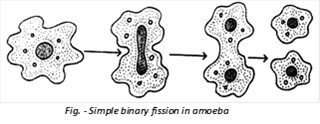
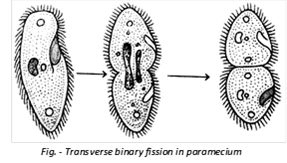
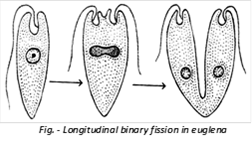
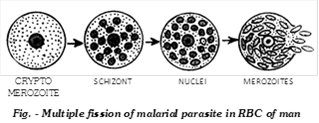
(b) Occurrence: Asexual reproduction occurs in protozoans and some lower animals such as sponges, coelentrates, certain worms and tunicates. It is absent among the higher non-vertibrates and all vertibrates. (c) Types: Asexual reproduction takes place in five principal ways: (1) Binary fission: Binary fission is the division of the parent into two small, nearly equalized daughter individuals. Examples - Protozoans (Amoeba, Euglena etc.) Bacteria and Planarians. Modes of binary fission: In Binary fission, the nucleus divides first and the cytoplasm next. Subsequently, the mother cell splits into two equal sized daughter halves or cells. There are three modes of binary fission. (i) Simple binary fission: If the plane of cytoplasmic division passes through any direction, the fission is called simple fission. Example - Amoeba.           (ii) Transverse binary fission: If the plane of cytoplasmic division concides with the transverse axis of the individual, the fission is termed transverse binary division. Example - Paramoecium and Planaria.           (iii) Longitudinal binary fission: It the plane of cytoplasmic division concides with the longitudinal axis of the individual. This kind of fission is designated as longitudinal binary fission. Example - Euglena and vorticella.         Binary fission involves mitotis only and consequently, the resultant offspring's are genetically identical to the parent and each other. (2) Multiple fission: Multiple fission is the division of the parent into many small daughter individuals simultaneously. Examples - Multiple fission occurs in many protozoans such as Plasmodium, Amoeba and Monocytis.       more...

  Male reproductive system   The male reproductive system consists of a scrotum, a pair of testes, vasa efferentia, a pair of epididymis, a pair of vasa deferentia, a pair of ejaculatory ducts, a urethra, a penis and certain glands.           (i) Reproductive organ  (a) Scrotum: The scrotum is a pouch of pigmented skin arising from the lower abdominal wall and hanging between the legs. Its dermis contains almost a continuous layer of smooth muscle fibres called dartos tunic. The scrotum is divided internally into right and left scrotal sacs by a muscular partition, the septum scroti. A scar like raphae marks the position of the septum externally. The testes originate in the abdominal but latter, during the seventh month of development, descend permanently into the respective scrotal sac through passages termed inguinal canal. If an inguinal canal remains open or is torn, a loop of intestine may descent in the scrotum to produce the disorder of inguinal hernia.
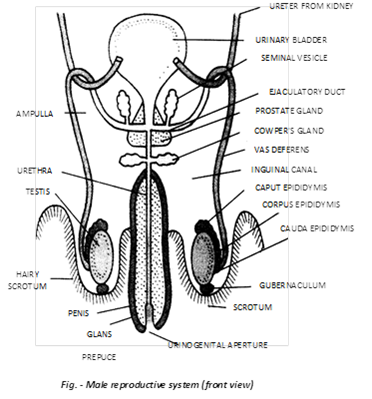
  • A spermatic cord connects testis with abdominal cavity. It consists of connective tissue that encloses an artery, a vein, a lymph vessel, a nerve, cremaster muscle and a vas deferens. A testis rests in it chamber over pad called gubernaculum.
  • Descent of testes in scrotum provides a low temperature (of\[2C{}^\text{o}\]) for maintenance of spermatogenic tissue and formation of sperms. Failure of testes to descend in scrotum is cryptorchidism, the disorder that causes sterlity because sperm formation does not occur at the abdominal temperature.
  • Men persistently wearing tight underpants or taking very hot baths may have a reduced sperm count almost leading to infertility.
  • The scrotal sac of male homologous to female's labia major.
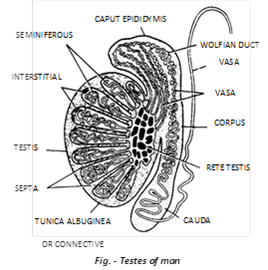
      Variations in position of testes: In some mammals (lion, bull, horse), the testes remain permanently in the scrotum and keep functioning throughout the year as in man. In certain seasonally breeding mammals, such as bat, otter and llama, (Insectivora, Tubulidentata, chiroptera and most Rodentia) the testes enlarge, become functional, and descent into the scrotum in the breeding season, but thereafter ascent into the abdominal cavity, and become reduced and inactive. In a few cases (elephant, whale, seal) the testes remain permanently in the abdomen as the body temperature is low enough for sperm maturation. Scrotum is absent in such cases. Scrotum is in front of penis in Kangaroo. (b) Testes: The testes are the primary sex organs. They are about 4 - 5 cm long, 2.5 cm wide and 3 cm thick. They are suspended in the scrotal sacs by spermatic cords. (1) Protective coats (Tunicae): Each testis has three coverings - tunica vaginalis, tunica albuginea and tunica vasculosa. On one side each testis is covered by hollowed tunica vaginalis, a bilayer of peritoneum with a narrow coelomic cavity having coelomic fluid for sliding. The actual covering more...

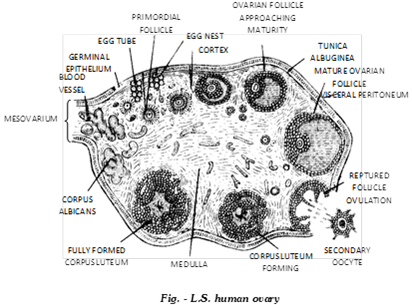
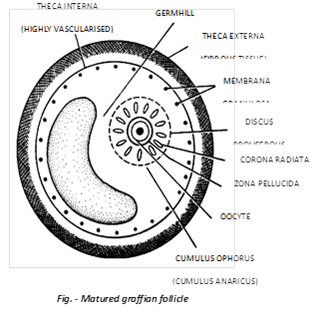
  Female Reproductive System   The female reproductive system consists of a pair of ovaries, a pair of fallopian tubes, uterus, vagina, external genitalia or vulva and breasts.   (i) Reproductive organ (a) Ovaries: Ovaries are the primary sex organs of female. (1) Size and form: The ovaries are almond shaped bodies, about 3 cm long, 1.5 cm wide and 1 cm thick. (2) Role: The ovaries, like the tests, have both an exocrine function (production of ova) and an endocrine role (secretion of female sex hormones: estrogen and progesterone). After menopause, the ovaries become small and lose follicles.         (3) Location: Each ovary is located close to the lateral walls of the pelvic cavity, being suspended from the dorsal body wall just behind the kidney, by a section of peritonium, the mesovarium. It is held in position by several connective tissue ligaments. Each ovary is connected by an ovarian ligament to the uterus, and by a suspensory ligament to the lateral pelvic wall. It has hilus where nerves and blood vessels are connected.           (4) Structure: Each ovary is a compact or solid organ, consisting of an outer cortex and inner medulla. The stroma of the cortical region is composed of spindle shaped fibroblasts. A poorly delineated dense connective tissue layer, the tunica albuginea, covers the cortex. It imparts the whitish colour to the ovary. Located outside the tunica albuginea, the germinal epithelium, formed of simple squamous or cuboidal epethelial cells, covers the surface of the ovary. Cells of germinal epithelium give rise to groups of oogonia that project into cortex as cords called egg tubes of Pfluger, each with a round terminal mass of oogonia called egg nest. Egg nests give rise to ovarian follicles. In neonate female baby the ovary contains about 2 million follicles but 50% of them are atretic or degenerate. Atresia continues and by the time of puberty some 3,00,000 - 4,00,000 ovarian follicles are present in an ovary. However, only 450 ovarian follicloes mature, one by one alternately in the two ovaries at intervals of 28 days. A mature ovarian follicle is called Graffian follicle. It has a diameter of 10 mm. Outer fibrous theca externa and inner cellular theca internal are derived from spindle cells of cortex. Estrogen secreted by the internal theca of graffian follicle. Other constituents are follicular cells (nourishing cells formed from undifferentiated oogonia), an antrum or follicular cavity having liquor folliculi and an eccentrically placed oocyte. Follicular cells form a cellular sheath (below theca internal) called membrane granulosa and cellular mass called cumulus ovaricus covering the oocyte. Cumulus oophorus or cumulus ovaricus differentiates into outer discus proligerous and inner corona radiata. Alongwith oocyte it also secretes a mucoprotein membrane called zona pellucida. Oocyte (secondary oocyte more...
  Gametogenesis   The process of the formation of haploid gametes from the undifferentiated, diploid germ cells in the gonads for sexual reproduction is called gametogenesis.        
  • As a result of this process, male gamete sperm and female gamete egg is formed.
  • The process of Gametogenesis is stimulated by the FSH or Follicle Stimulating Hormone and for this process Vitamin "A" and "E" are also necessary.
  • The process of Gametogenesis has been divided into 3 substages -
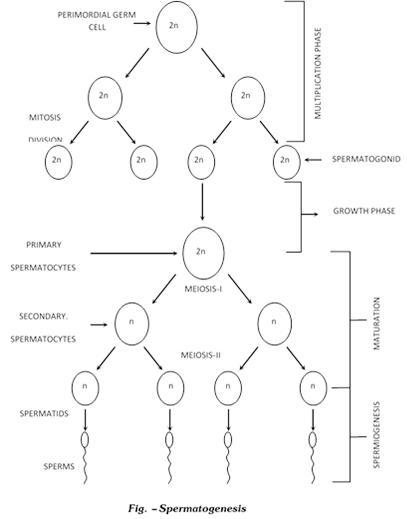
(1) Multiplication phase.   (2) Growth phase.                       (3) Maturation phase.   Types of gametogenesis   (i) Spermatogenesis     
  • The process of formation of sperms in the germinal-epithelium of the testis of the male animal is termed as spermatogenesis.
  • In mammals, testis have several coiled tubules in it called the seminiferous tubules.
  • Sperms are formed in these tubules. The inner wall of seminiferous tubules is made up of germinal epithelium whose cells are cuboidal.
  • Some special cells are present in this germinal epithelium which are called the primordial germ cells. Due to the division of these cells sperms are formed.
  • Some large cells are also found in this germinal epithelium. These are called the "Sertoli cells or Subtentacular cells".
  • These cells provide nutrition to the maturing sperms in the form of Glycogen.
  • For getting nutrition, the head of the sperms are submerged in the cytoplasm of sertoli cells.
  • When sperms fully mature, they move away from sertoli cells and get liberated in the cavity of seminiferous tubules.
  • Liberation of sperms from sertoli cells is termed as Spermiation.
  • Liberation of sperms from the testis is termed as Semination.
  • Liberation of sperms into the vagina of the female is termed as Insemination.
  • Sertoli cells are also endocrine in nature and they secrete 2 hormones -
      AMH (Anti Mullarian Hormone): This hormone stimulates degradation of female gonads in a male embryo.       Inhibine hormone: This hormone is secreted in adult stages and it stops the secretion or FSH.
  • Sertoli cells mainly provide nutrition and conserve the various stages of spermatogenesis. Spermatogenesis is a continuous process. To make it easier for study, it has been divided into the following steps -
(a) Formation of spermatid. (b) Spermiogenesis or Spermatolesis.   (a) Formation of spermatids: This process begins as the animal attains sexual maturity. The cells of the germinal epithelium of the seminiferous tubules which participate in this process are termed as the primordial germ cells. The process of formation of spermatids from primordial germ cells are termed as spermatocytosis. It has 3 sub-stages -   (1) Multiplication phase: During this process the primordial germ cells repeatedly undergo mitosis division, and as a result of these divisions spermatogonia are formed spermatogonia are diploid.   (2) Growth phase: Some spermatogonia either due to growth or due to food more...

  Phases of embryonic development     Embryonic development involves following dynamic changes and identifiable process. (i) Gametogenesis : It involve the formation of haploid sex cells or gametes called sperms and ova from diploid primary germ cells called gametogonia present in the reproductive organs called gonads (testes and ovary). It is of two types (a) Spermatogenesis: Formation of sperm.                       (b) Oogenesis: Formation of ova Note:    q  (See detail in module-2 Chapter-Reproduction) (ii) Fertilization: It involve the fusion of haploid male and female gametes to form diploid zygote. The fusion of gametic pronuclei is called Karyogamy while the mixing of two sets of chromosomes of two gametes is called amphimixis.   (iii) Cleavage: It includes the rapid mitotic division of the zygote to form a single layered hollow spherical larva called blastula and its formation is called blastulation.   (iv) Implantation: The process of attachment of the blastocyst (mammalian blastula) on the endometrium of the uterus is called implantation.   (v) Gastrulation: It includes the mass and orderly migration of the organ specific areas from the surface of blastula to their predetermined position which finally produces a 3 layered gastrula larva. It is with 3 primary layers.   (vi) Organogenesis: It includes the formation of specific organs system from three primary germ layers of gastrula and also includes the morphogenesis and differentiation.   Important Tips   Historical background of Embryonic Development:
  • George Newport: Observed fertilization of frog’s egg.
  • Oscar Hertwig: Described the fusion of sperm and egg nuclei in sea urchin.
  • Prevost and Dumas: Reported cleavage of frog’s egg.
  • Swammerdam: Observed the first cleavage of frog in 1738.
  • Spallanzani: Detailed process of cleavage of frog’s egg.
  • Von Bear: Proposed recapitulation theory.
  • Ernst Haeckel: Modified recapitulation theory to “Biogenetic law”. It states “Ontogeny repeats phylogeny.”
  • Spemann and Mangold: Reported embryonic induction on newt and gave concept of primary organizers.
  • Pander: Formation of three germinal layers in chick embryo.
  • Oviparity: Fertilization may be external or internal but development always outside the female body and inside the egg e.g. most of non-chordates, fishes, amphibians and reptiles; all birds and prototherians.
  • Ovoviviparity: Fetilization always internal. Development also inside the uterus and baby is born but there is no placenta formation so egg is yolky e.g. rattele snake, Dog fish
Viviparity: Fertilization and development always inside the body. Placenta is formed and female gives birth to young one e.g. most of mammals.

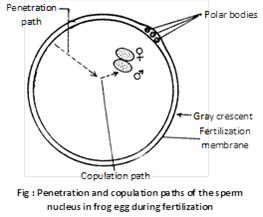
  Fertilization   (i) Definition: Fusion of a haploid male gamete (spermatozoon) and a haploid female gamete (ovum) to form a diploid cell, the zygote, is called fertilization or syngamy. (ii) Site of fertilization: Fertilization in human female is internal as in other mammals. It takes place usually in the ampulla of the fallopian tube. (iii) Steps of fertilization (a) Approach of sperm to ovum: Male discharge semen (3.5 ml) high up in the female’s vagina, close to the cervix during coitus. This is called ejaculation or insemination. This ejaculation contains as many as 400 million sperms but only about 100 sperms reach the fallopian tube because many sperms are either killed by the acidity of female genital tract or engulfed by the phagocytes of the vaginal epithelium. The sperm swim in the seminal fluid at the rate of 1-4 mm per minute by the aspiratory action of the uterus and peristaltic movement of the fallopian tube. Capacitation is the phenomenon of physiological maturation of sperms by breaking of acrosome membrane inside the female genital tract. It takes about 5-6 hours. Ovum is released on the 14th day of menestrual cycle trapped by the fimbriae of the ampulla of fallopian tube and move towards the uterus by peristalsis and ciliary action. At the time of ovulation, egg is at secondary oocyte stage. Fertilizability of human sperm in the female genital tract is of 12 to 24 hours while its survival value is up to 3 days and of ovum is only 24 hours though it can live for about 72 hours. (b) Penetration of sperm: The ovum secretes a chemical substance called fertilizin, which has a number of spermophillic sites on its surface where the sperm of species specific type can be bound by their antifertilizin site. This fertilizin-antifertilizin interaction, causing agglutination (sticking together) of egg and sperm. The sperm generally comes in contact with ovum in the animal pole (side of ovum with excentric nucleus) while the opposite side of ovum is called vegetal pole. Ovulation in the human female occurs at secondary oocyte stage in which meiosis-I has been completed and first polar body has been released but second maturation is yet to complete. Penetration of sperm is a chemical mechanism. In this acrosome of sperm undergoes acrosomal reaction and releases certain sperm lysins which dissolve the egg envelopes locally and make the path for the penetration of sperm. Sperm lysins are acidic proteins. These sperm lysins contain a lysing enzyme hyaluronidase which dissolves the hyaluronic acid polymers in the intercellular spaces which holds the granulosa cells of corona radiata together; corona penetrating enzyme (that dissolves the corona radiata) and acrosin (which dissolves the zona pellucida). Then it dissolves the zona pellucida. Only sperm nucleus and middle piece enter the ovum. The tail is lost.         (c) Cortical reaction: Immediately after the entry more...

  Cleavage   (i) Definition: The term cleavage refers to a series of rapid mitotic division of the zygote following fertilization, forming a many celled blastula. The cleavage follows fertilization and ends with the formation of a characteristic development stage called blastula.   (ii) Cleavage versus typical mitosis: The cleavage division are no doubt mitotic as they produce diploid cells, they differ from typical mitosis in a couple of significant points.  
S.No. Characters Cleavage Normal mitosis
(1) Site of occurrence In zygote  or parthenogenetic egg In most of somatic cells
(2) Interphase Of shorter period Of longer period
(3) Growth more...


You need to login to perform this action.
You will be redirected in 3 sec spinner