Root
Introduction
Angiospermic or flowering plants show a great variety of shape, size and form. The size ranges from the minute Wolffia and Lamna (0.1cm) to the tall Eucalyptus (up to 100 metre) and large sized Banyan (Ficus bengalensis). In habit, they range from herbs and shrubs to trees.
Morphology (Gr. Morphos = Form; logos = Study) is the branch of science which deals with the study of form and structure. In botany, it generally means the study of external features, forms and relative positions of different organs on plants.
It is virtually impossible to recognise and know all the flowering plants even for a professional taxonomist. However, a student of botany takes the help of morphology for recognition, identification and classification of plants. Some distinct morphological features are most significant in the study of phytogeography, phylogeny and evolution.
Parts of a flowering plant: Flowering plants consist of a long cylindrical axis which is differentiated into underground root system and an aerial shoot system. The root system consists of root and its lateral branches. The shoot system has a stem, a system of branches and leaves. The different parts of a plant are called organs. Organs are differentiated into two types, vegetative and reproductive. Vegetative organs take part in nourishing and fixing the plant, viz., root, stem, leaves. Reproductive organs are required in multiplication. They comprise flowers, fruits and seeds (formed inside fruits). Organs similar in basic internal structure and origin which may appear different and perform different functions are called homologous organs. The relationship amongst these organs is called homology. Organs performing a similar function or having a similar external form but different internal structure and origin are termed as analogous organs. The relationship in analogous organs is called anology.
The Root
The root is usually an underground part of the plant which helps in fixation and absorption of water. The root with its branches is known as the root system.
(1) Characteristics of the root
(i) The root is the descending portion of the plant axis and is positively geotropic.
(ii) It is non-green or brown in colour.
(iii) The root is not differentiated into nodes and internodes.
(iv) As a rule the root does not bear leaves and true buds.
(v) Usually the root tip is protected by a root cap.
(vi) The root bears unicellular root hairs.
(vii) Lateral roots arise from the root which are endogenous in origin (arises from pericycle).
(2) Parts of the root : From the tip of the root upwards, the following parts can be traced in root.
(i) Region of root cap : The tip of the root is called calyptra or root cap. It is for protection of root tip against any injury. It is formed from meristem called calyptrogen. Pandanus is the only plant with multiple root caps. In the aquatic plants like Pistia, Lemma and Eicchornia instead of root caps, more...
The Stem
The stem develop from the plumule of the germinating seed. Normally it is the aerial part of the plant body. The stem with it's branches, leaves, buds, flower and appandages is known as shoot system.
The stem shows the differentiation of nodes and internodes. The place where the leaf develops on the stem is called the node. The portion of the stem between two successive nodes is called the internode.
(1) Characteristics of stem
(i) Stem is an ascending axis of the plant and develops from the plumule and epicotyl of the embryo.
(ii) It is generally erect and grows away from the soil towards light. Therefore, it is negatively geotropic and positively phototropic.
(iii) The growing apex of stem bears a terminal bud for growth in length.
(iv) In flowering plants, stem is differentiated into nodes and internodes. A node occurs where leaves are attached to the stem. Internode is the portion of stem between the two nodes.
(v) The lateral organs of stem (i.e., leaves and branches) are exogenous in origin (from cortical region).
(vi) The young stem is green and photosynthetic.
(vii) Hair, if present, are generally multicellular.
(viii) In mature plants, stem and its branches bear flowers and fruits.
(2) Diverse forms of stem
(i) Reduced stems: In some plants, the stem is in the form of a reduced small disc which is not differentiated into nodes and internodes. e.g., (a) A reduced green-coloured disc-like stem lies just above the base of fleshy roots of Radish, Carrot and Turnip ; (b) Green-coloured small discoid stem occurs in free-floating Lemna, Spirodela and Wolffia; (c) Highly reduced non-green discoid stem occurs at the base of Onion and Garlic bulbs, etc.
(ii) Erect stems : Majority of angiosperms possess upright, growing-ascending, vertically-erect stems. They are fixed in the soil with the help of roots. Erect stems belong to four categories :
(a) Clum : Erect stems with solid nodes and hollow internodes. The nodes are swollen giving the stem a jointed appearance e.g., Bamboo (Bambusa arundinacea) and wheat (Triticum vulgare).
(b) Caudex : The main stem remains unbranched and bears a crown of leaves at its top. e.g., Coconut (Cocos nucifera), Palm, etc.
(c) Excurrent : The main stem is trunk like. It is thickest at the base and gradually tapers towards the apex. The branches arise in acropetal succession, i.e., oldest at the base and youngest at the apex. The tree appears cone-shaped. e.g., Casuarina, Eucalyptus, etc.
(d) Decurrent or Deliquescent : The apical bud of main stem is weak as compared to the buds of lateral branches. Thus, the lateral branches are prominent and spreading. The main stem grows upto a certain height after which it gives several branches. These branches dominate by giving the branches of several orders. more...
The Leaf
The leaf is a green, flat, thin, expanded lateral appendage of stem which is borne at a node and bears a bud in its axil. It is exogenous in origin and develops from the leaf primordium of shoot apex. The green colour of leaf is due to presence of the photosynthetic pigment - chlorophyll which helps plants to synthesize organic food. The green photosynthetic leaves of a plant are collectively called foliage. They are borne on stem in acropetal succession.
(1) Characteristics of leaf
(i) The leaf is a lateral dissimilar appendage of the stem.
(ii) A leaf is always borne at the node of stem.
(iii) Generally there is always an axillary bud in the axil of a leaf.
(iv) It is exogenous in origin and develops from the swollen leaf primordium of the growing apex.
(v) The growth of leaf is limited.
(vi) The leaves do not possess any apical bud or a regular growing point.
(vii) A leaf has three main parts - Leaf base, petiole and leaf lamina. In addition, it may possess two lateral outgrowths of the leaf base, called stipules.
(viii) The leaf lamina is traversed by prominent vascular strands, called veins.
(2) Parts of a typical leaf : The leaf consists of three parts namely, leaf base (usually provided with a pair of stipules), petiole and leaf blade or lamina.
(i) Leaf base (Hypopodium) : Leaf base is the lower most part of the leaf meant for attachment. It acts as a leaf cushion. In most of the plants it is indistinct. Some times leaf base shows different variations as follows:
(a) Pulvinate leaf base : In members of leguminosae the leaf is swollen. Such swollen leaf bases are called pulvinate leaf bases as seen in mango leaves. It helps in seismonastic movements (e.g., Mimosa pudica) and nyctinastic movements (e.g., Enterobium, Arachis, Bean).
(b) Sheathing leaf base : In grasses and many monocots, the leaf base is broad and surrounds the stem as an envelope, such a leafbase is called sheathing leaf base. e.g., Sorghum, Wheat and Palms. In grasses (Sorghum, Wheat etc.) the sheathing leaf base protects the intercalary meristem.
(c) Modified leaf base : The leaf bases in few plants perform accessory functions and show modifications. In Allium cepa (Onion), the leaf bases store food materials and become fleshy. They are arranged concentrically to form a tunicated bulb. In Platanus and Robenia, the leaf bases protect the axillary buds and grow around them to form cup like structures.
(d) Stipule : The stipules are the small lateral appendages present on either side of the leaf base. They protect the young leaf or leaf primordia. Leaves with stipules are called stipulate and those without them are called exstipulate. The stipules are commonly found in dicotyledons. In some grasses (Monocots) an additional outgrowth is present between leaf base and lamina. It is called ligule. The leaves having more...
Taxonomy of Angiospermic plants
Introduction
Taxonomy is concerned with the laws governing the classification of plants. The term taxonomy includes two Greek words taxis - arrangement and nomos- laws. Plant taxonomy is otherwise known as systematic botany. Classification, identification, description and naming the plants are the bases of plant taxonomy. The taxonomic knowledge about the plants is based on their form and structure. The knowledge gained through taxonomy is useful in the fields of medicine, agriculture, forestry, etc.
The ultimate aim of classification is to arrange plants in an orderly sequence based upon their similarities. The closely related plants are kept within a group and unrelated plants are kept far apart in separate groups.
The other aim of classification is to establish phylogenetic relationships among the different groups of plants. The plants that are closely related show more similarities than differences.
The earliest systems of classification were simple and based on one or few characters. They gave importance to vegetative characters. The later systems of classification gave more importance to floral characters because floral characters are more stable and permanent.
Types of classification
The different types of classification proposed by earlier taxonomists can be broadly categorized into three systems- artificial, natural and phylogenetic.
Artificial system
It was based on one or at most only a few superficial characters. In 1753, Carolus Linnaeus of Sweden published his book ' Species Plantarum' wherein he described 7,300 species. He divided the plants into 24 classes based on number, union, length and certain other characters of stamens. Hence, this system is also known as sexual system of classification. In those days, it was an important over other systems of classification. The importance of floral characters was felt by Linnaeus and his classification was more important than others. The main defect of this system is that totally unrelated plants are brought together in a single group and those that are closely related plants are placed in widely separated groups. For example, plants belonging to Zingiberaceae of Monocotyledons and that of Anacardiaceae of Dicotyledons had been placed in one group called Monandria, as these possess only one stamen. Another defect of this system was that no importance was given to either natural or phylogenetic relationships among different groups of plants.
Natural system
In this system of classification, plants are classified based on their natural affinities. More number of characters are taken into consideration in this system. It is mainly based on all the informations that were available during the time of direct observation of plants. The most important natural system of classification of seed plants was proposed by two British botanists George Bentham and Sir Joseph Dalton Hooker. It helps to determine the relationships between various groups of plants. However, it does not attempt to bring out evolutionary relationships among different groups of plants.
Phylogenetic system
This system is based on evolutionary sequence as well as genetic relationships more...
Glycolysis / EMP pathway
(1) Discovery: It is given by Embden, Meyerhoff and Parnas in 1930. It is the first stage of breakdown of glucose in the cell.
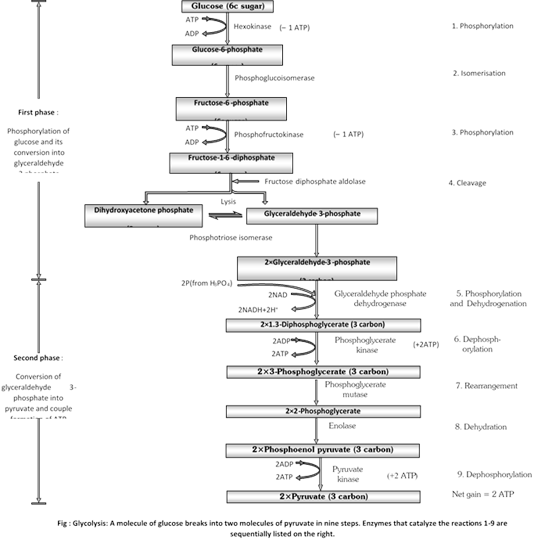
(2) Definition : Glycolysis ( Gr. glykys= sweet, sugar; lysis= breaking) is a stepped process by which one molecule of glucose (6c) breaks into two molecules of pyruvic acid (3c).
(3) Site of occurrence : Glycolysis takes place in the cytoplasm and does not use oxygen. Thus, it is an anaerobic pathway. In fact, it occurs in both aerobic and anaerobic respiration.
(4) Inter conversions of sugars : Different forms of carbohydrate before entering in glycolysis converted into simplest form like glucose, glucose 6-phosphate or fructose 6-phosphate. Then these sugars are metabolized into the glycolysis. The flow chart that showing inter conversion of sugar are given below:
(5) Glycolysis cycle
(6) Enzymes of glycolysis and their co-factors
Krebs Cycle and ETS
(1) Oxidative decarboxylation / Formation of acetyl CoA.
(2) Kreb's cycle / TCA cycle / Citric acid cycle.
(3) Electron Transport System
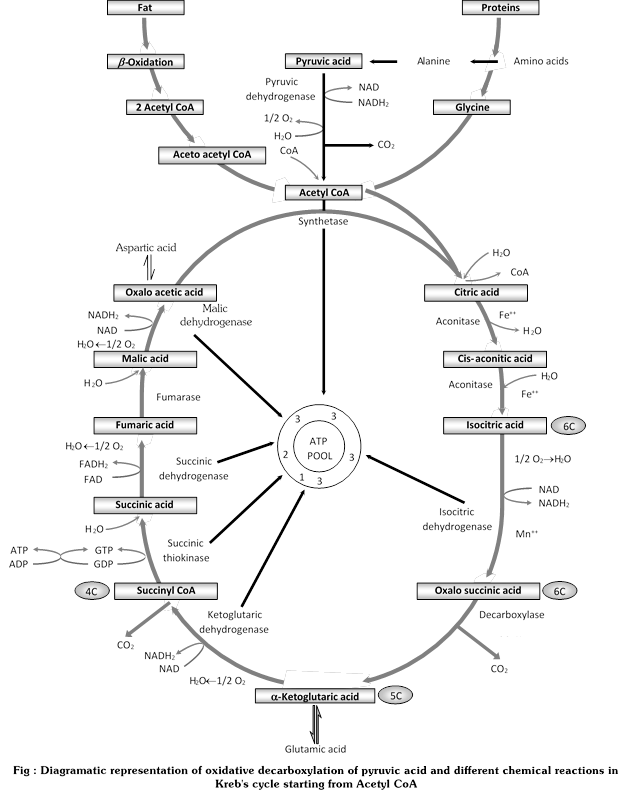
(1) Oxidative decarboxylation of pyruvic acid : If sufficient O2 is available, each 3-carbon pyruvate molecule \[\left( C{{H}_{3}}COCOOH \right)\] enters the mitochondrial matrix where its oxidation is completed by aerobic means. It is called gateway step or link reaction between glycolysis and Kreb's cycle. The pyruvate molecule gives off a molecule of CO2 and releases a pair of hydrogen atoms from its carboxyl group (-COOH), leaving the 2 carbon acetyl group \[(C{{H}_{3}}CO)\]. The reaction is called oxidative decarboxylation, and is catalyzed by the enzyme pyruvate dehydrogenase complex (decarboxylase, TPP, lipolic acid, transacetylase, Mg2+) . During this reaction, the acetyl group combines with the coenzyme A (CoA) to form acetyl coenzyme A with a high energy bond\[\left( C{{H}_{3}}CO-CoA \right)\]. Most of the free energy released by the oxidation of pyruvate is captured as chemical energy in high energy bond of acetyl coenzyme A. From a pair of hydrogen atoms released in the reaction, to electrons and one H+ pass to\[NA{{D}^{+}}\], forming, \[NAD{{H}^{+}}{{H}^{+}}\]. The NADH forms 3 ATP molecules by transferring its electron over ETS described ahead.
Decarboxylation and dehydration :
Image pending
**TPP=Thiamine pyrophosphate
**LAA=Lipoic acid amide
Acetyl CoA is a common intermediate of carbohydrate and fat metabolism. Latter this acetyl CoA from both the sources enters Kreb's cycle. This reaction is not a part of Kreb's cycle.
(2) Kreb's cycle / TCA cycle / Citric acid cycle
(i) Discovery : This cycle has been named after the German biochemist in England Sir Hans Krebs who discovered it in 1937. He won Noble Prize for this work in 1953. Krebs cycle is also called the citric acid cycle after one of the participating compounds.
(ii) Site of occurrence : It takes place in the mitochondrial matrix.
(iii) Kreb’s cycle
(iv) Enzymes of Kreb's cycle
Respiratory quotient / Respiration ratio
R.Q. is the ratio of the volume of \[C{{O}_{2}}\]released to the volume of oxygen taken in respiration and is written as
R.Q.=\[\frac{Volume\,of\,C{{O}_{2}}\,evolved}{Volume\,of\,{{O}_{2}}\,absorbed}=\frac{C{{O}_{2}}}{{{O}_{2}}}\]
Value of R.Q. varies with substrate. Thus the measurement of R.Q. gives some idea of the nature of substrate being respired in a particular tissue.
When carbohydrates are completely oxidised the value of R.Q. is unity (=one). If fats and proteins are the substrate the value of R.Q. is less than unity (0.5 to 0.9) and when organic acids are substrate the value is more than unity (1.3 to 4.0).
In succulent like Opuntia, Bryophyllum where there is incomplete oxidation of carbohydrates no CO2 is produced, hence the value of R.Q. is zero.
R.Q. is usually measured by Ganong's respirometer.
(1) When carbohydrates are the respiratory substrate (=germinating wheat, oat, barley, paddy grains or green leaves kept in dark or tubers, rhizomes, etc.)
\[\underset{\text{Glucose}}{\mathop{{{C}_{6}}{{H}_{12}}{{O}_{6}}}}\,+6{{O}_{2}}\to 6C{{O}_{2}}+{{H}_{2}}O\] ; \[\frac{C{{O}_{2}}}{{{O}_{2}}}=\frac{6}{6}=1\] (Unity)
(2) When fats are the respiratory substrate (=germinating castor, mustard, linseed, til seeds)-for fatty substances R.Q. is generally less than one .
(i) \[\underset{\text{Stearic}\,\text{acid}}{\mathop{{{C}_{18}}{{H}_{36}}{{O}_{2}}}}\,+26{{O}_{2}}\to 18C{{O}_{2}}+18{{H}_{2}}O\]; \[\frac{C{{O}_{2}}}{{{O}_{2}}}=\frac{18}{26}=0.7\](Less than unity)
(ii) \[\underset{\text{Tripalmitin}}{\mathop{2{{C}_{51}}{{H}_{98}}{{O}_{6}}}}\,+145{{O}_{2}}\to 102C{{O}_{2}}+98{{H}_{2}}O\]; \[\frac{C{{O}_{2}}}{{{O}_{2}}}=\frac{102}{145}=0.7\](Less than unity)
(3) When protein are the respiratory substrate (=germinating gram, pea, bean, mung seeds)- value of R.Q. is less than unity (0.5-0.9).
(4) When organic acids are the respiratory substrate
(i) \[\underset{\text{Malic}\,\text{acid}}{\mathop{{{C}_{4}}{{H}_{6}}{{O}_{5}}}}\,+3{{O}_{2}}\to 4C{{O}_{2}}+3{{H}_{2}}O\]; \[\frac{C{{O}_{2}}}{{{O}_{2}}}=\frac{4}{3}=1.33\](More than unity)
(ii) \[\underset{\text{Oxalic}\,\text{acid}}{\mathop{2{{(COOH)}_{2}}}}\,+{{O}_{2}}\to 4C{{O}_{2}}+2{{H}_{2}}O\]; \[\frac{C{{O}_{2}}}{{{O}_{2}}}=\frac{4}{1}=4\](More than unity)
Organic acid
R.Q.
Succinic acid
1.14
Taurtric acid
1.6
Acetic acid
1
(5) When there is incomplete oxidation of carbohydrates (In the respiration of succulents i.e. : Bryophyllum, Opuntia)
\[2{{C}_{6}}{{H}_{12}}{{O}_{6}}+3{{O}_{2}}\to 3{{C}_{4}}{{H}_{6}}{{O}_{5}}+3{{H}_{2}}O\]; \[\frac{C{{O}_{2}}}{{{O}_{2}}}=\frac{0}{3}=0\](Zero)
(6) Respiration in the absence of O2 (in anaerobic respiration)
\[{{C}_{6}}{{H}_{12}}{{O}_{6}}\xrightarrow{\text{Zymase}}2{{C}_{2}}{{H}_{5}}OH+2C{{O}_{2}}\]; \[\frac{C{{O}_{2}}}{{{O}_{2}}}=\frac{2}{0}=\infty \] (Infinite)
Factors Affecting Rate of Respiration
Many external and internal factors affecting the rate of respiration are as follows:
(1) External factors
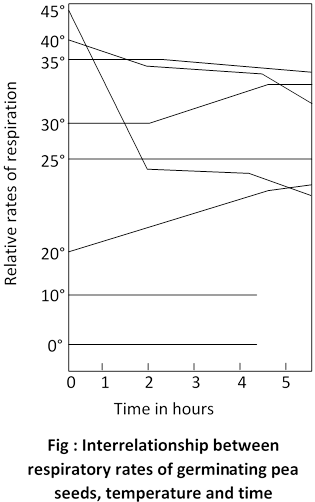
(i) Temperature: Temperature is the most important factor for respiration. Most of the plants respire normally between\[{{0}^{o}}Cto\text{ }{{30}^{o}}C\]. With every \[{{10}^{0}}C\] rise of temperature from \[{{0}^{o}}Cto\text{ }{{30}^{o}}C\] the rate of respiration increases 2 to 2.5 times (i.e., temperature coefficient \[\left( {{Q}_{10}}^{o} \right)\] is = 2 to 2.5), following Vant Hoff’s Law. Maximum rate of respiration takes place at 30oC, there is an initial rise, soon followed by a decline. Higher the temperature above this limit, more is the initial rise but more is the decline and earlier is the decline in the rate of respiration. Probably this is due to denaturation of enzymes at high temperature.
Below 0oC the rate of respiration is greatly reduced although in some plants respiration takes place even at\[-{{20}^{o}}C\]. Dormant seeds kept at \[5{{0}^{o}}C\]B survive.
(ii) Supply of oxidisable food : Increase in soluble food content readily available for utilization as respiratory substrate, generally leads to an increase in the rate of respiration upto a certain point when some other factor becomes limiting.
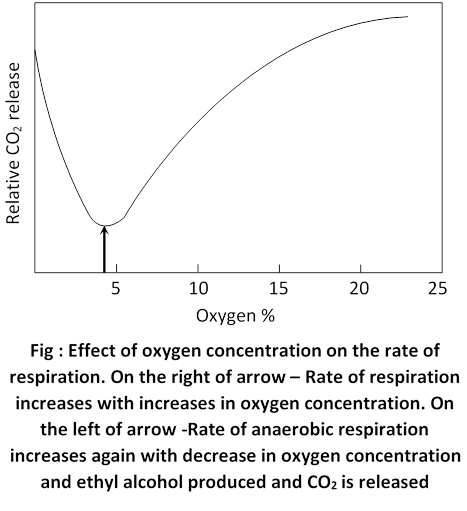
(iii) Oxygen concentration of the atmosphere : Respiration is aerobic or anaerobic depending upon the presence or absence of oxygen. Air has 20.8% oxygen which is more than enough keeping in view the requirements of plants. Due to this if the amount of oxygen in the environment of plants is increased or reduced upto quite low values the rate of respiration is not effected. On decreasing the amount of oxygen to 1.9% in the environment aerobic respiration become negligible (extinction point of aerobic respiration) but anaerobic respiration takes place.
Oxygen poisoning: The significant fall in respiration rate was observed in many tissues in pure O2, even at N.T.P. This inhibiting effect was also observed in green peas when they are exposed to pure oxygen exerting a pressure of 5 atm- the respiration rate fall rapidly. The oxygen poisoning effect was reversible, if the exposure to high oxygen pressure was not too prolonged.
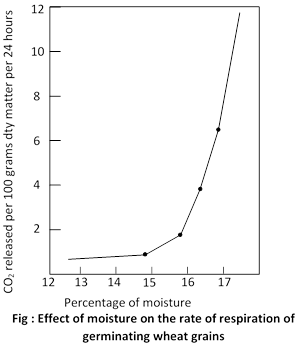
(iv) Water: With increase in the amount of water the rate of respiration increases. In dry seeds, which have 8-12% of water the rate of respiration is very low but as the seeds imbibe water the respiration increases. The life of seeds decreases with increase of water. This increase is slow at first but very rapid later. This is very clearly seen in the tissues of many xerophytes. As the water contents of such plants is increased, often there is no great immediate effect upon the rate of respiration. Minor variation in water content of well-hydrated plant cell do not appear to have very great influence upon the rate of respiration.
Figure shows that in wheat grains rate of respiration increases with increase of water more...
Mendelism
Introduction: Gregor Johann Mendel (1822-1884) first "geneticist", also known as father of genetics was born in 1822 in Silisian, a village in Heizendorf (Austria). In 1843, he joined Augustinian monastry at Brunn (then in Austria, now Brno Czechoslovakia). In 1856, Mendel got interested in breeding of Garden pea (Pisum sativum). He selected pure breeding varieties or pure lines of pea. Breeding experiments were performed between 1859 - 1864. The results were read out in two meetings of Natural History Society of Brunn in 1865 and published in 1866 in "Proceedings of Brunn Natural History Society" under the topic "Experiments in Plant Hybridisation". Mendel died in 1884 without getting any recognition during his lifetime.
In 1900, Hugo de Vries of Holland, Carl Correns of Germany and Erich von Tshermak of Austria came to the same findings as were got by Mendel. Hugo de Vries found the paper of Mendel and got it reprinted in ‘Flora’ in 1901. Correns converted two of the generalisations of Mendel into two laws of heredity. These are law of segregation and law of independent assortment.
(1) Reasons for Mendel’s success: The reasons of his success can be discussed as follows:
(i) Method of working: He maintained the statistical records of all the experiments and analysed them. He selected genetically pure (pure breed line) and purity was tested by self-crossing the progeny for several generations.
(ii) Selection of material: Mendel selected garden pea as his experimental material because it has the following advantages.
It was an annual plant. Its short life-cycle made it possible to study several generations within a short period and has perfect bisexual flowers containing both male and female parts. The flowers are predominantly self-pollinating because of self-fertilization, plants are homozygous. It is, therefore, easy to get pure lines for several generations and also easy to cross because pollens from one plant can be introduced to the stigma of another plant by removing anthers (emasculation) and bagging. In addition to that there was one reason more for his success. He studied seven pairs of characters which were present on four different pairs of chromosomes.
(iii) Selection of traits: Mendel selected seven pairs of contrasting characters as listed in the table. Luckily all were related as dominant and recessive.
List of seven pairs of contrasting characters in pea plant

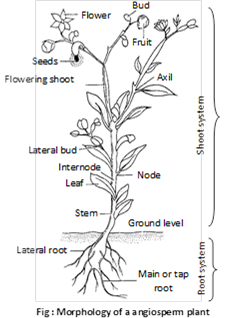 Parts of a flowering plant: Flowering plants consist of a long cylindrical axis which is differentiated into underground root system and an aerial shoot system. The root system consists of root and its lateral branches. The shoot system has a stem, a system of branches and leaves. The different parts of a plant are called organs. Organs are differentiated into two types, vegetative and reproductive. Vegetative organs take part in nourishing and fixing the plant, viz., root, stem, leaves. Reproductive organs are required in multiplication. They comprise flowers, fruits and seeds (formed inside fruits). Organs similar in basic internal structure and origin which may appear different and perform different functions are called homologous organs. The relationship amongst these organs is called homology. Organs performing a similar function or having a similar external form but different internal structure and origin are termed as analogous organs. The relationship in analogous organs is called anology.
The Root
The root is usually an underground part of the plant which helps in fixation and absorption of water. The root with its branches is known as the root system.
(1) Characteristics of the root
(i) The root is the descending portion of the plant axis and is positively geotropic.
(ii) It is non-green or brown in colour.
(iii) The root is not differentiated into nodes and internodes.
(iv) As a rule the root does not bear leaves and true buds.
(v) Usually the root tip is protected by a root cap.
(vi) The root bears unicellular root hairs.
(vii) Lateral roots arise from the root which are endogenous in origin (arises from pericycle).
(2) Parts of the root : From the tip of the root upwards, the following parts can be traced in root.
(i) Region of root cap : The tip of the root is called calyptra or root cap. It is for protection of root tip against any injury. It is formed from meristem called calyptrogen. Pandanus is the only plant with multiple root caps. In the aquatic plants like Pistia, Lemma and Eicchornia instead of root caps, more...
Parts of a flowering plant: Flowering plants consist of a long cylindrical axis which is differentiated into underground root system and an aerial shoot system. The root system consists of root and its lateral branches. The shoot system has a stem, a system of branches and leaves. The different parts of a plant are called organs. Organs are differentiated into two types, vegetative and reproductive. Vegetative organs take part in nourishing and fixing the plant, viz., root, stem, leaves. Reproductive organs are required in multiplication. They comprise flowers, fruits and seeds (formed inside fruits). Organs similar in basic internal structure and origin which may appear different and perform different functions are called homologous organs. The relationship amongst these organs is called homology. Organs performing a similar function or having a similar external form but different internal structure and origin are termed as analogous organs. The relationship in analogous organs is called anology.
The Root
The root is usually an underground part of the plant which helps in fixation and absorption of water. The root with its branches is known as the root system.
(1) Characteristics of the root
(i) The root is the descending portion of the plant axis and is positively geotropic.
(ii) It is non-green or brown in colour.
(iii) The root is not differentiated into nodes and internodes.
(iv) As a rule the root does not bear leaves and true buds.
(v) Usually the root tip is protected by a root cap.
(vi) The root bears unicellular root hairs.
(vii) Lateral roots arise from the root which are endogenous in origin (arises from pericycle).
(2) Parts of the root : From the tip of the root upwards, the following parts can be traced in root.
(i) Region of root cap : The tip of the root is called calyptra or root cap. It is for protection of root tip against any injury. It is formed from meristem called calyptrogen. Pandanus is the only plant with multiple root caps. In the aquatic plants like Pistia, Lemma and Eicchornia instead of root caps, more... 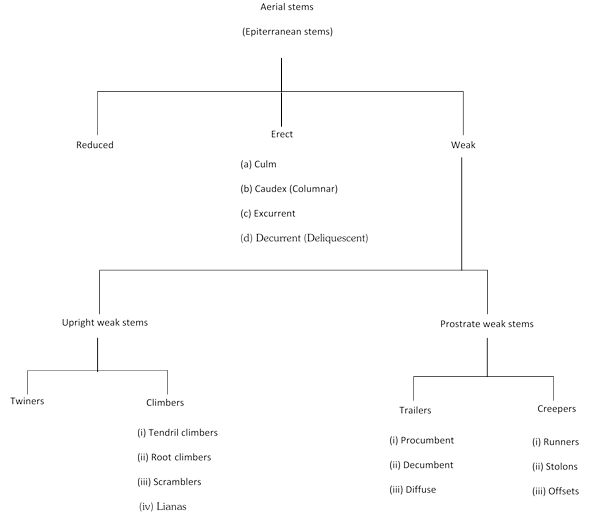 (i) Reduced stems: In some plants, the stem is in the form of a reduced small disc which is not differentiated into nodes and internodes. e.g., (a) A reduced green-coloured disc-like stem lies just above the base of fleshy roots of Radish, Carrot and Turnip ; (b) Green-coloured small discoid stem occurs in free-floating Lemna, Spirodela and Wolffia; (c) Highly reduced non-green discoid stem occurs at the base of Onion and Garlic bulbs, etc.
(ii) Erect stems : Majority of angiosperms possess upright, growing-ascending, vertically-erect stems. They are fixed in the soil with the help of roots. Erect stems belong to four categories :
(a) Clum : Erect stems with solid nodes and hollow internodes. The nodes are swollen giving the stem a jointed appearance e.g., Bamboo (Bambusa arundinacea) and wheat (Triticum vulgare).
(b) Caudex : The main stem remains unbranched and bears a crown of leaves at its top. e.g., Coconut (Cocos nucifera), Palm, etc.
(c) Excurrent : The main stem is trunk like. It is thickest at the base and gradually tapers towards the apex. The branches arise in acropetal succession, i.e., oldest at the base and youngest at the apex. The tree appears cone-shaped. e.g., Casuarina, Eucalyptus, etc.
(d) Decurrent or Deliquescent : The apical bud of main stem is weak as compared to the buds of lateral branches. Thus, the lateral branches are prominent and spreading. The main stem grows upto a certain height after which it gives several branches. These branches dominate by giving the branches of several orders. more...
(i) Reduced stems: In some plants, the stem is in the form of a reduced small disc which is not differentiated into nodes and internodes. e.g., (a) A reduced green-coloured disc-like stem lies just above the base of fleshy roots of Radish, Carrot and Turnip ; (b) Green-coloured small discoid stem occurs in free-floating Lemna, Spirodela and Wolffia; (c) Highly reduced non-green discoid stem occurs at the base of Onion and Garlic bulbs, etc.
(ii) Erect stems : Majority of angiosperms possess upright, growing-ascending, vertically-erect stems. They are fixed in the soil with the help of roots. Erect stems belong to four categories :
(a) Clum : Erect stems with solid nodes and hollow internodes. The nodes are swollen giving the stem a jointed appearance e.g., Bamboo (Bambusa arundinacea) and wheat (Triticum vulgare).
(b) Caudex : The main stem remains unbranched and bears a crown of leaves at its top. e.g., Coconut (Cocos nucifera), Palm, etc.
(c) Excurrent : The main stem is trunk like. It is thickest at the base and gradually tapers towards the apex. The branches arise in acropetal succession, i.e., oldest at the base and youngest at the apex. The tree appears cone-shaped. e.g., Casuarina, Eucalyptus, etc.
(d) Decurrent or Deliquescent : The apical bud of main stem is weak as compared to the buds of lateral branches. Thus, the lateral branches are prominent and spreading. The main stem grows upto a certain height after which it gives several branches. These branches dominate by giving the branches of several orders. more... 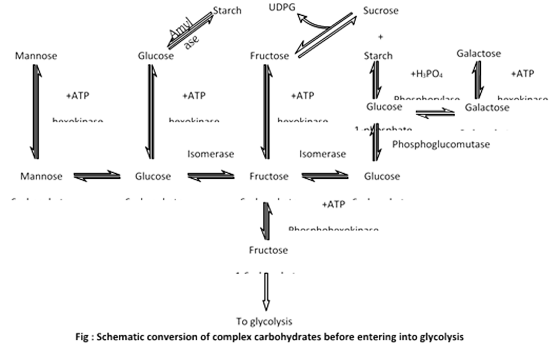 (5) Glycolysis cycle
 (6) Enzymes of glycolysis and their co-factors


 (iv) Enzymes of Kreb's cycle