
| Quantity of gas | Kinetic energy |
| 1 mole gas | \[\frac{3}{2}RT\]; R = Universal gas constant |
| \[\mu \] mole gas | \[\frac{3}{2}\mu RT\] |
| 1 molecule | \[\frac{3}{2}k\,T\]; k = Boltzmann?s constant |
| N molecule | \[\frac{3}{2}N\,k\,T\] |
| 1 gm gas | \[\frac{3}{2}rT\]; r = Specific gas constant |
| m gm gas |
 (2) Diatomic gas : Molecules of diatomic gas are made up of two atoms joined rigidly to one another through a bond. This cannot only move bodily, but also rotate about one of the three co-ordinate axes. However its moment of inertia about the axis joining the two atoms is negligible compared to that about the other two axes.
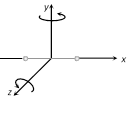 Hence it can have only two rotational motion. Thus a diatomic molecule has 5 degree of freedom : 3 translational and 2 rotational.
(3) Triatomic gas (Non-linear) : A non-linear molecule can rotate about any of three co-ordinate axes. Hence it has 6 degrees of freedom : 3 translational and 3 rotational.
Hence it can have only two rotational motion. Thus a diatomic molecule has 5 degree of freedom : 3 translational and 2 rotational.
(3) Triatomic gas (Non-linear) : A non-linear molecule can rotate about any of three co-ordinate axes. Hence it has 6 degrees of freedom : 3 translational and 3 rotational.
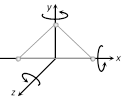 Degree of freedom for different gases
| Atomicity of gas | Example | A | B | f = 3 A - B | Figure |
| Monoatomic | He, Ne, Ar | 1 | 0 | f = 3 |  |
| Diatomic | \[{{H}_{2}},{{O}_{2}}{{,}_{{}}}{{N}_{2}},C{{l}_{2}}\] etc. | 2 | 1 | f = 5 |  |
| Triatomic non linear | \[{{H}_{2}}O\] | 3 | 3 | f = 6 |  |
| Triatomic linear | \[C{{O}_{2}},BeC{{l}_{2}}\] | 3 | 2 | f = 7 |  |
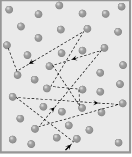 \[\lambda =\frac{{{\lambda }_{1}}+{{\lambda }_{2}}+{{\lambda }_{3}}+....+{{\lambda }_{n}}}{n}\]
(2) \[\lambda =\frac{1}{\sqrt{2}\pi n{{d}^{2}}}\]
where d = Diameter of the molecule,
n = Number of molecules per unit volume
(3) As \[PV=\mu RT=\mu NkT\Rightarrow \frac{N}{V}=\frac{P}{kT}=n=\]Number of molecule per unit volume so \[\lambda =\frac{1}{\sqrt{2}}\frac{kT}{\pi {{d}^{2}}P}\].
(4) From \[\lambda =\frac{1}{\sqrt{2}\pi n{{d}^{2}}}=\frac{m}{\sqrt{2}\pi (mn){{d}^{2}}}\]\[=\frac{m}{\sqrt{2}\pi {{d}^{2}}\rho }\]
[As m = Mass each molecule, mn = Mass per unit volume = Density \[=\rho \]]
(5) If average speed of molecule is v then \[\lambda =v\times \frac{t}{N}\]\[=v\times T\]
[As N = Number of collision in time t, T = time interval between two collisions].
(i) As \[\lambda \propto \frac{1}{\rho }\] and \[\lambda \propto \,m\] i.e. the mean free path is inversely proportional to the density of a gas and directly proportional to the mass of each molecule.
\[\lambda =\frac{{{\lambda }_{1}}+{{\lambda }_{2}}+{{\lambda }_{3}}+....+{{\lambda }_{n}}}{n}\]
(2) \[\lambda =\frac{1}{\sqrt{2}\pi n{{d}^{2}}}\]
where d = Diameter of the molecule,
n = Number of molecules per unit volume
(3) As \[PV=\mu RT=\mu NkT\Rightarrow \frac{N}{V}=\frac{P}{kT}=n=\]Number of molecule per unit volume so \[\lambda =\frac{1}{\sqrt{2}}\frac{kT}{\pi {{d}^{2}}P}\].
(4) From \[\lambda =\frac{1}{\sqrt{2}\pi n{{d}^{2}}}=\frac{m}{\sqrt{2}\pi (mn){{d}^{2}}}\]\[=\frac{m}{\sqrt{2}\pi {{d}^{2}}\rho }\]
[As m = Mass each molecule, mn = Mass per unit volume = Density \[=\rho \]]
(5) If average speed of molecule is v then \[\lambda =v\times \frac{t}{N}\]\[=v\times T\]
[As N = Number of collision in time t, T = time interval between two collisions].
(i) As \[\lambda \propto \frac{1}{\rho }\] and \[\lambda \propto \,m\] i.e. the mean free path is inversely proportional to the density of a gas and directly proportional to the mass of each molecule.
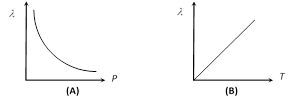
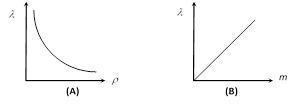 (ii) As \[\lambda =\frac{1}{\sqrt{2}}\frac{kT}{\pi {{d}^{2}}P}\]. For constant volume and hence constant number density n of gas molecules, \[\frac{P}{T}\] is constant so that l will not depend on P and T. But if volume of given mass of a gas is allowed to change with P or T then \[\lambda \propto T\] at constant pressure and \[\lambda \propto \frac{1}{P}\] at constant temperature.
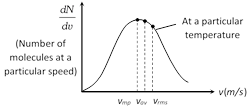 (3) Graph between \[\frac{dN}{dv}\] (number of molecules at a particular speed) and v (speed of these molecules). From the graph it is seen that \[\frac{dN}{dv}\] is maximum at most probable speed.
This graph also represent that \[{{v}_{rms}}>{{v}_{av}}>{{v}_{mp}}\]
(Order remember trick RAM)
\[\Rightarrow \]\[\sqrt{\frac{3RT}{M}}\,>\sqrt{\frac{8RT}{\pi M}}\,>\,\sqrt{\frac{2RT}{M}}\]\[\Rightarrow \]\[1.77\sqrt{\frac{RT}{M}}>1.6\sqrt{\frac{RT}{M}}\,>\,1.41\sqrt{\frac{RT}{M}}\]
Area bonded by this curve with speed axis represents the number of molecules corresponds to that velocity range. This curve is asymmetric curve.
Effect of temperature on velocity distribution : With temperature rise the \[\frac{dN}{dv}\,\text{vs}\,v\]. Curve shift towards right and becomes broader.
(3) Graph between \[\frac{dN}{dv}\] (number of molecules at a particular speed) and v (speed of these molecules). From the graph it is seen that \[\frac{dN}{dv}\] is maximum at most probable speed.
This graph also represent that \[{{v}_{rms}}>{{v}_{av}}>{{v}_{mp}}\]
(Order remember trick RAM)
\[\Rightarrow \]\[\sqrt{\frac{3RT}{M}}\,>\sqrt{\frac{8RT}{\pi M}}\,>\,\sqrt{\frac{2RT}{M}}\]\[\Rightarrow \]\[1.77\sqrt{\frac{RT}{M}}>1.6\sqrt{\frac{RT}{M}}\,>\,1.41\sqrt{\frac{RT}{M}}\]
Area bonded by this curve with speed axis represents the number of molecules corresponds to that velocity range. This curve is asymmetric curve.
Effect of temperature on velocity distribution : With temperature rise the \[\frac{dN}{dv}\,\text{vs}\,v\]. Curve shift towards right and becomes broader.
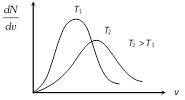 (Because with temperature rise average molecular speed increases).
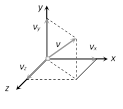
 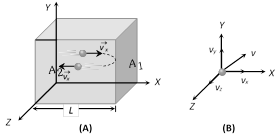 (1) Instantaneous velocity : Any molecule of gas moves with velocity \[\vec{v}\] in any direction
Where \[\vec{v}={{v}_{x}}\hat{i}+{{v}_{y}}\hat{j}+{{v}_{z}}\hat{k}\] \[\Rightarrow \] \[v=\sqrt{v_{x}^{2}+v_{y}^{2}+v_{z}^{2}}\]. Due to random motion of molecule \[{{v}_{x}}={{v}_{y}}={{v}_{z}}\] \[\Rightarrow \] \[{{v}^{2}}=3v_{x}^{2}=3v_{y}^{2}=3v_{z}^{2}\]
(2) Time during collision : Time between two successive collision with the wall \[{{A}_{1}}\].
\[\Delta t=\frac{\text{Distance travelled by molecule between two successive collision}}{\text{Velocity of molecule}}\]
\[=\frac{2L}{{{v}_{x}}}\]
(3) Collision frequency (n) : It means the number of collision per second. Hence \[n=\frac{1}{\Delta t}=\frac{{{v}_{x}}}{2L}\]
(4) Change in momentum : This molecule collides with the shaded wall \[({{A}_{1}})\] with velocity \[{{v}_{x}}\] and rebounds with velocity \[-{{v}_{x}}\].
The change in momentum of the molecule
\[\Delta p=(-m{{v}_{x}})-(m{{v}_{x}})=-2m{{v}_{x}}\]
As the momentum remains conserved in a collision, the change in momentum of the wall \[{{A}_{1}}\] is \[\Delta p=2m{{v}_{x}}\]
After rebound this molecule travel toward opposite wall \[{{A}_{2}}\] with velocity \[-{{v}_{x}}\], collide to it and again rebound with velocity \[{{v}_{x}}\] towards wall \[{{A}_{1}}\].
(5) Force on wall : Force exerted by a single molecule on shaded wall is equal to rate at which the momentum is transferred to the wall by this molecule.
i.e. \[{{F}_{\text{Single molecule}}}=\frac{\Delta p}{\Delta t}=\frac{2m{{v}_{x}}}{(2L/{{v}_{x}})}=\frac{mv_{x}^{2}}{L}\]
The total force on the wall \[{{A}_{1}}\] due to all the molecules
\[{{F}_{x}}=\frac{m}{L}\sum{v_{x}^{2}}\]\[=\frac{m}{M}(v_{{{x}_{1}}}^{2}+v_{{{x}_{2}}}^{2}+v_{{{x}_{3}}}^{2}+...)=\frac{mN}{L}\overline{v_{x}^{2}}\]
\[\overline{v_{x}^{2}}=\]mean square of \[x\] component of the velocity.
(6) Pressure : Now pressure is defined as force per unit area, hence pressure on shaded wall \[{{P}_{x}}=\frac{{{F}_{x}}}{A}=\frac{mN}{AL}\overline{v_{x}^{2}}=\frac{mN}{V}\overline{v_{x}^{2}}\]
For any molecule, the mean square velocity \[\overline{{{v}^{2}}}=\overline{v_{x}^{2}}+\overline{v_{y}^{2}}+\overline{v_{z}^{2}}\]; by symmetry
\[\overline{v_{x}^{2}}=\overline{v_{y}^{2}}=\overline{v_{z}^{2}}\]
\[\Rightarrow\]\ \overline{v_{x}^{2}}=\overline{v_{y}^{2}}=\overline{v_{z}^{2}}=\frac{\overline{{{v}^{2}}}}{3}\]
Total pressure inside the container
\[P=\frac{1}{3}\frac{mN}{V}\overline{{{v}^{2}}}=\frac{1}{3}\frac{m\,N}{V}v_{rms}^{2}\] (where \[{{v}_{rms}}=\sqrt{\overline{{{v}^{2}}}}\])
(7) Relation between pressure and kinetic energy : As we know \[P=\frac{1}{3}\frac{m\,N}{V}v_{rms}^{2}\]\[=\frac{1}{3}\frac{M}{V}v_{rms}^{2}\]\[\Rightarrow \]\[P=\frac{1}{3}\rho \,v_{rms}^{2}\] ... (i)
[As M = mN = Total mass of the gas and \[\rho =\frac{M}{V}\]]
\[\therefore \] K.E. per unit volume \[E=\frac{1}{2}\left( \frac{M}{V} \right)\,v_{rms}^{2}=\frac{1}{2}\rho \,v_{rms}^{2}\] ...(ii)
From (i) and (ii), we get \[P=\frac{2}{3}E\]
i.e. the pressure exerted by an ideal gas is numerically equal to the two third of the mean kinetic energy of translation per unit volume of the gas.
(8) Effect of mass, volume and temperature on pressure : \[P=\frac{1}{3}\frac{m\,N}{V}v_{rms}^{2}\] or \[P\propto \frac{(m\,N)T}{V}\] [As \[v_{rms}^{2}\propto T\]]
(i) If volume and temperature of a gas are constant \[P\propto mN\] i.e. Pressure µ (Mass of gas). i.e. if mass of gas is increased, number of molecules and hence number of collision per second increases i.e. pressure will increase.
(ii) If mass and temperature of a gas are constant. \[P\propto (1/V)\], i.e., if volume decreases, number of collisions per second will increase due to lesser effective distance between the walls resulting in greater pressure.
(iii) If mass and volume of gas are constant, \[P\propto {{({{v}_{rms}})}^{2}}\propto T\]
i.e., if temperature increases, the mean square speed of gas molecules will increase and as gas molecules are moving faster, they will collide with the walls more often with greater momentum resulting in greater pressure.
(1) Instantaneous velocity : Any molecule of gas moves with velocity \[\vec{v}\] in any direction
Where \[\vec{v}={{v}_{x}}\hat{i}+{{v}_{y}}\hat{j}+{{v}_{z}}\hat{k}\] \[\Rightarrow \] \[v=\sqrt{v_{x}^{2}+v_{y}^{2}+v_{z}^{2}}\]. Due to random motion of molecule \[{{v}_{x}}={{v}_{y}}={{v}_{z}}\] \[\Rightarrow \] \[{{v}^{2}}=3v_{x}^{2}=3v_{y}^{2}=3v_{z}^{2}\]
(2) Time during collision : Time between two successive collision with the wall \[{{A}_{1}}\].
\[\Delta t=\frac{\text{Distance travelled by molecule between two successive collision}}{\text{Velocity of molecule}}\]
\[=\frac{2L}{{{v}_{x}}}\]
(3) Collision frequency (n) : It means the number of collision per second. Hence \[n=\frac{1}{\Delta t}=\frac{{{v}_{x}}}{2L}\]
(4) Change in momentum : This molecule collides with the shaded wall \[({{A}_{1}})\] with velocity \[{{v}_{x}}\] and rebounds with velocity \[-{{v}_{x}}\].
The change in momentum of the molecule
\[\Delta p=(-m{{v}_{x}})-(m{{v}_{x}})=-2m{{v}_{x}}\]
As the momentum remains conserved in a collision, the change in momentum of the wall \[{{A}_{1}}\] is \[\Delta p=2m{{v}_{x}}\]
After rebound this molecule travel toward opposite wall \[{{A}_{2}}\] with velocity \[-{{v}_{x}}\], collide to it and again rebound with velocity \[{{v}_{x}}\] towards wall \[{{A}_{1}}\].
(5) Force on wall : Force exerted by a single molecule on shaded wall is equal to rate at which the momentum is transferred to the wall by this molecule.
i.e. \[{{F}_{\text{Single molecule}}}=\frac{\Delta p}{\Delta t}=\frac{2m{{v}_{x}}}{(2L/{{v}_{x}})}=\frac{mv_{x}^{2}}{L}\]
The total force on the wall \[{{A}_{1}}\] due to all the molecules
\[{{F}_{x}}=\frac{m}{L}\sum{v_{x}^{2}}\]\[=\frac{m}{M}(v_{{{x}_{1}}}^{2}+v_{{{x}_{2}}}^{2}+v_{{{x}_{3}}}^{2}+...)=\frac{mN}{L}\overline{v_{x}^{2}}\]
\[\overline{v_{x}^{2}}=\]mean square of \[x\] component of the velocity.
(6) Pressure : Now pressure is defined as force per unit area, hence pressure on shaded wall \[{{P}_{x}}=\frac{{{F}_{x}}}{A}=\frac{mN}{AL}\overline{v_{x}^{2}}=\frac{mN}{V}\overline{v_{x}^{2}}\]
For any molecule, the mean square velocity \[\overline{{{v}^{2}}}=\overline{v_{x}^{2}}+\overline{v_{y}^{2}}+\overline{v_{z}^{2}}\]; by symmetry
\[\overline{v_{x}^{2}}=\overline{v_{y}^{2}}=\overline{v_{z}^{2}}\]
\[\Rightarrow\]\ \overline{v_{x}^{2}}=\overline{v_{y}^{2}}=\overline{v_{z}^{2}}=\frac{\overline{{{v}^{2}}}}{3}\]
Total pressure inside the container
\[P=\frac{1}{3}\frac{mN}{V}\overline{{{v}^{2}}}=\frac{1}{3}\frac{m\,N}{V}v_{rms}^{2}\] (where \[{{v}_{rms}}=\sqrt{\overline{{{v}^{2}}}}\])
(7) Relation between pressure and kinetic energy : As we know \[P=\frac{1}{3}\frac{m\,N}{V}v_{rms}^{2}\]\[=\frac{1}{3}\frac{M}{V}v_{rms}^{2}\]\[\Rightarrow \]\[P=\frac{1}{3}\rho \,v_{rms}^{2}\] ... (i)
[As M = mN = Total mass of the gas and \[\rho =\frac{M}{V}\]]
\[\therefore \] K.E. per unit volume \[E=\frac{1}{2}\left( \frac{M}{V} \right)\,v_{rms}^{2}=\frac{1}{2}\rho \,v_{rms}^{2}\] ...(ii)
From (i) and (ii), we get \[P=\frac{2}{3}E\]
i.e. the pressure exerted by an ideal gas is numerically equal to the two third of the mean kinetic energy of translation per unit volume of the gas.
(8) Effect of mass, volume and temperature on pressure : \[P=\frac{1}{3}\frac{m\,N}{V}v_{rms}^{2}\] or \[P\propto \frac{(m\,N)T}{V}\] [As \[v_{rms}^{2}\propto T\]]
(i) If volume and temperature of a gas are constant \[P\propto mN\] i.e. Pressure µ (Mass of gas). i.e. if mass of gas is increased, number of molecules and hence number of collision per second increases i.e. pressure will increase.
(ii) If mass and temperature of a gas are constant. \[P\propto (1/V)\], i.e., if volume decreases, number of collisions per second will increase due to lesser effective distance between the walls resulting in greater pressure.
(iii) If mass and volume of gas are constant, \[P\propto {{({{v}_{rms}})}^{2}}\propto T\]
i.e., if temperature increases, the mean square speed of gas molecules will increase and as gas molecules are moving faster, they will collide with the walls more often with greater momentum resulting in greater pressure. 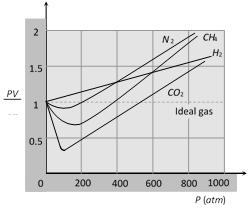 (5) Deviation from ideal behaviour as a function of temperature
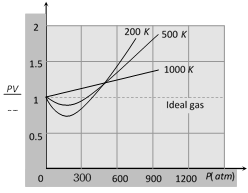 (6) A real gas behaves as ideal gas most closely at low pressure and high temperature. Also can actual gas can be liquefied most easily which deviates most from ideal gas behaviour at low temperature and high pressure.
(7) Equation of state for real gases : It is given by Vander Waal's with two correction in ideal gas equation. The it know as Vander Waal's gas equation.
(i) Volume correction : Due to finite size of molecule, a certain portion of volume of a gas is covered by the molecules themselves. Therefore the space available for the free motion of molecules of gas will be slightly less than the volume V of a gas. Hence the effective volume becomes \[(V-b)\].
(ii) Pressure correction : Due to intermolecular force in real gases, molecule do not exert that force on the wall which they would have exerted in the absence of intermolecular force. Therefore the observed pressure P of the gas will be less than that present in the absence of intermolecular force. Hence the effective pressure becomes \[\left( P+\frac{a}{{{V}^{2}}} \right)\].
(iii) Vander Waal's gas equations
For 1 mole of gas \[\left( P+\frac{a}{{{V}^{2}}} \right)\,(V-b)=RT\]
For \[\mu \] moles of gas \[\left( P+\frac{a{{\mu }^{2}}}{{{V}^{2}}} \right)\ (V-\mu b)=\mu \,RT\]
Here a and b are constant called Vander Waalís constant.
Dimension : \[[a]=[M{{L}^{5}}{{T}^{-2}}]\] and \[[b]=[{{L}^{3}}]\]
Units : \[a=N\times {{m}^{4}}\] and \[b={{m}^{3}}\].
(8) Andrews curves : The pressure (P) versus volume (V) curves for actual gases are called Andrews curves.
(6) A real gas behaves as ideal gas most closely at low pressure and high temperature. Also can actual gas can be liquefied most easily which deviates most from ideal gas behaviour at low temperature and high pressure.
(7) Equation of state for real gases : It is given by Vander Waal's with two correction in ideal gas equation. The it know as Vander Waal's gas equation.
(i) Volume correction : Due to finite size of molecule, a certain portion of volume of a gas is covered by the molecules themselves. Therefore the space available for the free motion of molecules of gas will be slightly less than the volume V of a gas. Hence the effective volume becomes \[(V-b)\].
(ii) Pressure correction : Due to intermolecular force in real gases, molecule do not exert that force on the wall which they would have exerted in the absence of intermolecular force. Therefore the observed pressure P of the gas will be less than that present in the absence of intermolecular force. Hence the effective pressure becomes \[\left( P+\frac{a}{{{V}^{2}}} \right)\].
(iii) Vander Waal's gas equations
For 1 mole of gas \[\left( P+\frac{a}{{{V}^{2}}} \right)\,(V-b)=RT\]
For \[\mu \] moles of gas \[\left( P+\frac{a{{\mu }^{2}}}{{{V}^{2}}} \right)\ (V-\mu b)=\mu \,RT\]
Here a and b are constant called Vander Waalís constant.
Dimension : \[[a]=[M{{L}^{5}}{{T}^{-2}}]\] and \[[b]=[{{L}^{3}}]\]
Units : \[a=N\times {{m}^{4}}\] and \[b={{m}^{3}}\].
(8) Andrews curves : The pressure (P) versus volume (V) curves for actual gases are called Andrews curves.
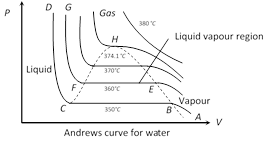 (i) At \[{{350}^{o}}C,\] part AB represents vapour phase of water, in this part Boyle?s law is obeyed \[\left( P\propto \frac{1}{V} \right)\]. Part BC represents the co-existence of vapour and liquid phases. At point C, vapours completely change to liquid phase. Part CD is parallel to pressure axis which shows that compressibility of the water is negligible.
(ii) At \[{{360}^{o}}C\] portion representing the co-existence of liquid vapour phase is shorter.
(iii) At \[{{370}^{o}}C\] this portion is further decreased.
(iv) At \[{{374.1}^{o}}C,\] it reduces to point (H) called critical point and the temperature \[{{374.1}^{o}}C\] is called critical temperature \[({{T}_{c}})\] of water.
(v) The phase of water (at \[{{380}^{o}}C\]) above the critical temperature is called gaseous phase.
(9) Critical temperature, pressure and volume : The point on the P-V curve at which the matter gets converted from gaseous state to liquid state is known as critical point. At this point the difference between the liquid and vapour more...
(i) At \[{{350}^{o}}C,\] part AB represents vapour phase of water, in this part Boyle?s law is obeyed \[\left( P\propto \frac{1}{V} \right)\]. Part BC represents the co-existence of vapour and liquid phases. At point C, vapours completely change to liquid phase. Part CD is parallel to pressure axis which shows that compressibility of the water is negligible.
(ii) At \[{{360}^{o}}C\] portion representing the co-existence of liquid vapour phase is shorter.
(iii) At \[{{370}^{o}}C\] this portion is further decreased.
(iv) At \[{{374.1}^{o}}C,\] it reduces to point (H) called critical point and the temperature \[{{374.1}^{o}}C\] is called critical temperature \[({{T}_{c}})\] of water.
(v) The phase of water (at \[{{380}^{o}}C\]) above the critical temperature is called gaseous phase.
(9) Critical temperature, pressure and volume : The point on the P-V curve at which the matter gets converted from gaseous state to liquid state is known as critical point. At this point the difference between the liquid and vapour more... | Quantity of gas | Equation | Constant |
| 1 mole gas | \[PV=RT\] | R = universal gas constant |
| \[\mu \] mole gas | \[PV=\mu RT\] | |
| 1 molecule of gas | \[PV=\left( \frac{R}{{{N}_{A}}} \right)\,T=kT\] | k = Boltzmann's constant |
| N molecules of gas | \[PV=NkT\] | |
| 1 gm of gas | \[PV=\left( \frac{R}{M} \right)\,T=rT\] | r = Specific gas constant |
| m gm of gas | \[PV=mrT\] |
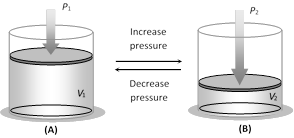 i.e. \[V\propto \frac{1}{P}\] or PV = constant \[\Rightarrow \] \[{{P}_{1}}{{V}_{1}}={{P}_{2}}{{V}_{2}}\]
(i) \[PV=P\,\left( \frac{m}{\rho } \right)=\] constant \[\Rightarrow \] \[\frac{P}{\rho }=\text{constant}\] or \[\frac{{{P}_{1}}}{{{\rho }_{1}}}=\frac{{{P}_{2}}}{{{\rho }_{2}}}\]
(As volume \[=\frac{m}{\rho (\text{Density of the gas)}}\]and m = constant)
(ii) \[PV=P\left( \frac{N}{n} \right)=\text{constant}\] \[\Rightarrow \] \[\frac{P}{n}=\text{constant}\] or \[\frac{{{P}_{1}}}{{{n}_{1}}}=\frac{{{P}_{2}}}{{{n}_{2}}}\]
(iii) As number of molecules per unit volume \[n=\frac{N}{V}\]
\[\Rightarrow \] \[V=\frac{N}{n}\] also N = constant
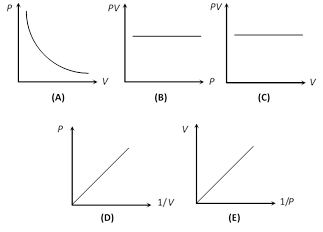
(iv) Graphical representation : If m and T are constant
i.e. \[V\propto \frac{1}{P}\] or PV = constant \[\Rightarrow \] \[{{P}_{1}}{{V}_{1}}={{P}_{2}}{{V}_{2}}\]
(i) \[PV=P\,\left( \frac{m}{\rho } \right)=\] constant \[\Rightarrow \] \[\frac{P}{\rho }=\text{constant}\] or \[\frac{{{P}_{1}}}{{{\rho }_{1}}}=\frac{{{P}_{2}}}{{{\rho }_{2}}}\]
(As volume \[=\frac{m}{\rho (\text{Density of the gas)}}\]and m = constant)
(ii) \[PV=P\left( \frac{N}{n} \right)=\text{constant}\] \[\Rightarrow \] \[\frac{P}{n}=\text{constant}\] or \[\frac{{{P}_{1}}}{{{n}_{1}}}=\frac{{{P}_{2}}}{{{n}_{2}}}\]
(iii) As number of molecules per unit volume \[n=\frac{N}{V}\]
\[\Rightarrow \] \[V=\frac{N}{n}\] also N = constant
(iv) Graphical representation : If m and T are constant
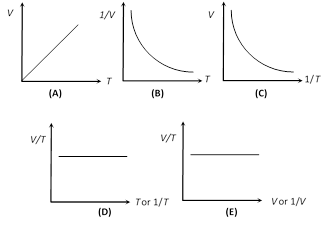
 (2) Charle's law : If the pressure remaining constant, the volume of the given mass of a gas is directly proportional to its absolute temperature.
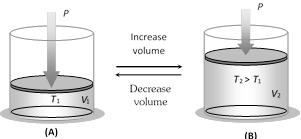 i.e., \[V\propto T\] \[\Rightarrow \] \[\frac{V}{T}=\text{constant}\]\[\Rightarrow \]\[\frac{{{V}_{1}}}{{{T}_{1}}}=\frac{{{V}_{2}}}{{{T}_{2}}}\]
(i) \[\frac{V}{T}=\]\[\frac{m}{\rho T}=\text{constant}\] (As volume \[V=\frac{m}{\rho }\])
or \[\rho T=\text{constant}\]\[\Rightarrow \]\[{{\rho }_{1}}{{T}_{1}}={{\rho }_{2}}{{T}_{2}}\]
(ii) If the pressure remains constant, the volume of the given mass of a gas increases or decreases by \[\frac{1}{273.15}\] of its volume at \[{{0}^{o}}C\] for each \[{{1}^{o}}C\] rise or fall in temperature.
i.e., \[V\propto T\] \[\Rightarrow \] \[\frac{V}{T}=\text{constant}\]\[\Rightarrow \]\[\frac{{{V}_{1}}}{{{T}_{1}}}=\frac{{{V}_{2}}}{{{T}_{2}}}\]
(i) \[\frac{V}{T}=\]\[\frac{m}{\rho T}=\text{constant}\] (As volume \[V=\frac{m}{\rho }\])
or \[\rho T=\text{constant}\]\[\Rightarrow \]\[{{\rho }_{1}}{{T}_{1}}={{\rho }_{2}}{{T}_{2}}\]
(ii) If the pressure remains constant, the volume of the given mass of a gas increases or decreases by \[\frac{1}{273.15}\] of its volume at \[{{0}^{o}}C\] for each \[{{1}^{o}}C\] rise or fall in temperature.
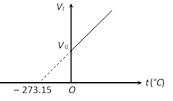 \[{{V}_{t}}={{V}_{0}}\left( 1+\frac{1}{273.15}t \right)\].
This is Charle?s law for centigrade scale. (v) Graphical representation: If m and P are constant
\[{{V}_{t}}={{V}_{0}}\left( 1+\frac{1}{273.15}t \right)\].
This is Charle?s law for centigrade scale. (v) Graphical representation: If m and P are constant
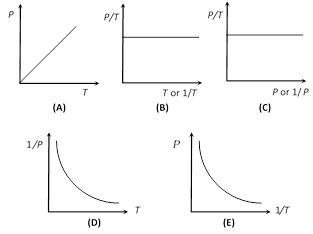
 (3) Gay-Lussac's law or pressure law : The volume remaining constant, the pressure of a given mass of a gas is directly proportional to its absolute temperature.
\[P\propto T\] or \[\frac{P}{T}=\text{constant}\] \[\Rightarrow \] \[\frac{{{P}_{1}}}{{{T}_{1}}}=\frac{{{P}_{2}}}{{{T}_{2}}}\]
(i) The volume remaining constant, the pressure of a given mass of a gas increases or decreases by \[\frac{1}{273.15}\] of its pressure at \[{{0}^{o}}C\] for each \[{{1}^{o}}C\] rise or fall in temperature.
(3) Gay-Lussac's law or pressure law : The volume remaining constant, the pressure of a given mass of a gas is directly proportional to its absolute temperature.
\[P\propto T\] or \[\frac{P}{T}=\text{constant}\] \[\Rightarrow \] \[\frac{{{P}_{1}}}{{{T}_{1}}}=\frac{{{P}_{2}}}{{{T}_{2}}}\]
(i) The volume remaining constant, the pressure of a given mass of a gas increases or decreases by \[\frac{1}{273.15}\] of its pressure at \[{{0}^{o}}C\] for each \[{{1}^{o}}C\] rise or fall in temperature.
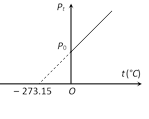 \[{{P}_{t}}={{P}_{0}}\left[ 1+\frac{1}{273.15}t \right]\]
This is pressure law for centigrade scale.
(ii) Graphical representation : If m and V are constants
\[{{P}_{t}}={{P}_{0}}\left[ 1+\frac{1}{273.15}t \right]\]
This is pressure law for centigrade scale.
(ii) Graphical representation : If m and V are constants
 (4) Avogadro's law : Equal volume of all the gases under similar conditions of temperature and pressure contain equal number of molecules i.e. \[{{N}_{1}}={{N}_{2}}\].
(5) Grahm's law of diffusion : When two gases at the same pressure and temperature are allowed to diffuse into each other, the rate of diffusion of each gas is inversely proportional to the square root of the density of the gas i.e. \[r\propto \frac{1}{\sqrt{\rho }}\] \[\propto \] \[\frac{1}{\sqrt{M}}\]
(M is the molecular weight of the gas) \[\Rightarrow \] \[\frac{{{r}_{1}}}{{{r}_{2}}}=\sqrt{\frac{{{\rho }_{2}}}{{{\rho }_{1}}}}\]\[=\sqrt{\frac{{{M}_{2}}}{{{M}_{1}}}}\]
If V is the volume of gas diffused in t sec then
\[r=\frac{V}{t}\]\[\Rightarrow \]\[\frac{{{r}_{1}}}{{{r}_{2}}}=\frac{{{V}_{1}}}{{{V}_{2}}}\times \frac{{{t}_{2}}}{{{t}_{1}}}\]
(6) Dalton?s law of partial pressure : The total pressure exerted by a mixture of non-reacting gases occupying a vessel is equal to the sum of the individual pressures which each gases exert if it alone occupied the same volume at a given temperature.
For n gases \[P={{P}_{1}}+{{P}_{2}}+{{P}_{3}}+.....{{P}_{n}}\]
where P = Pressure exerted by mixture and \[{{P}_{1}},\,{{P}_{2}},\,{{P}_{3}},\,......{{P}_{n}}=\]Partial pressure of component gases.
(4) Avogadro's law : Equal volume of all the gases under similar conditions of temperature and pressure contain equal number of molecules i.e. \[{{N}_{1}}={{N}_{2}}\].
(5) Grahm's law of diffusion : When two gases at the same pressure and temperature are allowed to diffuse into each other, the rate of diffusion of each gas is inversely proportional to the square root of the density of the gas i.e. \[r\propto \frac{1}{\sqrt{\rho }}\] \[\propto \] \[\frac{1}{\sqrt{M}}\]
(M is the molecular weight of the gas) \[\Rightarrow \] \[\frac{{{r}_{1}}}{{{r}_{2}}}=\sqrt{\frac{{{\rho }_{2}}}{{{\rho }_{1}}}}\]\[=\sqrt{\frac{{{M}_{2}}}{{{M}_{1}}}}\]
If V is the volume of gas diffused in t sec then
\[r=\frac{V}{t}\]\[\Rightarrow \]\[\frac{{{r}_{1}}}{{{r}_{2}}}=\frac{{{V}_{1}}}{{{V}_{2}}}\times \frac{{{t}_{2}}}{{{t}_{1}}}\]
(6) Dalton?s law of partial pressure : The total pressure exerted by a mixture of non-reacting gases occupying a vessel is equal to the sum of the individual pressures which each gases exert if it alone occupied the same volume at a given temperature.
For n gases \[P={{P}_{1}}+{{P}_{2}}+{{P}_{3}}+.....{{P}_{n}}\]
where P = Pressure exerted by mixture and \[{{P}_{1}},\,{{P}_{2}},\,{{P}_{3}},\,......{{P}_{n}}=\]Partial pressure of component gases. 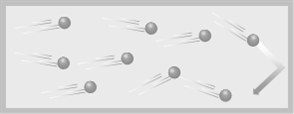 Kinetic theory of gases relates the macroscopic properties of gases (such as pressure, temperature etc.) to the microscopic properties of the gas molecules (such as speed, momentum, kinetic energy of molecule etc.)
Actually it attempts to develop a model of the molecular behaviour which should result in the observed behaviour of an ideal gas. It is based on following assumptions :
(1) Every gas consists of extremely small particles known as molecules. The molecules of a given gas are all identical but are different than those of another gas.
(2) The molecules of a gas are identical, spherical, rigid and perfectly elastic point masses.
(3) Their size is negligible in comparison to intermolecular distance \[({{10}^{-9}}\,m)\]
(4) The volume of molecules is negligible in comparison to the volume of gas. (The volume of molecules is only 0.014% of the volume of the gas).
(5) Molecules of a gas keep on moving randomly in all possible direction with all possible velocities.
(6) The speed of gas molecules lie between zero and infinity
(7) The gas molecules keep on colliding among themselves as well as with the walls of containing vessel. These collisions are perfectly elastic.
(8) The time spent in a collision between two molecules is negligible in comparison to time between two successive collisions.
(9) The number of collisions per unit volume in a gas remains constant.
(10) No attractive or repulsive force acts between gas molecules.
(11) Gravitational attraction among the molecules is ineffective due to extremely small masses and very high speed of molecules.
(12) Molecules constantly collide with the walls of container due to which their momentum changes. The change in momentum is transferred to the walls of the container. Consequently pressure is exerted by gas molecules on the walls of container.
(13) The density of gas is constant at all points of the container.
Kinetic theory of gases relates the macroscopic properties of gases (such as pressure, temperature etc.) to the microscopic properties of the gas molecules (such as speed, momentum, kinetic energy of molecule etc.)
Actually it attempts to develop a model of the molecular behaviour which should result in the observed behaviour of an ideal gas. It is based on following assumptions :
(1) Every gas consists of extremely small particles known as molecules. The molecules of a given gas are all identical but are different than those of another gas.
(2) The molecules of a gas are identical, spherical, rigid and perfectly elastic point masses.
(3) Their size is negligible in comparison to intermolecular distance \[({{10}^{-9}}\,m)\]
(4) The volume of molecules is negligible in comparison to the volume of gas. (The volume of molecules is only 0.014% of the volume of the gas).
(5) Molecules of a gas keep on moving randomly in all possible direction with all possible velocities.
(6) The speed of gas molecules lie between zero and infinity
(7) The gas molecules keep on colliding among themselves as well as with the walls of containing vessel. These collisions are perfectly elastic.
(8) The time spent in a collision between two molecules is negligible in comparison to time between two successive collisions.
(9) The number of collisions per unit volume in a gas remains constant.
(10) No attractive or repulsive force acts between gas molecules.
(11) Gravitational attraction among the molecules is ineffective due to extremely small masses and very high speed of molecules.
(12) Molecules constantly collide with the walls of container due to which their momentum changes. The change in momentum is transferred to the walls of the container. Consequently pressure is exerted by gas molecules on the walls of container.
(13) The density of gas is constant at all points of the container. 





You need to login to perform this action.
You will be redirected in
3 sec