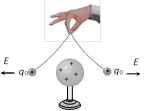
 (1) Electric field intensity \[(\vec{E})\]: The electric field intensity at any point is defined as the force experienced by a unit positive charge placed at that point. \[\vec{E}= \frac{{\vec{F}}}{{{q}_{0}}}\]
Where \[{{q}_{0}}\to 0\] so that presence of this charge may not affect the source charge Q and its electric field is not changed, therefore expression for electric field intensity can be better written as \[\vec{E}=\underset{{{q}_{0}}\to 0}{\mathop{\text{Lim}}}\,\,\,\,\frac{{\vec{F}}}{{{q}_{\mathbf{0}}}}\]
(2) Unit and Dimensional formula
It's S.I. unit \[\frac{Newton}{coulomb}=\frac{volt}{meter}=\frac{Joule}{coulomb\times meter}\]
and C.G.S. unit - dyne/stat coulomb.
Dimension :\[[E]=[ML{{T}^{-3}}{{A}^{-1}}]\]
(3) Direction of electric field : Electric field (intensity) \[\vec{E}\] is a vector quantity. Electric field due to a positive charge is always away from the charge and that due to a negative charge is always towards the charge.
(4) Relation between electric force and electric field : In an electric field \[\vec{E}\] a charge (Q) experiences a force \[\overrightarrow{F}=Q\overrightarrow{E}\]. If charge is positive then force is directed in the direction of field while if charge is negative force acts on it in the opposite direction of field
(1) Electric field intensity \[(\vec{E})\]: The electric field intensity at any point is defined as the force experienced by a unit positive charge placed at that point. \[\vec{E}= \frac{{\vec{F}}}{{{q}_{0}}}\]
Where \[{{q}_{0}}\to 0\] so that presence of this charge may not affect the source charge Q and its electric field is not changed, therefore expression for electric field intensity can be better written as \[\vec{E}=\underset{{{q}_{0}}\to 0}{\mathop{\text{Lim}}}\,\,\,\,\frac{{\vec{F}}}{{{q}_{\mathbf{0}}}}\]
(2) Unit and Dimensional formula
It's S.I. unit \[\frac{Newton}{coulomb}=\frac{volt}{meter}=\frac{Joule}{coulomb\times meter}\]
and C.G.S. unit - dyne/stat coulomb.
Dimension :\[[E]=[ML{{T}^{-3}}{{A}^{-1}}]\]
(3) Direction of electric field : Electric field (intensity) \[\vec{E}\] is a vector quantity. Electric field due to a positive charge is always away from the charge and that due to a negative charge is always towards the charge.
(4) Relation between electric force and electric field : In an electric field \[\vec{E}\] a charge (Q) experiences a force \[\overrightarrow{F}=Q\overrightarrow{E}\]. If charge is positive then force is directed in the direction of field while if charge is negative force acts on it in the opposite direction of field
 (5) Super position of electric field (electric field at a point due to various charges) : The resultant electric field at any point is equal to the vector sum of electric fields at that point due to various charges i.e. \[\vec{E}={{\vec{E}}_{1}}+{{\vec{E}}_{2}}+{{\vec{E}}_{3}}+...\]
(6) Electric field due to continuous distribution of charge : A system of closely spaced electric charges forms a continuous charge distribution. To find the field of a continuous charge distribution, we divide the charge into infinitesimal charge elements. Each infinitesimal charge element is then considered, as a point charge and electric field \[\overrightarrow{dE}\] is determined due to this charge at given point. The Net field at the given point is the summation of fields of all the elements. i.e., \[\overrightarrow{E\,}=\int{\overrightarrow{dE}}\].
(5) Super position of electric field (electric field at a point due to various charges) : The resultant electric field at any point is equal to the vector sum of electric fields at that point due to various charges i.e. \[\vec{E}={{\vec{E}}_{1}}+{{\vec{E}}_{2}}+{{\vec{E}}_{3}}+...\]
(6) Electric field due to continuous distribution of charge : A system of closely spaced electric charges forms a continuous charge distribution. To find the field of a continuous charge distribution, we divide the charge into infinitesimal charge elements. Each infinitesimal charge element is then considered, as a point charge and electric field \[\overrightarrow{dE}\] is determined due to this charge at given point. The Net field at the given point is the summation of fields of all the elements. i.e., \[\overrightarrow{E\,}=\int{\overrightarrow{dE}}\]. 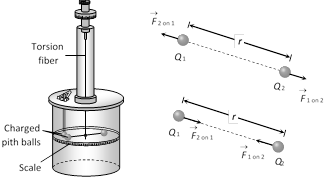 \[F\propto \frac{Q{}_{1}Q{}_{{{2}_{{}}}}}{{{r}^{2}}}\] i.e., \[F=\frac{kQ{}_{1}Q{}_{2}}{{{r}^{2}}}\](k = Proportionality constant)
In C.G.S. (for air ) \[k=1,\] \[F=\frac{{{Q}_{1}}\,{{Q}_{2}}}{{{r}^{2}}}\] Dyne
In S.I. (for air) \[k=\frac{1}{4\pi {{\varepsilon }_{0}}}=9\times {{10}^{9}}\frac{N\text{-}m{}^{2}}{C{}^{2}}\]
\[\Rightarrow \] \[F=\frac{1}{4\pi {{\varepsilon }_{0}}}.\frac{{{Q}_{1}}{{Q}_{2}}}{{{r}^{2}}}\] Newton (1 Newton \[={{10}^{5}}\] Dyne)
\[{{\varepsilon }_{0}}=\]Absolute permittivity of air or free space
\[=8.85\times {{10}^{-12}}\frac{{{C}^{2}}}{N-{{m}^{2}}}\]\[\left( =\frac{Farad}{m} \right)\]. It's Dimensional formula is \[[{{M}^{-1}}{{L}^{-3}}{{T}^{4}}{{A}^{2}}]\]
(1) Vector form of coulomb's law : Vector form of Coulomb's law is \[{{\overrightarrow{F\,}}_{12}}=K.\frac{{{Q}_{1}}{{Q}_{2}}}{{{r}^{3}}}{{\overrightarrow{\,r}}_{12}}=K.\frac{{{Q}_{1}}{{Q}_{2}}}{{{r}^{2}}}{{\hat{r}}_{12}},\] where \[{{\hat{r}}_{12}}\] is the unit vector from first charge to second charge along the line joining the two charges.
(2) Effect of medium : When a dielectric medium is completely filled in between charges rearrangement of the charges inside the dielectric medium takes place and the force between the same two charges decreases by a factor of K (dielectric constant)
\[F\propto \frac{Q{}_{1}Q{}_{{{2}_{{}}}}}{{{r}^{2}}}\] i.e., \[F=\frac{kQ{}_{1}Q{}_{2}}{{{r}^{2}}}\](k = Proportionality constant)
In C.G.S. (for air ) \[k=1,\] \[F=\frac{{{Q}_{1}}\,{{Q}_{2}}}{{{r}^{2}}}\] Dyne
In S.I. (for air) \[k=\frac{1}{4\pi {{\varepsilon }_{0}}}=9\times {{10}^{9}}\frac{N\text{-}m{}^{2}}{C{}^{2}}\]
\[\Rightarrow \] \[F=\frac{1}{4\pi {{\varepsilon }_{0}}}.\frac{{{Q}_{1}}{{Q}_{2}}}{{{r}^{2}}}\] Newton (1 Newton \[={{10}^{5}}\] Dyne)
\[{{\varepsilon }_{0}}=\]Absolute permittivity of air or free space
\[=8.85\times {{10}^{-12}}\frac{{{C}^{2}}}{N-{{m}^{2}}}\]\[\left( =\frac{Farad}{m} \right)\]. It's Dimensional formula is \[[{{M}^{-1}}{{L}^{-3}}{{T}^{4}}{{A}^{2}}]\]
(1) Vector form of coulomb's law : Vector form of Coulomb's law is \[{{\overrightarrow{F\,}}_{12}}=K.\frac{{{Q}_{1}}{{Q}_{2}}}{{{r}^{3}}}{{\overrightarrow{\,r}}_{12}}=K.\frac{{{Q}_{1}}{{Q}_{2}}}{{{r}^{2}}}{{\hat{r}}_{12}},\] where \[{{\hat{r}}_{12}}\] is the unit vector from first charge to second charge along the line joining the two charges.
(2) Effect of medium : When a dielectric medium is completely filled in between charges rearrangement of the charges inside the dielectric medium takes place and the force between the same two charges decreases by a factor of K (dielectric constant)
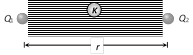 i.e. \[{{F}_{medium}}=\frac{{{F}_{air}}}{K}\]\[=\frac{1}{4\pi {{\varepsilon }_{0}}K}.\,\frac{{{Q}_{1}}{{Q}_{2}}}{{{r}^{2}}}\]
(Here \[{{\varepsilon }_{0}}K={{\varepsilon }_{0}}\,{{\varepsilon }_{r}}=\varepsilon \] = permittivity of medium)
If a dielectric medium (dielectric constant K, thickness t) is partially filled between the charges then effective air separation between the charges becomes \[(r-t\,+t\sqrt{K})\]
i.e. \[{{F}_{medium}}=\frac{{{F}_{air}}}{K}\]\[=\frac{1}{4\pi {{\varepsilon }_{0}}K}.\,\frac{{{Q}_{1}}{{Q}_{2}}}{{{r}^{2}}}\]
(Here \[{{\varepsilon }_{0}}K={{\varepsilon }_{0}}\,{{\varepsilon }_{r}}=\varepsilon \] = permittivity of medium)
If a dielectric medium (dielectric constant K, thickness t) is partially filled between the charges then effective air separation between the charges becomes \[(r-t\,+t\sqrt{K})\]
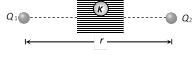 Hence force \[F=\frac{1}{4\pi {{\varepsilon }_{0}}}\,\frac{{{Q}_{1}}{{Q}_{2}}}{{{(r-t+t\sqrt{K})}^{2}}}\]
(3) Principle of superposition : According to the principle of super position, total force acting on a given charge due to number of charges is the vector sum of the individual forces acting on that charge due to all the charges.
Hence force \[F=\frac{1}{4\pi {{\varepsilon }_{0}}}\,\frac{{{Q}_{1}}{{Q}_{2}}}{{{(r-t+t\sqrt{K})}^{2}}}\]
(3) Principle of superposition : According to the principle of super position, total force acting on a given charge due to number of charges is the vector sum of the individual forces acting on that charge due to all the charges.
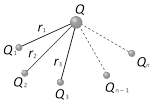 Consider number of charge \[{{Q}_{1}}\],\[{{Q}_{2}}\],\[{{Q}_{3}}\] ... are applying force on a charge Q.
Net force on Q will be
\[{{\overrightarrow{F}}_{net}}={{\overrightarrow{F}}_{1}}+{{\overrightarrow{F}}_{2}}+....+{{\overrightarrow{F}}_{n-1}}+{{\overrightarrow{F}}_{n}}\]
The magnitude of the resultant of two electric forces is given by
Consider number of charge \[{{Q}_{1}}\],\[{{Q}_{2}}\],\[{{Q}_{3}}\] ... are applying force on a charge Q.
Net force on Q will be
\[{{\overrightarrow{F}}_{net}}={{\overrightarrow{F}}_{1}}+{{\overrightarrow{F}}_{2}}+....+{{\overrightarrow{F}}_{n-1}}+{{\overrightarrow{F}}_{n}}\]
The magnitude of the resultant of two electric forces is given by
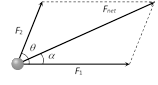 \[{{F}_{net}}=\sqrt{F_{1}^{2}+F_{2}^{2}+2{{F}_{1}}{{F}_{2}}\cos \theta }\]
and \[\tan \alpha =\frac{{{F}_{2}}\sin \theta }{{{F}_{1}}+{{F}_{2}}\cos \theta }\]
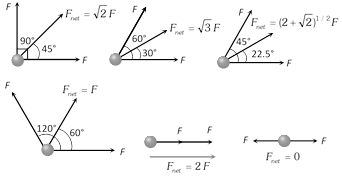
For problem solving remember following standard results.
\[{{F}_{net}}=\sqrt{F_{1}^{2}+F_{2}^{2}+2{{F}_{1}}{{F}_{2}}\cos \theta }\]
and \[\tan \alpha =\frac{{{F}_{2}}\sin \theta }{{{F}_{1}}+{{F}_{2}}\cos \theta }\]
For problem solving remember following standard results.
 Fundamental forces of nature
| Force | Nature and formula | Range | Relative strength | |||||||||||||||||
| Force of gravitation between two masses | more...
It is a simple apparatus with which the presence of electric charge on a body is detected (see figure). When metal knob is touched with a charged body, some charge is transferred to the gold leaves, which then diverges due to repulsion. The separation gives a rough idea of the amount of charge on the body. When a charged body brought near a charged electroscope, the leaves will further diverge, if the charge on body is similar to that on electroscope and will usually converge if opposite. If the induction effect is strong enough leaves after converging may again diverge.
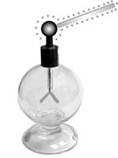
A body can be charged by following methods.
(1) By friction : By rubbing two bodies together, both positive and negative charges in equal amounts appear simultaneously due to transfer of electrons from one body to the other.
(i) When a glass rod is rubbed with silk, the rod becomes positively charged while the silk becomes negatively charged. The decrease in the mass of glass rod is equal to the total mass of electrons lost by it.
(ii) Ebonite on rubbing with wool becomes negatively charged making the wool positively charged.
(iii) Clouds also get charged by friction. (iv) A comb moving through dry hair gets electrically charged. It starts attracting small bits of paper.
(v) During landing or take-off, the tyres of an aircraft get electrified therefore special material is used to manufacture them.
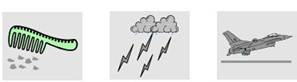 (2) By electrostatic induction : If a charged body is brought near an uncharged body, one side of neutral body (closer to charged body) becomes oppositely charged while the other side becomes similarly charged.
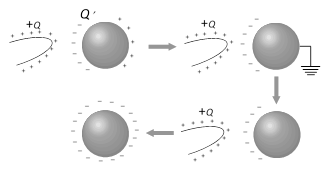 Induced charge can be lesser or equal to inducing charge (but never greater) and its maximum value is given by \[Q'=-Q\left[ 1-\frac{1}{K} \right]\] where Q is the inducing charge and K is the dielectric constant of the material of the uncharged body. It is also known as specific inductive capacity (SIC) of the medium, or relative permittivity er of the medium (relative means with respect to free space)
Different dielectric constants
Induced charge can be lesser or equal to inducing charge (but never greater) and its maximum value is given by \[Q'=-Q\left[ 1-\frac{1}{K} \right]\] where Q is the inducing charge and K is the dielectric constant of the material of the uncharged body. It is also known as specific inductive capacity (SIC) of the medium, or relative permittivity er of the medium (relative means with respect to free space)
Different dielectric constants
|


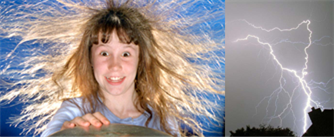 (1) Charge is the property associated with matter due to which it produces and experiences electrical and magnetic effects.
(2) It is known that every atom is electrically neutral, containing as many electrons as the number of protons in the nucleus.
(3) Charged particles can be created by disturbing neutrality of an atom. Loss of electrons gives positive charge (as then\[{{n}_{p}}>{{n}_{e}}\]) and gain of electrons gives negative charge (as then \[{{n}_{e}}>{{n}_{p}}\]) to a particle. In charging mass of the body changes as shown below
(1) Charge is the property associated with matter due to which it produces and experiences electrical and magnetic effects.
(2) It is known that every atom is electrically neutral, containing as many electrons as the number of protons in the nucleus.
(3) Charged particles can be created by disturbing neutrality of an atom. Loss of electrons gives positive charge (as then\[{{n}_{p}}>{{n}_{e}}\]) and gain of electrons gives negative charge (as then \[{{n}_{e}}>{{n}_{p}}\]) to a particle. In charging mass of the body changes as shown below
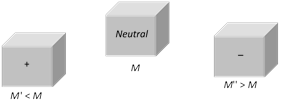 (4) Charges with the same electrical sign repel each other, and charges with opposite electrical sign attract each other.
 (5) Unit and dimensional formula
S.I. unit of charge is Ampere \[\times \] sec = coulomb (C), smaller S.I. units are \[mC,\,\,\mu C\].
C.G.S. unit of charge is Stat coulomb or e.s.u. Electromagnetic unit of charge is ab coulomb
\[1C=3\times {{10}^{9}}\,stat\,coulomb=\frac{1}{10}\,ab\,coulomb\,\].
Dimensional formula \[[Q]=\left[ AT \right]\]
(6) Charge is
(5) Unit and dimensional formula
S.I. unit of charge is Ampere \[\times \] sec = coulomb (C), smaller S.I. units are \[mC,\,\,\mu C\].
C.G.S. unit of charge is Stat coulomb or e.s.u. Electromagnetic unit of charge is ab coulomb
\[1C=3\times {{10}^{9}}\,stat\,coulomb=\frac{1}{10}\,ab\,coulomb\,\].
Dimensional formula \[[Q]=\left[ AT \right]\]
(6) Charge is
 (8) Point charge : A finite size body may behave like a point charge if it produces an inverse square electric field. For example an isolated charged sphere behave like a point charge at very large distance as well as very small distance close to it's surface.
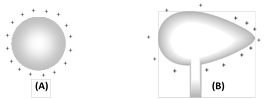
(9) Charge on a conductor : Charge given to a conductor always resides on it's outer surface. This is why a solid and hollow conducting sphere of same outer radius will hold maximum equal charge. If surface is uniform the charge distributes uniformly on the surface and for irregular surface the distribution of charge, i.e., charge density is not uniform. It is maximum where the radius of curvature is minimum and vice versa. i.e., \[\sigma \propto \] \[\left( 1/R \right)\]. This is why charge leaks from sharp points.
(8) Point charge : A finite size body may behave like a point charge if it produces an inverse square electric field. For example an isolated charged sphere behave like a point charge at very large distance as well as very small distance close to it's surface.
(9) Charge on a conductor : Charge given to a conductor always resides on it's outer surface. This is why a solid and hollow conducting sphere of same outer radius will hold maximum equal charge. If surface is uniform the charge distributes uniformly on the surface and for irregular surface the distribution of charge, i.e., charge density is not uniform. It is maximum where the radius of curvature is minimum and vice versa. i.e., \[\sigma \propto \] \[\left( 1/R \right)\]. This is why charge leaks from sharp points.
 (10)
(10)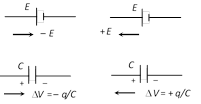 When an arrangement of capacitors cannot be simplified by the method of successive reduction, then we need to apply the Kirchhoff's laws to solve the circuit.
  A musical sound consist of a series of harmonic waves following each other rapidly at regular interval of time without a sudden change in amplitude.
(1) Noise : A noise consists of a series of waves following each other at irregular intervals of time with sudden changes in amplitude.
(2) Pitch : The pitch of a sound is the characteristic which distinguishes between a shrill (or sharp) sound and a grave (or flat) sound.
(i) A sound of high pitch is said to be shrill and it's frequency is high.
(ii) A sound of low pitch is said to be grave and it's frequency is low.
(iii) The pitch of female voice is higher than the pitch of male voice.
(iv) The pitch of sound produced by roaring of lion is lower where as the pitch of sound produced by mosquito whisper is high.
(3) Quality (or timbre) : A musical instrument vibrates with many frequencies at the same time. The quality of any musical sound is determined by the number of overtones and their relative intensities.
(i) The quality of sound enables us to distinguish between two sounds having same intensity and pitch.
(ii) The sounds of different instruments (such as Tabla and Mridang) are said to differ in quality.
(iii) Due to quality of sound one can recognise the voice of his friend without seeing him.
(4) Loudness : Characteristic of sound, on account of which the sound appears to be intense or slow.
(i) The loudness that we sense is related to the intensity of sound though it is not directly proportional.
(ii) The loudness depends on intensity as well as upon the sensitiveness of ear.
(iii) Our perception of loudness is better co-related with the sound level measured in decible (dB) and defined as follows \[\beta =10{{\log }_{10}}\,\left( \frac{I}{{{I}_{0}}} \right)\]; where \[{{l}_{0}}=\] The minimum intensity that can be heard called threshold of hearing \[={{10}^{-12}}W/{{m}^{2}}\] at 1 KHz.
(iv) At the threshold of hearing \[\beta =0\]. At the threshold of pain \[\beta =10{{\log }_{10}}\frac{1}{{{10}^{-2}}}=120\,dB.\]
(v) When the intensity doubles, the intensity level changes by 3 dB.
(vi) When the intensity increases 10 times the level increases by 10 dB.
Different sound intensity level
A musical sound consist of a series of harmonic waves following each other rapidly at regular interval of time without a sudden change in amplitude.
(1) Noise : A noise consists of a series of waves following each other at irregular intervals of time with sudden changes in amplitude.
(2) Pitch : The pitch of a sound is the characteristic which distinguishes between a shrill (or sharp) sound and a grave (or flat) sound.
(i) A sound of high pitch is said to be shrill and it's frequency is high.
(ii) A sound of low pitch is said to be grave and it's frequency is low.
(iii) The pitch of female voice is higher than the pitch of male voice.
(iv) The pitch of sound produced by roaring of lion is lower where as the pitch of sound produced by mosquito whisper is high.
(3) Quality (or timbre) : A musical instrument vibrates with many frequencies at the same time. The quality of any musical sound is determined by the number of overtones and their relative intensities.
(i) The quality of sound enables us to distinguish between two sounds having same intensity and pitch.
(ii) The sounds of different instruments (such as Tabla and Mridang) are said to differ in quality.
(iii) Due to quality of sound one can recognise the voice of his friend without seeing him.
(4) Loudness : Characteristic of sound, on account of which the sound appears to be intense or slow.
(i) The loudness that we sense is related to the intensity of sound though it is not directly proportional.
(ii) The loudness depends on intensity as well as upon the sensitiveness of ear.
(iii) Our perception of loudness is better co-related with the sound level measured in decible (dB) and defined as follows \[\beta =10{{\log }_{10}}\,\left( \frac{I}{{{I}_{0}}} \right)\]; where \[{{l}_{0}}=\] The minimum intensity that can be heard called threshold of hearing \[={{10}^{-12}}W/{{m}^{2}}\] at 1 KHz.
(iv) At the threshold of hearing \[\beta =0\]. At the threshold of pain \[\beta =10{{\log }_{10}}\frac{1}{{{10}^{-2}}}=120\,dB.\]
(v) When the intensity doubles, the intensity level changes by 3 dB.
(vi) When the intensity increases 10 times the level increases by 10 dB.
Different sound intensity level
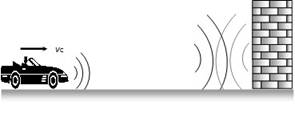 Can be solved in a different manner by using method of sound images. In this procedure we assume the image of the sound source behind the reflector.
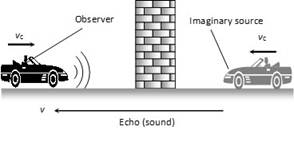 Here we assume that the sound which is reflected by the stationary wall is coming from the image of car which is at the back of it and coming toward it with velocity \[{{v}_{C}}\]. Now the frequency of sound heard by car driver can directly be given as
\[n'=n\,\left[ \frac{v-\,(-{{v}_{C}})}{v-\,(+{{v}_{C}})} \right]=n\,\left[ \frac{v+{{v}_{C}}}{v-{{v}_{C}}} \right]\]
This method of images for solving problems of Doppler effect is very convenient but is used only for velocities of source and observer which are very small compared to the speed of sound and it should not be used frequently when the reflector of sound is moving.
(2) Moving target : Let a sound source S and observer O are at rest (stationary). The frequency of sound emitted by the source is n and velocity of waves is v.
Here we assume that the sound which is reflected by the stationary wall is coming from the image of car which is at the back of it and coming toward it with velocity \[{{v}_{C}}\]. Now the frequency of sound heard by car driver can directly be given as
\[n'=n\,\left[ \frac{v-\,(-{{v}_{C}})}{v-\,(+{{v}_{C}})} \right]=n\,\left[ \frac{v+{{v}_{C}}}{v-{{v}_{C}}} \right]\]
This method of images for solving problems of Doppler effect is very convenient but is used only for velocities of source and observer which are very small compared to the speed of sound and it should not be used frequently when the reflector of sound is moving.
(2) Moving target : Let a sound source S and observer O are at rest (stationary). The frequency of sound emitted by the source is n and velocity of waves is v.
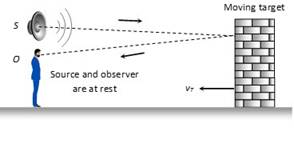 A target is moving towards the source and observer, with a velocity \[{{v}_{T}}\]. Our aim is to find out the frequency observed by the observer, for the waves reaching it after reflection from the moving target. The formula is derived by applying Doppler equations twice, first with the target as observer and then with the target as source.
The frequency \[n'\] of the waves reaching surface of the moving target (treating it as observer) will be \[n'=\left( \frac{v+{{v}_{T}}}{v} \right)\,n\]
Now these waves are reflected by the moving target (which now acts as a source). Therefore the apparent frequency, for the real observer O will be \[n''=\frac{v}{v-{{v}_{T}}}n'\]\[\Rightarrow \]\[n''=\frac{v+{{v}_{T}}}{v-{{v}_{T}}}n\]
(i) If the target is moving away from the observer, then \[n'=\frac{v-{{v}_{T}}}{v+{{v}_{T}}}n\]
(ii) If target velocity is much less than the speed of sound, \[({{v}_{T}}<<v),\] then \[n'=\left( 1+\frac{2{{v}_{T}}}{v} \right)\,n,\] for approaching target
and \[n'=\left( 1-\frac{2{{v}_{T}}}{v} \right)\,n,\] for receding target
(3) Transverse Doppler's effect
(i) If a source is moving in a direction making an angle \[\theta \] w.r.t. the observer
A target is moving towards the source and observer, with a velocity \[{{v}_{T}}\]. Our aim is to find out the frequency observed by the observer, for the waves reaching it after reflection from the moving target. The formula is derived by applying Doppler equations twice, first with the target as observer and then with the target as source.
The frequency \[n'\] of the waves reaching surface of the moving target (treating it as observer) will be \[n'=\left( \frac{v+{{v}_{T}}}{v} \right)\,n\]
Now these waves are reflected by the moving target (which now acts as a source). Therefore the apparent frequency, for the real observer O will be \[n''=\frac{v}{v-{{v}_{T}}}n'\]\[\Rightarrow \]\[n''=\frac{v+{{v}_{T}}}{v-{{v}_{T}}}n\]
(i) If the target is moving away from the observer, then \[n'=\frac{v-{{v}_{T}}}{v+{{v}_{T}}}n\]
(ii) If target velocity is much less than the speed of sound, \[({{v}_{T}}<<v),\] then \[n'=\left( 1+\frac{2{{v}_{T}}}{v} \right)\,n,\] for approaching target
and \[n'=\left( 1-\frac{2{{v}_{T}}}{v} \right)\,n,\] for receding target
(3) Transverse Doppler's effect
(i) If a source is moving in a direction making an angle \[\theta \] w.r.t. the observer
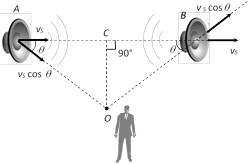 The apparent frequency heard by observer O at rest
At point A : \[{n}'=\frac{nv}{v-{{v}_{S}}\cos \theta }\]
As source moves along AB, value of \[\theta \] increases, \[\cos \theta \] decreases, \[{n}'\]goes on decreasing.
At point C : \[\theta ={{90}^{o}}\], \[\cos \theta =\cos \,{{90}^{o}}=0\], \[{n}'=n\].
At point B : the apparent frequency of sound becomes
\[{n}''=\frac{nv}{v+{{v}_{s}}\cos \theta }\]
(ii) When two cars are moving on perpendicular roads : When car-1 sounds a horn of frequency n, the
The apparent frequency heard by observer O at rest
At point A : \[{n}'=\frac{nv}{v-{{v}_{S}}\cos \theta }\]
As source moves along AB, value of \[\theta \] increases, \[\cos \theta \] decreases, \[{n}'\]goes on decreasing.
At point C : \[\theta ={{90}^{o}}\], \[\cos \theta =\cos \,{{90}^{o}}=0\], \[{n}'=n\].
At point B : the apparent frequency of sound becomes
\[{n}''=\frac{nv}{v+{{v}_{s}}\cos \theta }\]
(ii) When two cars are moving on perpendicular roads : When car-1 sounds a horn of frequency n, the