
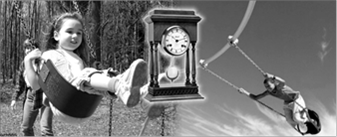
 (1) A motion, which repeat itself over and over again after a regular interval of time is called a periodic motion.
Revolution of earth around the sun (period one year), rotation of earth about its polar axis (period one day), Motion of hour's hand of a clock (period 12-hour) etc are common example of periodic motion.
(2) Oscillatory or vibratory motion is that motion in which a body moves to and fro or back and forth repeatedly about a fixed point in a definite interval of time. In such a motion, the body is confined with in well-defined limits on either side of mean position.
Oscillatory motion is also called as harmonic motion.
(i) Common examples are
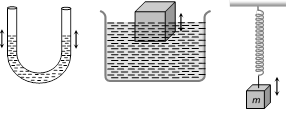
(a) The motion of the pendulum of a wall clock
(b) The motion of a load attached to a spring, when it is pulled and then released.
(c) The motion of liquid contained in U-tube when it is compressed once in one limb and left to itself.
(d) A loaded piece of wood floating over the surface of a liquid when pressed down and then released executes oscillatory motion.
(1) A motion, which repeat itself over and over again after a regular interval of time is called a periodic motion.
Revolution of earth around the sun (period one year), rotation of earth about its polar axis (period one day), Motion of hour's hand of a clock (period 12-hour) etc are common example of periodic motion.
(2) Oscillatory or vibratory motion is that motion in which a body moves to and fro or back and forth repeatedly about a fixed point in a definite interval of time. In such a motion, the body is confined with in well-defined limits on either side of mean position.
Oscillatory motion is also called as harmonic motion.
(i) Common examples are
(a) The motion of the pendulum of a wall clock
(b) The motion of a load attached to a spring, when it is pulled and then released.
(c) The motion of liquid contained in U-tube when it is compressed once in one limb and left to itself.
(d) A loaded piece of wood floating over the surface of a liquid when pressed down and then released executes oscillatory motion.
 (ii) Harmonic oscillation is that oscillation which can be expressed in terms of single harmonic function (i.e. sine or cosine function). Example : \[y=a\sin \omega \,t\] or \[y=a\cos \omega \,t\]
(iii) Non-harmonic oscillation is that oscillation which can not be expressed in terms of single harmonic function. It is a combination of two or more than two harmonic oscillations. Example : \[y=a\sin \omega \,t+b\sin 2\omega \,t\]
(ii) Harmonic oscillation is that oscillation which can be expressed in terms of single harmonic function (i.e. sine or cosine function). Example : \[y=a\sin \omega \,t\] or \[y=a\cos \omega \,t\]
(iii) Non-harmonic oscillation is that oscillation which can not be expressed in terms of single harmonic function. It is a combination of two or more than two harmonic oscillations. Example : \[y=a\sin \omega \,t+b\sin 2\omega \,t\] 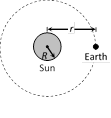 \[S=\frac{P}{4\pi {{r}^{2}}}=\frac{4\pi {{R}^{2}}\sigma {{T}^{4}}}{4\pi {{r}^{2}}}\]
i.e.\[T={{\left[ {{\left( \frac{r}{R} \right)}^{2}}\frac{S}{\sigma } \right]}^{1/4}}\]
\[={{\left[ {{\left( \frac{1.5\times {{10}^{8}}}{7\times {{10}^{5}}} \right)}^{2}}\times \frac{1.4\times {{10}^{3}}}{5.67\times {{10}^{-8}}} \right]}^{1/4}}\tilde{-}5800\,K\]
As \[r=1.5\times {{10}^{8}}\,km,\] \[R=7\times {{10}^{5}}\,km,\]
\[S=2\frac{cal}{c{{m}^{2}}min}=1.4\frac{kW}{{{m}^{2}}}\] and \[\sigma =5.67\times {{10}^{-8}}\frac{W}{{{m}^{2}}{{K}^{4}}}\]
This result is in good agreement with the experimental value of temperature of sun, i.e., 6000 K.
\[S=\frac{P}{4\pi {{r}^{2}}}=\frac{4\pi {{R}^{2}}\sigma {{T}^{4}}}{4\pi {{r}^{2}}}\]
i.e.\[T={{\left[ {{\left( \frac{r}{R} \right)}^{2}}\frac{S}{\sigma } \right]}^{1/4}}\]
\[={{\left[ {{\left( \frac{1.5\times {{10}^{8}}}{7\times {{10}^{5}}} \right)}^{2}}\times \frac{1.4\times {{10}^{3}}}{5.67\times {{10}^{-8}}} \right]}^{1/4}}\tilde{-}5800\,K\]
As \[r=1.5\times {{10}^{8}}\,km,\] \[R=7\times {{10}^{5}}\,km,\]
\[S=2\frac{cal}{c{{m}^{2}}min}=1.4\frac{kW}{{{m}^{2}}}\] and \[\sigma =5.67\times {{10}^{-8}}\frac{W}{{{m}^{2}}{{K}^{4}}}\]
This result is in good agreement with the experimental value of temperature of sun, i.e., 6000 K. 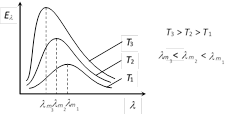 This law is of great importance in 'Astrophysic' as through the analysis of radiations coming from a distant star, by finding \[{{\lambda }_{m}}\] the temperature of the star \[T(=b/{{\lambda }_{m}})\] is determined.
  (3) For all wavelengths an increase in temperature causes an increase in intensity.
(4) The area under the curve will represent the total intensity of radiation at a particular temperature i.e. Area \[=E=\int{{{E}_{\lambda }}d\lambda }\]
From Stefan's law \[E=\sigma {{T}^{4}}\Rightarrow \] Area under \[{{E}_{\lambda }}-\lambda \] curve (A) \[\propto {{T}^{4}}\]
(5) The energy \[({{E}_{\max }})\] emitted corresponding to the wavelength of maximum emission \[({{\lambda }_{m}})\] increases with fifth power of the absolute temperature of the black body i.e., \[{{E}_{\max }}\propto {{T}^{5}}\]
(3) For all wavelengths an increase in temperature causes an increase in intensity.
(4) The area under the curve will represent the total intensity of radiation at a particular temperature i.e. Area \[=E=\int{{{E}_{\lambda }}d\lambda }\]
From Stefan's law \[E=\sigma {{T}^{4}}\Rightarrow \] Area under \[{{E}_{\lambda }}-\lambda \] curve (A) \[\propto {{T}^{4}}\]
(5) The energy \[({{E}_{\max }})\] emitted corresponding to the wavelength of maximum emission \[({{\lambda }_{m}})\] increases with fifth power of the absolute temperature of the black body i.e., \[{{E}_{\max }}\propto {{T}^{5}}\] 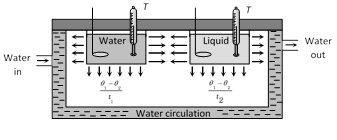 i.e. \[{{\left( \frac{dQ}{dt} \right)}_{\text{water}}}={{\left( \frac{dQ}{dt} \right)}_{\text{liquid}}}\]
\[({{m}_{W}}{{c}_{W}}+W)\frac{({{\theta }_{1}}-{{\theta }_{2}})}{{{t}_{1}}}=({{m}_{l}}{{c}_{l}}+W)\frac{({{\theta }_{1}}-{{\theta }_{2}})}{{{t}_{2}}}\]
or \[\left[ \frac{{{m}_{W}}{{c}_{W}}+W}{{{t}_{1}}} \right]=\left[ \frac{{{m}_{l}}{{c}_{l}}+W}{{{t}_{2}}} \right]\]
\[W={{m}_{c}}{{c}_{c}}=\] Water equivalent of calorimeter, where \[{{m}_{c}}\] and \[{{c}_{c}}\] are mass and specific heat of calorimeter.
If density of water and liquid is \[\rho \] and \[\rho '\] respectively then \[{{m}_{W}}=V{{\rho }_{W}}\] and \[{{m}_{l}}=V\rho {{\,}_{l}}\]
Specific heat of liquid \[{{c}_{l}}=\frac{1}{{{m}_{l}}}\left[ \frac{{{t}_{l}}}{{{t}_{W}}}({{m}_{W}}{{c}_{W}}+W)-W \right]\]
i.e. \[{{\left( \frac{dQ}{dt} \right)}_{\text{water}}}={{\left( \frac{dQ}{dt} \right)}_{\text{liquid}}}\]
\[({{m}_{W}}{{c}_{W}}+W)\frac{({{\theta }_{1}}-{{\theta }_{2}})}{{{t}_{1}}}=({{m}_{l}}{{c}_{l}}+W)\frac{({{\theta }_{1}}-{{\theta }_{2}})}{{{t}_{2}}}\]
or \[\left[ \frac{{{m}_{W}}{{c}_{W}}+W}{{{t}_{1}}} \right]=\left[ \frac{{{m}_{l}}{{c}_{l}}+W}{{{t}_{2}}} \right]\]
\[W={{m}_{c}}{{c}_{c}}=\] Water equivalent of calorimeter, where \[{{m}_{c}}\] and \[{{c}_{c}}\] are mass and specific heat of calorimeter.
If density of water and liquid is \[\rho \] and \[\rho '\] respectively then \[{{m}_{W}}=V{{\rho }_{W}}\] and \[{{m}_{l}}=V\rho {{\,}_{l}}\]
Specific heat of liquid \[{{c}_{l}}=\frac{1}{{{m}_{l}}}\left[ \frac{{{t}_{l}}}{{{t}_{W}}}({{m}_{W}}{{c}_{W}}+W)-W \right]\] 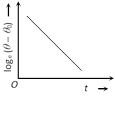 As \[\frac{d\theta }{dt}\propto -(\theta -{{\theta }_{0}})\Rightarrow \,\frac{d\theta }{(\theta -{{\theta }_{0}})}=-Kdt\]
Integrating \[{{\log }_{e}}(\theta -{{\theta }_{0}})=-Kt+C\] \[{{\log }_{e}}(\theta -{{\theta }_{0}})=-Kt+{{\log }_{e}}A\]
This is a straight line with negative slope
(2) Curve between temperature of body and time
As \[\frac{d\theta }{dt}\propto -(\theta -{{\theta }_{0}})\Rightarrow \,\frac{d\theta }{(\theta -{{\theta }_{0}})}=-Kdt\]
Integrating \[{{\log }_{e}}(\theta -{{\theta }_{0}})=-Kt+C\] \[{{\log }_{e}}(\theta -{{\theta }_{0}})=-Kt+{{\log }_{e}}A\]
This is a straight line with negative slope
(2) Curve between temperature of body and time
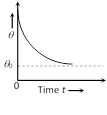 As \[{{\log }_{e}}(\theta -{{\theta }_{0}})=-Kt+{{\log }_{e}}A\]\[\Rightarrow \]\[{{\log }_{e}}\frac{\theta -{{\theta }_{0}}}{A}=-Kt\]
\[\Rightarrow \] \[\theta -{{\theta }_{0}}=A{{e}^{-kt}}\]
which indicates temperature decreases exponentially with increasing time.
(3) Curve between the rate of cooling (R) and body temperature \[(\theta )\].
As \[{{\log }_{e}}(\theta -{{\theta }_{0}})=-Kt+{{\log }_{e}}A\]\[\Rightarrow \]\[{{\log }_{e}}\frac{\theta -{{\theta }_{0}}}{A}=-Kt\]
\[\Rightarrow \] \[\theta -{{\theta }_{0}}=A{{e}^{-kt}}\]
which indicates temperature decreases exponentially with increasing time.
(3) Curve between the rate of cooling (R) and body temperature \[(\theta )\].
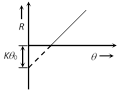 \[R=K(\theta -{{\theta }_{0}})=K\theta -K{{\theta }_{0}}\] This is a straight line intercept R-axis at \[-K{{\theta }_{0}}\]
(4) Curve between rate of cooling (R) and temperature difference between body \[(\theta )\] and surrounding \[({{\theta }_{0}})\]
\[R=K(\theta -{{\theta }_{0}})=K\theta -K{{\theta }_{0}}\] This is a straight line intercept R-axis at \[-K{{\theta }_{0}}\]
(4) Curve between rate of cooling (R) and temperature difference between body \[(\theta )\] and surrounding \[({{\theta }_{0}})\]
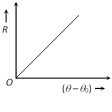 \[R\propto (\theta -{{\theta }_{0}})\]. This is a straight line passing through origin.
 | Body | Condition | Rate of heat loss \[{{R}_{H}}=\frac{dQ}{dt}\] | Rate of cooling \[{{R}_{c}}=\frac{dT}{dt}\]or\[\frac{d\theta }{dt}\] |
| Two solid sphere | \[T,\,{{T}_{0}},\,c,\,\rho \] are same | \[{{R}_{H}}\propto A\propto {{r}^{2}}\] Þ \[\frac{{{({{R}_{H}})}_{1}}}{{{({{R}_{H}})}_{2}}}=\frac{r_{1}^{2}}{r_{2}^{2}}\] | \[{{R}_{c}}\propto \frac{A}{V}\propto \] \[\propto \frac{{{r}^{2}}}{{{r}^{3}}}\propto \frac{1}{r}\] |
| Two solid sphere of diff. material | \[T,\,{{T}_{0}}-\] same | \[{{R}_{H}}\propto A\propto {{r}^{2}}\] | \[{{R}_{c}}\propto \frac{A}{V\rho \,c}\] \[\propto \frac{1}{r\rho \,c}\] |
| Different shape bodies like cube, sphere plate | \[T,\,{{T}_{0}},\,c,\,\rho -\] same | \[{{R}_{H}}\propto A\] \[{{A}_{\max }}\to \]Plate \[{{A}_{\min }}\to \]sphere | \[{{R}_{c}}\propto \frac{A}{V}\] |
| Bodies of different materials | \[T,\,{{T}_{0}},\,m,\,A\] are same but c diff. | \[{{R}_{H}}\to \] same for all. bodies | \[{{R}_{c}}\propto \frac{1}{c}\] |






You need to login to perform this action.
You will be redirected in
3 sec