
 Ascending Order of numbers:
Arranging numbers from the least number to the largest number is called Ascending Order.
Ex: 13, 67, 132, 168 are in ascending order
Descending Order of numbers:
Arranging numbers from the largest number to the least number is called Descending Order.
Ex: 168, 132, 67, 13 are in descending order.
Symbols used for comparison of two numbers:
Ascending Order of numbers:
Arranging numbers from the least number to the largest number is called Ascending Order.
Ex: 13, 67, 132, 168 are in ascending order
Descending Order of numbers:
Arranging numbers from the largest number to the least number is called Descending Order.
Ex: 168, 132, 67, 13 are in descending order.
Symbols used for comparison of two numbers:
 This is the "equal to” sign. When we use it between two numbers, it means that the numbers on both sides of the sign have the same value.
Ex: 53 = 53
This is the "equal to” sign. When we use it between two numbers, it means that the numbers on both sides of the sign have the same value.
Ex: 53 = 53
 This is the "greater than" sign. It is placed between two numbers in such a way that the
open side is towards the bigger number.
Ex: 43 > 34
This is the "greater than" sign. It is placed between two numbers in such a way that the
open side is towards the bigger number.
Ex: 43 > 34
 This is the “less than" sign. It is placed between two numbers in such a way that the closed side is towards the smaller number.
Ex: 57 < 69
Rules for comparison of numbers:
Rule 1:
A numeral containing more digits is greater.
Ex: 163 > 35
Rule 2:
If two numerals contain the same number of digits, the numeral having greater digit at the left most place will be greater.
This is the “less than" sign. It is placed between two numbers in such a way that the closed side is towards the smaller number.
Ex: 57 < 69
Rules for comparison of numbers:
Rule 1:
A numeral containing more digits is greater.
Ex: 163 > 35
Rule 2:
If two numerals contain the same number of digits, the numeral having greater digit at the left most place will be greater.
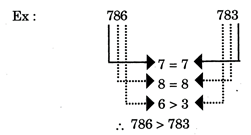
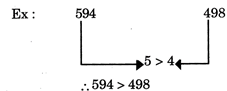 Rule 3:
If the left most digits are also the same, we go to next digit from left and compare.
Rule 3:
If the left most digits are also the same, we go to next digit from left and compare.
 Successor of a numeral:
Successor of a particular numeral comes just after that numeral. So, we can find out the successor of a numeral by adding 1 to the given numeral.
Ex : The successor of 99 is 99 + 1 or 100.
Predecessor of a numeral:
Predecessor of a particular numeral comes just before that numeral. So, we can find out the
predecessor of a numeral by subtracting 1 from more...
Successor of a numeral:
Successor of a particular numeral comes just after that numeral. So, we can find out the successor of a numeral by adding 1 to the given numeral.
Ex : The successor of 99 is 99 + 1 or 100.
Predecessor of a numeral:
Predecessor of a particular numeral comes just before that numeral. So, we can find out the
predecessor of a numeral by subtracting 1 from more...  Step-2: Add the ONES first, then the TENs and finally the HUNDREDS.
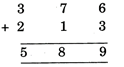
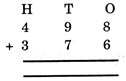
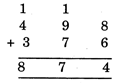
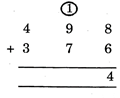 Step - 3: Add tens
1 + 9 + 7 = 17
17 tens = I hundred + 7 tens
1 hundred is carried to hundreds column.
7 is written in tens place.
Step - 3: Add tens
1 + 9 + 7 = 17
17 tens = I hundred + 7 tens
1 hundred is carried to hundreds column.
7 is written in tens place.
 Step - 4: Add Hundreds
1+4+3=8
8 is written in Hundreds place.
Step - 4: Add Hundreds
1+4+3=8
8 is written in Hundreds place.
 Subtraction:
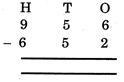 Step-2: Subtract ONES first, then the TENS and finally the HUNDREDS.
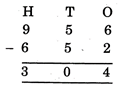
 Step - 2: Subtract ONES
1 – 2 = ?
We can't subtract 2 from 1. more...
Step - 2: Subtract ONES
1 – 2 = ?
We can't subtract 2 from 1. more... 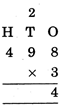 Step - 2: Multiply 9 tens by 3.
9 tens \[\times \] 3 = 27 tens
= 20 tens + 7 tens
= 2 hundreds + 7 tens
Carry 2 hundreds to the hundreds place.
Add the carried 2 tens to 7 tens.
So 7 tens + 2 tens = 9 tens,
write 9 in the tens place
Step - 2: Multiply 9 tens by 3.
9 tens \[\times \] 3 = 27 tens
= 20 tens + 7 tens
= 2 hundreds + 7 tens
Carry 2 hundreds to the hundreds place.
Add the carried 2 tens to 7 tens.
So 7 tens + 2 tens = 9 tens,
write 9 in the tens place
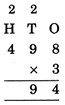 Step - 3: Multiply 4 hundreds by 3.
hundreds x 3 = 12 hundreds.
Add the carried 2 hundreds to 12 hundreds.
So, 12 hundreds + 2 hundreds = 14 hundreds,
write 14 in hundreds place
Step - 3: Multiply 4 hundreds by 3.
hundreds x 3 = 12 hundreds.
Add the carried 2 hundreds to 12 hundreds.
So, 12 hundreds + 2 hundreds = 14 hundreds,
write 14 in hundreds place
 Multiplication by TENS and HUNDREDS:
5 \[\times \] 10 = 5 \[\times \]1 ten = 5 tens = 50
7\[\times \] 30 = 7 \[\times \] 3 tens = 21 tens = 210
15 x 60 = 15 \[\times \] 6 tens = 90 tens = 900
8\[\times \]100=8\[\times \] 1 hundred = 8 hundreds = 800
9 \[\times \] 400 = 9 \[\times \] 4 hundreds = 36 hundreds = 3600
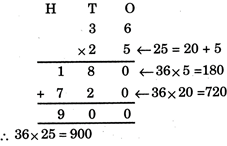
Multiplication by 2-digit numbers:
Ex: Multiply 36 by 25
Multiplication by TENS and HUNDREDS:
5 \[\times \] 10 = 5 \[\times \]1 ten = 5 tens = 50
7\[\times \] 30 = 7 \[\times \] 3 tens = 21 tens = 210
15 x 60 = 15 \[\times \] 6 tens = 90 tens = 900
8\[\times \]100=8\[\times \] 1 hundred = 8 hundreds = 800
9 \[\times \] 400 = 9 \[\times \] 4 hundreds = 36 hundreds = 3600
Multiplication by 2-digit numbers:
Ex: Multiply 36 by 25
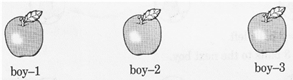 we have, 12-3 =9 apples left.
Step - 2: Again give 1 apple to each boy.
we have, 12-3 =9 apples left.
Step - 2: Again give 1 apple to each boy.
 we have, 9-3=6 apples left.
Step - 3: Give 1 more apple to each boy
we have, 9-3=6 apples left.
Step - 3: Give 1 more apple to each boy
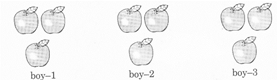 We have, 6-3=3 apples left.
Step - 4: Again give 1 more apple to each boy.
We have, 6-3=3 apples left.
Step - 4: Again give 1 more apple to each boy.
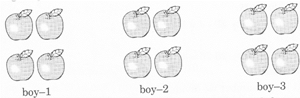 We have, 3-3=0. Each boy has got 4 apples and no apple is left.
We observed that 12 apples have been distributed among 3 boys. Each boy got 4 apples.
Thus 12- 3=4
Grouping:
Ex: 9 balls are to be distributed among some boys. Each boy should get 3 balls. How many boys are there?
Step -1: Give 3 balls to one boy
We have, 3-3=0. Each boy has got 4 apples and no apple is left.
We observed that 12 apples have been distributed among 3 boys. Each boy got 4 apples.
Thus 12- 3=4
Grouping:
Ex: 9 balls are to be distributed among some boys. Each boy should get 3 balls. How many boys are there?
Step -1: Give 3 balls to one boy
 We have, 9 - 3=6 balls left.
Step - 2: Give 3 balls to the next boy.
We have, 6 - 3=3 balls left
Step - 3: Give 3 balls to the next boy.
We have, 3 - 3 =0
No balls left. We observed that, Three boys got the balls.
We have, 9 - 3=6 balls left.
Step - 2: Give 3 balls to the next boy.
We have, 6 - 3=3 balls left
Step - 3: Give 3 balls to the next boy.
We have, 3 - 3 =0
No balls left. We observed that, Three boys got the balls.
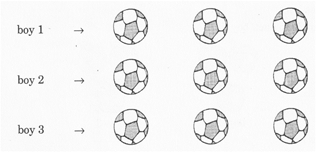 Thus, 9 – 3 = 3
Multiplication and Division facts:
Thus, 9 – 3 = 3
Multiplication and Division facts:
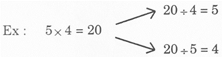 Basic terms used in division:


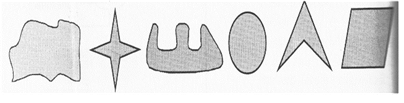
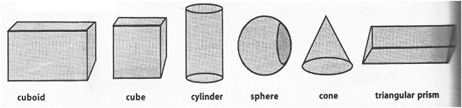 Closed and Open figures:
 Description of some basic shapes:
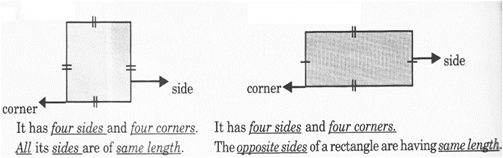 It has four sides and four corners.
All its sides are of same length.
It has four sides and four corners.
The opposite sides of a rectangle are having same length.
It has four sides and four corners.
All its sides are of same length.
It has four sides and four corners.
The opposite sides of a rectangle are having same length.
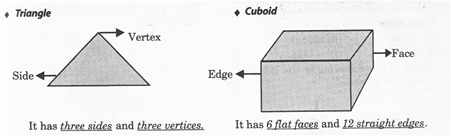
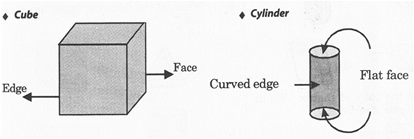 It has 6 flat faces and 12 straight edges.
It has 3 faces\[\to \] 1 curved face and 2 flat faces..
It has 2 cured edges.
It has 6 flat faces and 12 straight edges.
It has 3 faces\[\to \] 1 curved face and 2 flat faces..
It has 2 cured edges.
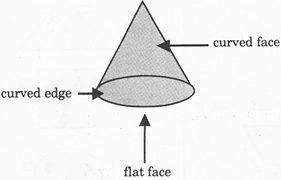 It has 2 faces \[\to \] 1 curved face and 1 flat face.
It has 1curued edge.
It has 2 faces \[\to \] 1 curved face and 1 flat face.
It has 1curued edge.





You need to login to perform this action.
You will be redirected in
3 sec