
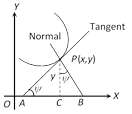
 (1) Length of tangent \[PA=y\,\,\text{cosec}\psi =y\frac{\sqrt{1+{{\left( \frac{dy}{dx} \right)}^{2}}}}{\left( \frac{dy}{dx} \right)}\]
(2) Length of normal \[r={{\left( \frac{b}{a} \right)}^{\frac{1}{n+1}}}\]
(3) Length of sub-tangent \[AC=y\cot \psi =\frac{y}{\left( \frac{dy}{dx} \right)}\]
(4) Length of subnormal \[b=\frac{2ac}{a+c}\].
(1) Length of tangent \[PA=y\,\,\text{cosec}\psi =y\frac{\sqrt{1+{{\left( \frac{dy}{dx} \right)}^{2}}}}{\left( \frac{dy}{dx} \right)}\]
(2) Length of normal \[r={{\left( \frac{b}{a} \right)}^{\frac{1}{n+1}}}\]
(3) Length of sub-tangent \[AC=y\cot \psi =\frac{y}{\left( \frac{dy}{dx} \right)}\]
(4) Length of subnormal \[b=\frac{2ac}{a+c}\]. 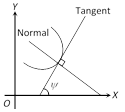 ·
If the tangent is parallel to x-axis, \[\psi =0\Rightarrow
{{\left( \frac{dy}{dx} \right)}_{({{x}_{1}},\,{{y}_{1}})}}=0\]
·
If the tangent is perpendicular to x-axis, \[\psi
=\frac{\pi }{2}\Rightarrow {{\left( \frac{dy}{dx}
\right)}_{({{x}_{1}},\,{{y}_{1}})}}\to \,\,\,\infty \]
(2) Slope of the normal : The normal to a
curve at a point \[P({{x}_{1}},\,{{y}_{1}})\] is a line perpendicular to the tangent at P and passing
through P. Slope of the normal \[=\frac{-1}{\text{Slope of
tangent }}=\frac{-1}{{{\left( \frac{dy}{dx}
\right)}_{P({{x}_{1}},\,{{y}_{1}})}}}=-{{\left( \frac{dx}{dy}
\right)}_{P({{x}_{1}},\,{{y}_{1}})}}\].
·
If the normal is parallel to x-axis, \[-{{\left(
\frac{dx}{dy} \right)}_{({{x}_{1}},\,{{y}_{1}})}}=0\] or
\[\frac{b}{a}=\frac{c}{b}\].
·
If the normal is perpendicular to x-axis (or parallel to
y-axis), \[-{{\left( \frac{dy}{dx}
\right)}_{({{x}_{1}},\,{{y}_{1}})}}=0\].
·
If the tangent is parallel to x-axis, \[\psi =0\Rightarrow
{{\left( \frac{dy}{dx} \right)}_{({{x}_{1}},\,{{y}_{1}})}}=0\]
·
If the tangent is perpendicular to x-axis, \[\psi
=\frac{\pi }{2}\Rightarrow {{\left( \frac{dy}{dx}
\right)}_{({{x}_{1}},\,{{y}_{1}})}}\to \,\,\,\infty \]
(2) Slope of the normal : The normal to a
curve at a point \[P({{x}_{1}},\,{{y}_{1}})\] is a line perpendicular to the tangent at P and passing
through P. Slope of the normal \[=\frac{-1}{\text{Slope of
tangent }}=\frac{-1}{{{\left( \frac{dy}{dx}
\right)}_{P({{x}_{1}},\,{{y}_{1}})}}}=-{{\left( \frac{dx}{dy}
\right)}_{P({{x}_{1}},\,{{y}_{1}})}}\].
·
If the normal is parallel to x-axis, \[-{{\left(
\frac{dx}{dy} \right)}_{({{x}_{1}},\,{{y}_{1}})}}=0\] or
\[\frac{b}{a}=\frac{c}{b}\].
·
If the normal is perpendicular to x-axis (or parallel to
y-axis), \[-{{\left( \frac{dy}{dx}
\right)}_{({{x}_{1}},\,{{y}_{1}})}}=0\].






You need to login to perform this action.
You will be redirected in
3 sec