
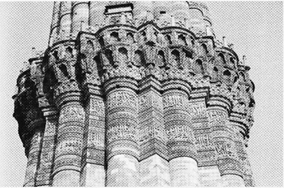
 Inscriptions
and balcony of Qutb Minar
India is a treasure house of
architectural art. Though architecture has flourished in India through many centuries/
it was during the medieval period that architecture was at its zenith. There
was immense impact of foreign style of architecture during this period. Both
the Delhi Sultans and the Mughals brought in different styles of architecture.
Thus, the medieval period witnessed a wide variety of architecture. Some of
them were indigenous and some were the contributions of foreign invasions.
INDIAN ARCHITECTURE IN THE
MEDIEVAL PERIOD
Many monuments were built during
this period. Rulers spent enormous money on construction. Temple building was
regarded as a sacred duty of the rich and kings. Temple building was sponsored
because it was a pious act bringing religious merit. The Muslim invaders built
mosques to show their power, wealth and victories. The buildings built by the
Mughals impart a sense of ruler power and were a potent symbol of authority.
The Mughal wealth is reflected in
the opulence of their architecture. The buildings made by Shah Jahan are lavish
and display the superb wealth and status of the Mughal emperor. Tombs were
built by emperors in an effort to be remembered. Forts were built as safeguards
from invasions and were also a measure of the ruler's strength.
The monuments are important
sources of information about the medieval period. They give information about
the religious beliefs of more...
Inscriptions
and balcony of Qutb Minar
India is a treasure house of
architectural art. Though architecture has flourished in India through many centuries/
it was during the medieval period that architecture was at its zenith. There
was immense impact of foreign style of architecture during this period. Both
the Delhi Sultans and the Mughals brought in different styles of architecture.
Thus, the medieval period witnessed a wide variety of architecture. Some of
them were indigenous and some were the contributions of foreign invasions.
INDIAN ARCHITECTURE IN THE
MEDIEVAL PERIOD
Many monuments were built during
this period. Rulers spent enormous money on construction. Temple building was
regarded as a sacred duty of the rich and kings. Temple building was sponsored
because it was a pious act bringing religious merit. The Muslim invaders built
mosques to show their power, wealth and victories. The buildings built by the
Mughals impart a sense of ruler power and were a potent symbol of authority.
The Mughal wealth is reflected in
the opulence of their architecture. The buildings made by Shah Jahan are lavish
and display the superb wealth and status of the Mughal emperor. Tombs were
built by emperors in an effort to be remembered. Forts were built as safeguards
from invasions and were also a measure of the ruler's strength.
The monuments are important
sources of information about the medieval period. They give information about
the religious beliefs of more... | The Delhi Sultanate | ||||||||||||||||||||||||||||||||||||||||||||||||||||||
| 1 | Slave Dynasty | |||||||||||||||||||||||||||||||||||||||||||||||||||||
| Qutb-ud-din Aybak lltutmish | 1206-1210 | |||||||||||||||||||||||||||||||||||||||||||||||||||||
|
New
Kings and Kingdoms in India
We have already read in the
previous class that Marshals vast empire broke up after his death. Many small
kingdoms appeared in India after the downfall of Harsha's empire and before the
Turkish invasions. There was a constant struggle for power between the ruling
kings and the chieftains of these small kingdoms. They fought to increase the
land and wealth of their kingdom.
NEW KINGS AND KINGDOMS
The seventh century witnessed the
emergence of big landlords or chieftains in various regions of the subcontinent.
They were often considered as subordinates or samantas to the kings. They
offered extravagant gifts to the kings. Also/ they maintained small armies
which were used by the kings in the times of war. Over the period, many
chieftains or samantas became very powerful. Some of these chieftains became
ambitious and asserted their independence and set up their own small kingdoms.
The Rashtrakuta, Gurjaras and Pratihara dynasties are the
instances. Their origin is discussed later in the chapter.
THE RAJPUTS
Many Rajput dynasties ruled small
kingdoms. They called themselves Rajput or Rajputrameaning 'son of a king'.
There are many theories about the origin of the Rajputs. Some called themselves
Suryavanshi, 'descendants of the Sun God', or Chandravanshi,
'descendants of the Moon God'. Some were called Agnikulas. They are
believed to have been born out of a fire pit. The following tale tells us about
the origin of the Agnikula Rajputs.
Once a warrior saint, Parshurama,
got very angry and destroyed all Kshatriyas. As a result, there were no
warriors left. Therefore, all the Brahmanas got together and decided to do
something about it. They organized a large fire pit at Mount Abu. After many
chants and prayers, four warriors emergedfrom the fire pit. It is believed that
these were the ancestors of the Agnikulas.
The Rajputs were courageous and
valiant. However, they constantly fought amongst themselves to show off their
strength. Therefore, they could not set up a unified empire. Several small
dynasties belonging to the Rajputs gradually rose to power and established
their supremacy. Some of these were the Pratiharas, the Rashtrakutas and the
Palas.
THE PRATIHARAS
The Pratiharas established a large
empire in the region of Gujarat and Rajasthan from 6th to the 18th century CE.
This dynasty was founded by King Harishchandra. He was a samanta of the
Rashtrakuta dynasty. Nagabhata I ascended the throne in the 8th century.
His capital was Ujjain. He fought many wars and extended his empire. He also
defeated the Arabs and prevented their entry into India. The Pratiharas were
involved in a more...
History
- When, Where and How
History is a study of the past.
This is facilitated by dividing the past into blocks of time. This is called
periodisation and helps in the study and analysis of history.
Indian History can be divided into
three periods - ancient, medieval and modem. Our focus is on medieval history.
Each period is characterised by numerous changes and developments.
The medieval period of Indian
history stretches from the 8th to the 18th century CE. This is further divided
into early and later medieval periods. The early medieval period is from the
8th to the 13th century CE. This period saw the rise of Rajputs, followed by
Muslim invasions into India. The 13th to 18th century CE is considered to be
the later medieval period which saw the great Delhi Sultanate and Mughal
Empire.
James Mill, a British historian,
has divided Indian history into three periods-Hindu Period, Muslim Period and
Christian Period. This division has its flaws. This is based on the idea that
religion determines history. However, a period of history cannot be
characterized by the religion of the rulers. The lives, beliefs and practices
of the common People have to be considered when history is recorded. Also, all
rulers did not share the same religion.
Many changes took place in these
thousand years of the medieval period. The Indian sub-continent reached a high
level of prosperity which led to major developments.
MAJOR DEVELOPMENTS
The medieval period was a period
of change in every sphere - political, social, cultural, religious and
economic.
· Many Rajput kingdoms came up. They
were warriors and fought to increase their empires.
· India saw many invasions during
this period. Mahmud of Ghazni and Muhammad of Ghor plundered India. This marked
the advent of Islam in India.
· The first Muslim empire in India
was established by Muhammad of Ghor. Later, the Delhi Sultanate and Mughal
Empire were established.
· The invaders brought in new ideas,
new religion and new ways of thinking.
· The economy of India flourished
under the Mughals and they looked after the welfare of people.
· Many new technologies were
introduced like the 'Persian Wheel' in farming and the 'Spinning Wheel' in
weaving textiles.
· Many forests were cleared for
agriculture.
· The more...
Heat
Synopsis
Light
Synopsis
Electric Current and Its Effects
Synopsis
Physical and Chemical Changes
Synopsis
Acids, Bases and Salts
Synopsis
Current Affairs CategoriesArchive
Trending Current Affairs

You need to login to perform this action. | ||||||||||||||||||||||||||||||||||||||||||||||||||||||