
 Refraction of Light
Refraction of light occurs, when it posses from one medium to another. Let's study about it in detail.
Refraction of Light
Refraction of light occurs, when it posses from one medium to another. Let's study about it in detail.
 Refraction of Light in Transparent Glass
We are able to see things because of the light. Light can travel through any transparent medium. When a beam of white light enters into a transparent glass from air, the path of the white light gets tilted at an angle. This feature of light is called the refraction of light.
Look at the following picture of refraction of light in a glass medium:
Refraction of Light in Transparent Glass
We are able to see things because of the light. Light can travel through any transparent medium. When a beam of white light enters into a transparent glass from air, the path of the white light gets tilted at an angle. This feature of light is called the refraction of light.
Look at the following picture of refraction of light in a glass medium:
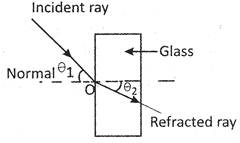 In the picture above \[{{\theta }_{1}}\] is the angle of incident with respect to the normal and \[{{\theta }_{2}}\] is the angle of refraction.
Refraction of light or angle of refraction in a medium depends on the refractive index or speed of light in that medium. The refractive index of a substance is the ratio of velocity of light in vacuum to the velocity of light in that medium.
A transparent glass passes the incident beam of light through it. But a glass with one side painted cannot allow the light to pass through it.
Refraction of Light in Water
When light enters into the water from air, the incident ray is refracted by the water at an angle. Angle of refraction with respect to the normal is increased due the impurities in the water.
In the picture above \[{{\theta }_{1}}\] is the angle of incident with respect to the normal and \[{{\theta }_{2}}\] is the angle of refraction.
Refraction of light or angle of refraction in a medium depends on the refractive index or speed of light in that medium. The refractive index of a substance is the ratio of velocity of light in vacuum to the velocity of light in that medium.
A transparent glass passes the incident beam of light through it. But a glass with one side painted cannot allow the light to pass through it.
Refraction of Light in Water
When light enters into the water from air, the incident ray is refracted by the water at an angle. Angle of refraction with respect to the normal is increased due the impurities in the water.
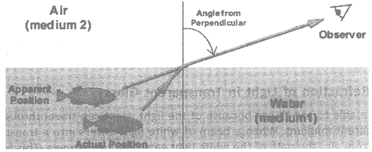 In the picture above a stick in the water is observed by an observer. The stick appears upward from its position because of the refraction of light.
Dispersion of Light
Look at the following picture of dispersion of light by a prism:
In the picture above a stick in the water is observed by an observer. The stick appears upward from its position because of the refraction of light.
Dispersion of Light
Look at the following picture of dispersion of light by a prism:
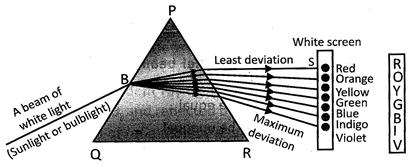 In the picture above, AB is the incident beam of white light. AB is dispersed into seven colours when passed through a prism. The detector (white screen) detects the dispersed light into seven visible colours and the order of least deviation to maximum deviation of colours of light is same as the given in the picture above. The rays, which have smaller wave length than violet, are called ultra violet rays and the rays which have greater wavelength than red are called infra red rays. Both the rays, ultraviolet and infrared are invisible to the naked eyes. The band of these seven colours which is obtained in the dispersion phenomena is called spectrum.
The formation of rainbow in the sky is based on the dispersion of light.
Rainbow formation
Rainbow formation is a natural phenomenon. When Sun rays strike on the small water droplets in the atmosphere, it more...
In the picture above, AB is the incident beam of white light. AB is dispersed into seven colours when passed through a prism. The detector (white screen) detects the dispersed light into seven visible colours and the order of least deviation to maximum deviation of colours of light is same as the given in the picture above. The rays, which have smaller wave length than violet, are called ultra violet rays and the rays which have greater wavelength than red are called infra red rays. Both the rays, ultraviolet and infrared are invisible to the naked eyes. The band of these seven colours which is obtained in the dispersion phenomena is called spectrum.
The formation of rainbow in the sky is based on the dispersion of light.
Rainbow formation
Rainbow formation is a natural phenomenon. When Sun rays strike on the small water droplets in the atmosphere, it more...  Reflection of Light
Reflection of light occurs, when a beam of light, falls on a reflecting surface. Let's study about them in detail.
Reflection of Light
Reflection of light occurs, when a beam of light, falls on a reflecting surface. Let's study about them in detail.
 Reflection of light by a Plane Mirror
A glass with painted one side is called a plane mirror. A most important application of a plane mirror is the formation of image. Incident light on the plane mirror is reflected at the same angle at which the ray of light is incident on the mirror. The backside of a plane mirror does not allow the beam of light to pass through it, hence the beam of light is reflected by the surface of the mirror,
Look at the following picture of reflection of light by a plane mirror:
Reflection of light by a Plane Mirror
A glass with painted one side is called a plane mirror. A most important application of a plane mirror is the formation of image. Incident light on the plane mirror is reflected at the same angle at which the ray of light is incident on the mirror. The backside of a plane mirror does not allow the beam of light to pass through it, hence the beam of light is reflected by the surface of the mirror,
Look at the following picture of reflection of light by a plane mirror:
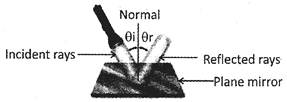 In the picture above, incident ray from a torch fall on the surface of the plane mirror with an angle of \[{{\theta }_{1}}\] and reflected by the plane mirror with an angle of \[{{\theta }_{R}}\]. According to the laws of reflection by a plane mirror:
(i) The angle of incident with respect to the normal is equal to the angle of reflection.
(ii) The incident ray, reflected ray and normal lie on the same plane.
(iii) The incident ray and the reflected ray are on the opposite sides of the normal.
Reflection of Light by a Rough Surface
If a beam of white light strikes on the rough surface, it defuses in different directions. The beam of white light diffuses in different directions due to the irregularity of the surface.
Look at the following picture of diffused reflection:
In the picture above, incident ray from a torch fall on the surface of the plane mirror with an angle of \[{{\theta }_{1}}\] and reflected by the plane mirror with an angle of \[{{\theta }_{R}}\]. According to the laws of reflection by a plane mirror:
(i) The angle of incident with respect to the normal is equal to the angle of reflection.
(ii) The incident ray, reflected ray and normal lie on the same plane.
(iii) The incident ray and the reflected ray are on the opposite sides of the normal.
Reflection of Light by a Rough Surface
If a beam of white light strikes on the rough surface, it defuses in different directions. The beam of white light diffuses in different directions due to the irregularity of the surface.
Look at the following picture of diffused reflection:
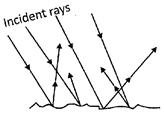 Image Formed by a Plane Mirror
Every plane and shiny object forms image. Image is formed by the reflection of light. When light strikes an object, some amount of light is absorbed by the object itself and some are reflected back as shown in the figure given herewith. The incident beam of light from the object on the plane mirror is reflected and reflected beam of light is detected by the detector which is the result of formation of the image of that object. The distance between the plane mirror and object is same as the distance between the surface of the mirror and image formed. Therefore, the sum of the both distances in opposite directions is always zero. The image formed by a plane mirror cannot be obtained, hence the image which is formed by the plane mirror is called virtual image. When we place a thing in front of a plane mirror, left part of the thing appears at right and right part appears at left, therefore, the image formed by a plane mirror is called lateral inverted image and this characteristic more...
Image Formed by a Plane Mirror
Every plane and shiny object forms image. Image is formed by the reflection of light. When light strikes an object, some amount of light is absorbed by the object itself and some are reflected back as shown in the figure given herewith. The incident beam of light from the object on the plane mirror is reflected and reflected beam of light is detected by the detector which is the result of formation of the image of that object. The distance between the plane mirror and object is same as the distance between the surface of the mirror and image formed. Therefore, the sum of the both distances in opposite directions is always zero. The image formed by a plane mirror cannot be obtained, hence the image which is formed by the plane mirror is called virtual image. When we place a thing in front of a plane mirror, left part of the thing appears at right and right part appears at left, therefore, the image formed by a plane mirror is called lateral inverted image and this characteristic more...  Movement
Most animals can move from one place to another. This type of movement is called locomotion. Animals move from place to place in search of food, in response to the environment, to escape from enemies and in search of mates. However, when we speak about movement, in humans, we do not mean only locomotion, for which we use our legs. We also mean other kinds of movement, like bending, sitting, stretching, turning, and so on. What makes movement possible are the joints. If our skeleton were made of one bone, we would not be able to move. Imagine the arm without the joint at the elbow. You would not be able to bend it, which would make even the simple task of putting food into your mouth impossible.
The ligaments, which bind bones, make it possible for them to move by stretching and relaxing. The cartilage cushioning bones and the synovial fluid, which lubricates joints, help in the movement of the bones. But what actually makes bones move is the contraction and relaxation of the muscles attached to the bones. Every bone capable of movement has muscles attached to it by tough, elastic cord like tissue called tendon. When a muscles attached to a bone contracts, it pulls the bone and makes it move. But it cannot push it back.
So another muscle is required to pull it back in the opposite direction. That is why muscles work in antagonistic pairs.
One muscles pulls a bone away from the joint, while its partner pulls it back. The biceps and triceps in the upper arm are an example of such an antagonistic pair of muscles. The contraction of the biceps pulls the forearm up, while the contraction of the triceps pulls it back down.
Movement
Most animals can move from one place to another. This type of movement is called locomotion. Animals move from place to place in search of food, in response to the environment, to escape from enemies and in search of mates. However, when we speak about movement, in humans, we do not mean only locomotion, for which we use our legs. We also mean other kinds of movement, like bending, sitting, stretching, turning, and so on. What makes movement possible are the joints. If our skeleton were made of one bone, we would not be able to move. Imagine the arm without the joint at the elbow. You would not be able to bend it, which would make even the simple task of putting food into your mouth impossible.
The ligaments, which bind bones, make it possible for them to move by stretching and relaxing. The cartilage cushioning bones and the synovial fluid, which lubricates joints, help in the movement of the bones. But what actually makes bones move is the contraction and relaxation of the muscles attached to the bones. Every bone capable of movement has muscles attached to it by tough, elastic cord like tissue called tendon. When a muscles attached to a bone contracts, it pulls the bone and makes it move. But it cannot push it back.
So another muscle is required to pull it back in the opposite direction. That is why muscles work in antagonistic pairs.
One muscles pulls a bone away from the joint, while its partner pulls it back. The biceps and triceps in the upper arm are an example of such an antagonistic pair of muscles. The contraction of the biceps pulls the forearm up, while the contraction of the triceps pulls it back down.

 Which one of the following joints exists between our skull and neck?
(a) Ball and socket joint
(b) Pivot joint
(c) Hinge joint
(d) Fixed joint
(e) None of these
Answer: (b)
Which one of the following joints exists between our skull and neck?
(a) Ball and socket joint
(b) Pivot joint
(c) Hinge joint
(d) Fixed joint
(e) None of these
Answer: (b)
 Which one of the following joints is present in knee?
(a) Ball and socket joint
(b) Pivot joint
(c) Hinge joint
(d) Fixed joint
(e) None of these
Answer: (c)
Which one of the following joints is present in knee?
(a) Ball and socket joint
(b) Pivot joint
(c) Hinge joint
(d) Fixed joint
(e) None of these
Answer: (c)
 A tissue is a group of similar cells which cooperate to perform a particular function.
The skeletal system gives shape to our body.
The human skeletal system is made up of 206 bones.
Skull protects our brain.
Ball and socket joint allows maximum variety of movements as compared to other type of joints.
Fixed joints do not allow any movements..
A tissue is a group of similar cells which cooperate to perform a particular function.
The skeletal system gives shape to our body.
The human skeletal system is made up of 206 bones.
Skull protects our brain.
Ball and socket joint allows maximum variety of movements as compared to other type of joints.
Fixed joints do not allow any movements..  Joints
A place where two or more bones join is called a joint. Bones are joined by tough, flexible bands of elastic tissue called ligaments. A layer of smooth, rubbery tissue called cartilage, covers the surface of a bone where it joins another. This reduced friction between the surfaces when the bones move against each other. The freely moving joints are also surrounded by a fluid- filled capsule. The fluid, called synovial fluid, helps movement the way a lubricant (oil) helps movement of machine parts.
Broadly speaking, joints are of two types—fixed and movable.
Joints
A place where two or more bones join is called a joint. Bones are joined by tough, flexible bands of elastic tissue called ligaments. A layer of smooth, rubbery tissue called cartilage, covers the surface of a bone where it joins another. This reduced friction between the surfaces when the bones move against each other. The freely moving joints are also surrounded by a fluid- filled capsule. The fluid, called synovial fluid, helps movement the way a lubricant (oil) helps movement of machine parts.
Broadly speaking, joints are of two types—fixed and movable.
 Fixed Joints
Some joints, such as between the bones of the cranium, do not allow any movement. These are fixed joints. The joints between the teeth and the jaw bones are also fixed, as also are the joints between the bones that make up the hip bones.
Movable Joints
There are many movable joints in our body. Let us study about them in some detail. Ball-and-Socket Joints: These joints allow the greatest freedom of movement or are the most mobile. In such joints, the rounded head of one bone fits into the hollow, cup-shaped socket of another. The bone that fits into the socket is free to move in all directions about the joint. The joint of the upper arm and the shoulder bone is an example of this type of joint. That is how a bowler can swing his arm or a swimmer can rotate his arms freely. The hip joint too is a ball-and-socket joint.
Hinge Joints: These joints work like a door hinge or a penknife. In this type of joints the convex (slightly bulging) surface of one bone fits into the concave (slightly depressed) surface of another bone, allowing movement only in one direction. For example, the hinge joint at your elbow allows you to bend your forearm and straighten it. It does not let your bend your arm backwards or sideways. The same is true of the knee joint.
Pivot Joints: In such joints, a bony ring rotates around a pivot (axis), or stick like bone. This allows twisting movement about the joint. The head moves from side to side because it rests on a pivot joint at the top of our spine.
Gliding Joints: Such joints occur between the vertebrae and between the bones of the wrists and ankles. The cartilage between these bones allows small movements, somewhat like the movement of a spring. These are not freely moving joints..
Fixed Joints
Some joints, such as between the bones of the cranium, do not allow any movement. These are fixed joints. The joints between the teeth and the jaw bones are also fixed, as also are the joints between the bones that make up the hip bones.
Movable Joints
There are many movable joints in our body. Let us study about them in some detail. Ball-and-Socket Joints: These joints allow the greatest freedom of movement or are the most mobile. In such joints, the rounded head of one bone fits into the hollow, cup-shaped socket of another. The bone that fits into the socket is free to move in all directions about the joint. The joint of the upper arm and the shoulder bone is an example of this type of joint. That is how a bowler can swing his arm or a swimmer can rotate his arms freely. The hip joint too is a ball-and-socket joint.
Hinge Joints: These joints work like a door hinge or a penknife. In this type of joints the convex (slightly bulging) surface of one bone fits into the concave (slightly depressed) surface of another bone, allowing movement only in one direction. For example, the hinge joint at your elbow allows you to bend your forearm and straighten it. It does not let your bend your arm backwards or sideways. The same is true of the knee joint.
Pivot Joints: In such joints, a bony ring rotates around a pivot (axis), or stick like bone. This allows twisting movement about the joint. The head moves from side to side because it rests on a pivot joint at the top of our spine.
Gliding Joints: Such joints occur between the vertebrae and between the bones of the wrists and ankles. The cartilage between these bones allows small movements, somewhat like the movement of a spring. These are not freely moving joints..  The Skeletal System
The human skeleton or skeletal system is made up of 206 bones. A baby has 300 bones in all. But as it grows, some of the bones fuse together or join. Before we learn more about bones and the joints where they are joined together, let us take a look at the functions of the skeletal system.
The Skeletal System
The human skeleton or skeletal system is made up of 206 bones. A baby has 300 bones in all. But as it grows, some of the bones fuse together or join. Before we learn more about bones and the joints where they are joined together, let us take a look at the functions of the skeletal system.
 Functions Skelton
The bones of our body act as a framework or give it shape. Without bones, our body could be a shapeless mass, e.g. like the body of a snail. The bones give our body support, like the pillars of a building or the frame over which an idol- maker makes an idol. The bones also protect delicate internal organs. For example, the skull protects the brain, which lies inside it, and the ribs protect the heart and lungs. The third function of the bones is to help us move. It is the movement of the bones that helps us bend, run, walk, and so on.
The skull
Twenty-two bones make up the skull. These are the hardest of all the bones in the body. Some of these form the cranium, or the cover for the brain. The rest are the facial bones, which give shape to the face. Two hollows, or sockets, formed by the facial bones protect the eyes. All the bones of the skull except the one forming the lower jaw are fixed firmly, and cannot move. Only the bone of the lower jaw is capable of movement, which helps us eat and speak.
Functions Skelton
The bones of our body act as a framework or give it shape. Without bones, our body could be a shapeless mass, e.g. like the body of a snail. The bones give our body support, like the pillars of a building or the frame over which an idol- maker makes an idol. The bones also protect delicate internal organs. For example, the skull protects the brain, which lies inside it, and the ribs protect the heart and lungs. The third function of the bones is to help us move. It is the movement of the bones that helps us bend, run, walk, and so on.
The skull
Twenty-two bones make up the skull. These are the hardest of all the bones in the body. Some of these form the cranium, or the cover for the brain. The rest are the facial bones, which give shape to the face. Two hollows, or sockets, formed by the facial bones protect the eyes. All the bones of the skull except the one forming the lower jaw are fixed firmly, and cannot move. Only the bone of the lower jaw is capable of movement, which helps us eat and speak.
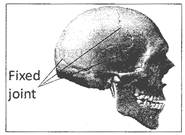 Fig. Most of the bones of the skull are fixed. Only the lower jaw can move.
The Spine
The spine is also called the vertebral column or backbone, the spine consists of 33 small bones known as vertebrae (singular: vertebra). The vertebrae are hollow at the centre and are joined together to form a tube, through which runs the spinal cord.
One of the functions of the vertebral column is to protect the spinal cord. The other functions are to hold the body up and help us bend forward, backward, sideways and twist from the waist.
Of the 33 vertebrae, seven are in the neck or down to the upper chest, 12 vertebrae are extended to the back, and five making up the lower back between the hips and chest. The last nine vertebrae are fused into two segments, coccyx and sacrum. They are fixed and make us to sit properly. Coccyx is also called tail bone. The vertebrae in the neck allow us to move our head from side to side and bend the neck forward and backward. The vertebrae also act like a spring, cushioning more...
Fig. Most of the bones of the skull are fixed. Only the lower jaw can move.
The Spine
The spine is also called the vertebral column or backbone, the spine consists of 33 small bones known as vertebrae (singular: vertebra). The vertebrae are hollow at the centre and are joined together to form a tube, through which runs the spinal cord.
One of the functions of the vertebral column is to protect the spinal cord. The other functions are to hold the body up and help us bend forward, backward, sideways and twist from the waist.
Of the 33 vertebrae, seven are in the neck or down to the upper chest, 12 vertebrae are extended to the back, and five making up the lower back between the hips and chest. The last nine vertebrae are fused into two segments, coccyx and sacrum. They are fixed and make us to sit properly. Coccyx is also called tail bone. The vertebrae in the neck allow us to move our head from side to side and bend the neck forward and backward. The vertebrae also act like a spring, cushioning more...  Body Movements
The cells that make up a multicellular animal are organized into tissues. A tissue, as you know, is a group of similar cells which cooperate to perform a particular function. Many tissues are grouped together to form an organ. They work together to help the organ to perform its function. Many organs of our body work together to perform the life functions necessary for our survival. For example, the stomach, mouth, liver, pancreas, small intestine and large intestine work together to help us digest food. Together they form the digestive system. A group of organs which work together to help the body perform a life function is called an organ system.
Some organ systems of our body are the circulatory system, urinary system, skeletal system and nervous system. In this chapter, we will discuss only the skeletal system in detail..
Body Movements
The cells that make up a multicellular animal are organized into tissues. A tissue, as you know, is a group of similar cells which cooperate to perform a particular function. Many tissues are grouped together to form an organ. They work together to help the organ to perform its function. Many organs of our body work together to perform the life functions necessary for our survival. For example, the stomach, mouth, liver, pancreas, small intestine and large intestine work together to help us digest food. Together they form the digestive system. A group of organs which work together to help the body perform a life function is called an organ system.
Some organ systems of our body are the circulatory system, urinary system, skeletal system and nervous system. In this chapter, we will discuss only the skeletal system in detail..  Changes Around Us
We observe changes around us all the time. Changes may occur in shape, size, mass, density, colour, position, temperature, structure or in composition of a substance. So we can define a change as:
Transformation in one or more than one properties of a substance is called change'.
Changes Around Us
We observe changes around us all the time. Changes may occur in shape, size, mass, density, colour, position, temperature, structure or in composition of a substance. So we can define a change as:
Transformation in one or more than one properties of a substance is called change'.
 Types of Changes
All the changes have been classified into two categories on the basis of, either the changes can be reversed to bring back the original substance, or not.
Types of Changes
All the changes have been classified into two categories on the basis of, either the changes can be reversed to bring back the original substance, or not.
 Reversible Changes
The changes which can be made to occur in the opposite direction are called reversible changes. In reversible change we can bring back the original substance. Melting of ice, freezing of water, dissolution of salt in water, increase in temperature of a metal rod etc. are the examples of reversible changes. Irreversible Changes.
Irreversible changes
The changes which cannot be made to occur in the opposite direction are called irreversible changes. Burning of wood, ripening of fruit, turning milk sour etc. are the examples of irreversible changes. On the basis of either new substance is formed or not, all the changes has been classified into two groups.
Physical Changes
The change in which molecules of a substance do not undergo any change or no new substances are formed, are called physical changes. Melting of ice, freezing of water, evaporation of water, dissolution of salt in water are examples of physical changes.
Chemical changes
The change, in which molecules of substance undergo change or new substances are formed, are called chemical changes. Burning of paper, rusting of iron, growth in animals, spoil of food are the examples of chemical changes.
Reversible Changes
The changes which can be made to occur in the opposite direction are called reversible changes. In reversible change we can bring back the original substance. Melting of ice, freezing of water, dissolution of salt in water, increase in temperature of a metal rod etc. are the examples of reversible changes. Irreversible Changes.
Irreversible changes
The changes which cannot be made to occur in the opposite direction are called irreversible changes. Burning of wood, ripening of fruit, turning milk sour etc. are the examples of irreversible changes. On the basis of either new substance is formed or not, all the changes has been classified into two groups.
Physical Changes
The change in which molecules of a substance do not undergo any change or no new substances are formed, are called physical changes. Melting of ice, freezing of water, evaporation of water, dissolution of salt in water are examples of physical changes.
Chemical changes
The change, in which molecules of substance undergo change or new substances are formed, are called chemical changes. Burning of paper, rusting of iron, growth in animals, spoil of food are the examples of chemical changes.

 Which one of the following is a reversible change?
(a) Dissolution of common salt into water
(b) Burning plastics
(c) Decaying of organic substances
(d) All of these
(e) None of these
Answer: (a)
Which one of the following is a reversible change?
(a) Dissolution of common salt into water
(b) Burning plastics
(c) Decaying of organic substances
(d) All of these
(e) None of these
Answer: (a)
 Melting of coal tar on heating is an example of:
(a) Reversible change
(b) Irreversible change
(c) Chemical change
(d) All of these
(e) None of these
Answer: (a)
Melting of coal tar on heating is an example of:
(a) Reversible change
(b) Irreversible change
(c) Chemical change
(d) All of these
(e) None of these
Answer: (a)
 Transformation in one or more than one properties of a substance is known as change.
The changes which can be reversed to bring back original substance is known as reversible change.
Irreversible changes can be reversed to bring back original substance.
New substance is formed when chemical changes occur.
No new substance is formed when a physical change occur.
Transformation in one or more than one properties of a substance is known as change.
The changes which can be reversed to bring back original substance is known as reversible change.
Irreversible changes can be reversed to bring back original substance.
New substance is formed when chemical changes occur.
No new substance is formed when a physical change occur.  Methods of Separation
Some methods of separation has been discussed below:
Threshing: This method is used to separate grains from their stalks. In this method stalks of grains are beaten to separate grains.
Threshing is done by hands, by machines or by cattle.
Methods of Separation
Some methods of separation has been discussed below:
Threshing: This method is used to separate grains from their stalks. In this method stalks of grains are beaten to separate grains.
Threshing is done by hands, by machines or by cattle.
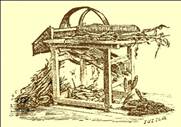 Winnowing: This method is used to separate husk from grains with the help of wind..
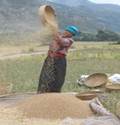 Husk is very light whereas grains are comparatively heavy. So when mixture of husk and grains are slowly fallen down from a height, wind carry away the husk.
Thus husk is separated from the grains.
Hand-picking: By this method, undesirable substances like small pieces of stones are picked out and separated from the grains by hands.
Sieving: This method is used to separate the constituents of a mixture whose particles are of different sizes.
Sedimentation and decantation: By this method insoluble solid particles present in a liquid is separated out.
Insoluble solid particles, which are heavier than the liquid, are allowed to settling down at the bottom of the container by keeping the solution undisturbed for sometime. This process is called sedimentation. The liquid is then poured out from the container without disturbing the sediments. This process is known as decantation.
Loading: Fine solid particles have very small weight therefore they do not easily settle down in a liquid.
Loading is the process of adding weight to the fine solid particles so that solid particles easily settled down in the liquid.
Filtration: By this method insoluble solid particles present in a liquid are separated using a filter paper.
Evaporation: By this method dissolved solid particles in a liquid are separated out. In this method liquid is evaporated by heating. When all the liquid is evaporated, dissolved particles are left behind as a solid residue.
Distillation: This is the method of separating a liquid from a mixture of liquids having different boiling points. The liquid to be separated is evaporated and its vapor is then collected after it condenses.
Saturated Solution:
A solution in which no more substance can be dissolved at that temperature, is called saturated solution.
Note : Water can dissolves large number of substances, therefore, water is called universal solvent.
Husk is very light whereas grains are comparatively heavy. So when mixture of husk and grains are slowly fallen down from a height, wind carry away the husk.
Thus husk is separated from the grains.
Hand-picking: By this method, undesirable substances like small pieces of stones are picked out and separated from the grains by hands.
Sieving: This method is used to separate the constituents of a mixture whose particles are of different sizes.
Sedimentation and decantation: By this method insoluble solid particles present in a liquid is separated out.
Insoluble solid particles, which are heavier than the liquid, are allowed to settling down at the bottom of the container by keeping the solution undisturbed for sometime. This process is called sedimentation. The liquid is then poured out from the container without disturbing the sediments. This process is known as decantation.
Loading: Fine solid particles have very small weight therefore they do not easily settle down in a liquid.
Loading is the process of adding weight to the fine solid particles so that solid particles easily settled down in the liquid.
Filtration: By this method insoluble solid particles present in a liquid are separated using a filter paper.
Evaporation: By this method dissolved solid particles in a liquid are separated out. In this method liquid is evaporated by heating. When all the liquid is evaporated, dissolved particles are left behind as a solid residue.
Distillation: This is the method of separating a liquid from a mixture of liquids having different boiling points. The liquid to be separated is evaporated and its vapor is then collected after it condenses.
Saturated Solution:
A solution in which no more substance can be dissolved at that temperature, is called saturated solution.
Note : Water can dissolves large number of substances, therefore, water is called universal solvent.

 Which one of the following is a pure substance?
(a) Iron
(b) Silver
(c) Copper
(d) All of these
(e) None of these
Answer: (d
Which one of the following methods is used to separate the constituents of a mixture whose particles are of different sizes?
(a) Loading
(b) Evaporation
(c) Sieving
(d) Distillation
(e) None of these
Answer: (c)
Which one of the following is a pure substance?
(a) Iron
(b) Silver
(c) Copper
(d) All of these
(e) None of these
Answer: (d
Which one of the following methods is used to separate the constituents of a mixture whose particles are of different sizes?
(a) Loading
(b) Evaporation
(c) Sieving
(d) Distillation
(e) None of these
Answer: (c)
 Pure substance are made up of only one more...
  Separation of Substances
Most of the substances available in the nature are in the mixture form. Mixtures are separated into their constituents as per our requirement. In this chapter we will study about mixtures and some methods of their separation.
Pure Substances: The substances which are made up of only one kind of atoms or molecules are called pure substances. For example gold, silver, copper etc.
Mixture: When two or more than two different substances are mixed up together a mixture is formed. For example air is a mixture of many gasses like nitrogen, oxygen, carbon dioxide and some other gasses.
Constituents of a Mixture: The different substances which are present in a mixture are called constituents of the mixture. For example nitrogen, oxygen, carbon dioxide and many other gasses which are present in the air are constituents of air.
Homogeneous mixture: A mixture that is uniform in composition is called Homogeneous mixture. Example air, milk, salt water solution etc.
Heterogeneous mixture: A mixture that is not uniform in composition is called Heterogeneous mixture. Example mixture of air and water, sandy water, orange juice with pulp in it etc.
Why do we separate mixtures?
We separate mixtures for the following purposes:
(a) For removing undesirable constituents
(b) For obtaining useful constituents
(c) For obtaining the pure substances
Now let us study some method of separation of mixtures..
Separation of Substances
Most of the substances available in the nature are in the mixture form. Mixtures are separated into their constituents as per our requirement. In this chapter we will study about mixtures and some methods of their separation.
Pure Substances: The substances which are made up of only one kind of atoms or molecules are called pure substances. For example gold, silver, copper etc.
Mixture: When two or more than two different substances are mixed up together a mixture is formed. For example air is a mixture of many gasses like nitrogen, oxygen, carbon dioxide and some other gasses.
Constituents of a Mixture: The different substances which are present in a mixture are called constituents of the mixture. For example nitrogen, oxygen, carbon dioxide and many other gasses which are present in the air are constituents of air.
Homogeneous mixture: A mixture that is uniform in composition is called Homogeneous mixture. Example air, milk, salt water solution etc.
Heterogeneous mixture: A mixture that is not uniform in composition is called Heterogeneous mixture. Example mixture of air and water, sandy water, orange juice with pulp in it etc.
Why do we separate mixtures?
We separate mixtures for the following purposes:
(a) For removing undesirable constituents
(b) For obtaining useful constituents
(c) For obtaining the pure substances
Now let us study some method of separation of mixtures..  Properties of Matter
Now let us understand some properties of matter.
Appearance: Some objects have shiny appearance called luster, whereas some materials have dull appearance. For example gold, silver, copper have shiny appearance whereas psiper, wood, rubber have dull appearance.
Properties of Matter
Now let us understand some properties of matter.
Appearance: Some objects have shiny appearance called luster, whereas some materials have dull appearance. For example gold, silver, copper have shiny appearance whereas psiper, wood, rubber have dull appearance.
 Hardness or Softness: The materials can be classified on the basis of hardness and softness. Candle, wax, rubber are the examples of soft materials whereas iron, diamond, glass are the examples of hard materials.
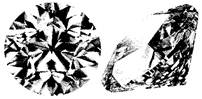
 Solubility: Some materials are soluble in water whereas others are not. Sugar, common salt, washing soda, lemon juice are soluble in water whereas glass, plastic, iron, mustard oil, coconut oil are not soluble in water.
Density: Density is the mass per unit volume of a substance. The substances which sink in the water have higher density than water and the substances which do not sink in the water have lower density than water. Substances like iron, copper, aluminum, silver, gold and glass have higher density than water whereas wood, plastic, ice, oil and petrol have lower density than water.
Transparency: All the materials have been classified into three groups on the basis of transparency
Transparent: The materials through which light can pass are called are transparent materials. Example glass, water, air, alcohol etc.
Translucent: The materials through which light can pass partially are called translucent materials. Example Butter paper, ground-glass, tissue paper, muddy water etc.
Opaque: The materials through which light cannot pass are called opaque materials. Example metals, stones, books, woods etc.
Solubility: Some materials are soluble in water whereas others are not. Sugar, common salt, washing soda, lemon juice are soluble in water whereas glass, plastic, iron, mustard oil, coconut oil are not soluble in water.
Density: Density is the mass per unit volume of a substance. The substances which sink in the water have higher density than water and the substances which do not sink in the water have lower density than water. Substances like iron, copper, aluminum, silver, gold and glass have higher density than water whereas wood, plastic, ice, oil and petrol have lower density than water.
Transparency: All the materials have been classified into three groups on the basis of transparency
Transparent: The materials through which light can pass are called are transparent materials. Example glass, water, air, alcohol etc.
Translucent: The materials through which light can pass partially are called translucent materials. Example Butter paper, ground-glass, tissue paper, muddy water etc.
Opaque: The materials through which light cannot pass are called opaque materials. Example metals, stones, books, woods etc.

 Which one of the following materials is soluble in water?
(a) Plastic
(b) Washing soda
(c) Paper
(d) Chalk powder
(e) None of these
Answer: (b)
Which one of the following statements is true?
Statement 1: Air is a transparent material
Statement 2: Wood is a opaque material
(a) Statement 1
(b) Statement 2
(c) Both statements are correct
(d) Both statements are incorrect
(e) None of these
Answer: (c)
Which one of the following materials is soluble in water?
(a) Plastic
(b) Washing soda
(c) Paper
(d) Chalk powder
(e) None of these
Answer: (b)
Which one of the following statements is true?
Statement 1: Air is a transparent material
Statement 2: Wood is a opaque material
(a) Statement 1
(b) Statement 2
(c) Both statements are correct
(d) Both statements are incorrect
(e) None of these
Answer: (c)
 All the objects around us are made up of matter.
The process of grouping objects according to shared characteristics is known as classification.
Metals have generally shiny appearance whereas non-metals have dull appearance.
The substances which sink in the water have higher density than water and the substances which do not sink in the water have lower density than water.
Light can pass through transparent materials..
All the objects around us are made up of matter.
The process of grouping objects according to shared characteristics is known as classification.
Metals have generally shiny appearance whereas non-metals have dull appearance.
The substances which sink in the water have higher density than water and the substances which do not sink in the water have lower density than water.
Light can pass through transparent materials.. 
You need to login to perform this action.
You will be redirected in
3 sec