
A) circular anti-clockwise
B) circular clockwise
C) elliptical anti-clockwise
D) elliptical clockwise
Correct Answer: B
Solution :
| Two simple harmonic motions be written as |
| \[x=A\sin (\omega t+\delta )\] (i) |
| and \[y=A\,\,\sin \,\left( \omega t+\delta +\frac{\pi }{2} \right)\] |
| or \[y=A\cos (\omega t+\delta )\] (ii) |
| Squaring and adding Eqs. (i) and (ii) we obtain |
| \[{{x}^{2}}+{{y}^{2}}={{A}^{2}}\,[\sin (\omega t+\delta )+{{\cos }^{2}}(\omega t+\delta )]\] |
| or \[{{x}^{2}}+{{y}^{2}}={{A}^{2}}\] \[(\because {{\sin }^{2}}\,\theta +{{\cos }^{2}}\,\theta =1)\] |
| This is the equation of a circle. |
| At \[\,\omega t+\delta =0\,;\,x=0,\,y=A\] |
| At \[\omega t+\delta =\frac{\pi }{2}\,;\,x=A,\,y=0\] |
| At \[\omega t+\delta =\pi \,\,\,;\,x=0,\,y=-A\] |
| At \[\omega t+\delta =\frac{3\pi }{2}\,\,\,;\,x=-A,\,y=0\] |
| At \[\omega t+\delta =2\pi \,\,\,;\,x=0,\,y=A\] |
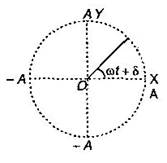 |
| Thus, it is obvious that motion of particle is traversed in clockwise direction. |






You need to login to perform this action.
You will be redirected in
3 sec