
A) \[{{10}^{-8}}\,m\]
B) \[2\times {{10}^{-8}}\,m\]
C) \[{{10}^{-6}}\,m\]
D) \[{{10}^{-10}}\,m\]
Correct Answer: A
Solution :
| [a] If electron moves in a magnetic field at an angle \[\theta \] (other than \[0{}^\circ ,\text{ }180{}^\circ \] or \[90{}^\circ \]), its velocity can be resolved in two components one along \[\vec{B}\] and another perpendicular to \[\vec{B}\]. Let the two components be \[{{v}_{||}}\] and \[{{v}_{\bot }}\] Then |
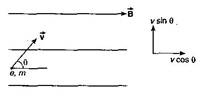 |
| \[{{v}_{||}}=v\cos \theta \] |
| and \[{{v}_{\bot }}=v\sin \theta \] |
| The component perpendicular to field \[({{v}_{\bot }})\] gives a circular path and the component parallel to field\[({{v}_{||}})\] gives a straight line path. |
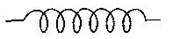 |
| The resultant path is, helix as shown in figure. |
| The radius of this helical path is |
| \[r=\frac{m{{v}_{\bot }}}{eB}\] |
| \[=\frac{mv\sin \theta }{eB}\] |
| or \[r=\frac{v\sin \theta }{\left( \frac{e}{m} \right)B}\] |
| Given, \[v=1\times {{10}^{3}}\,m/s,\,B=0.3\,T,\,\theta ={{30}^{o}},\] |
| \[\frac{e}{m}=1.76\times {{10}^{11}}\,C/kg\] |
| \[\therefore \] \[r=\frac{1\times {{10}^{3}}\sin {{30}^{o}}}{1.76\times {{10}^{11}}\times 0.3}\] |
| \[=\frac{1\times {{10}^{3}}\times \frac{1}{2}}{1.76\times {{10}^{11}}\times 0.3}={{10}^{-8}}\,m\] |






You need to login to perform this action.
You will be redirected in
3 sec