
| Choose the correct option: |
| (i) A carnivore with stripes on its body moves very fast while catching its prey. It is likely to be found in: |
| Choose the correct option: |
| (ii) Tornadoes are also called: |
| Choose the correct option: |
| (iii) Percolation rate is highest in: |
| Choose the correct option: |
| (iv) Which of the following organisms can respire anaerobically? |
| Choose the correct option: |
| (v) Function of WBCs is: |
| Choose the correct option: |
| (vi) Bryophyllum can reproduce by its: |
| Choose the correct option: |
| (vii) The distance moved by the vehicle is measured by: |
| Choose the correct option: |
| (viii) Which effects are produced by the electric current? |
| Choose the correct option: |
| (ix) The splitting of white light into seven colours is called: |
| Choose the correct option: |
| (x) The moisture content in air is expressed as: |
| Write products of the following reactions : |
| (i) Sulphuric acid reacts with sodium hydroxide. |
| (ii) Copper oxide reacts with hydrochloric acid. |
| (iii) Sulphur dioxide reacts with sodium hydroxide. |
| What characteristics does a polar bear possess: |
| (i) Protecting them from predators? |
| (ii) Protecting them from extreme cold? |
| (iii) Avoiding getting over heated? |
| (i) Why does a glowing electric bulb become warm? |
| (ii) Mention any two effects of electric current. |
| (iii) Why does a glowing CFL not become warm? |
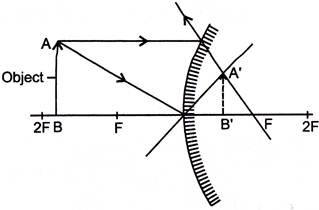 Answer the following questions: (i) Name the mirror used.
 | A chemical change may occur by one of the following changes: |
| (i) Evolution of gas |
| (ii) Change of colour |
| (iii) Formation of precipitate |
| (iv) Absorption or evolution of heat and light |
| (v) Change of smell |
| Give an example of each case. |






You need to login to perform this action.
You will be redirected in
3 sec